
Alternative to ActiveCampaign : comparison benchmark with Webmecanik
- Alternative to ActiveCampaign: how to choose a marketing automation solution that fits
- Why look for an alternative to ActiveCampaign?
- Needs that go beyond sending emails
- A strong expectation of readability
- Which criteria should you compare to choose an alternative?
- 1. Automating customer and prospect journeys
- 2. Marketing segmentation
- 3. Lead nurturing
- 4. Lead scoring
- 5. Automated email and SMS campaigns
- 6. Marketing CRM
- 7. Campaign management
- How do you assess the relevance of a marketing automation solution?
- Onboarding should remain simple
- The tool should serve multiple teams
- Automation and management must stay aligned
- Journeys should remain flexible
- In which use cases can an alternative to Active Campaign meet expectations?
- Structuring automated journeys
- Segmenting and personalizing messages better
- Nurturing leads over time
- Qualifying opportunities better
- Coordinating marketing, sales, and the CRM
- Webmecanik vs ActiveCampaign: which one should you consider for your marketing automation strategy?
- Webmecanik at a glance
- ActiveCampaign at a glance
- Comparison of key features
- How do you move forward with your decision?
- Start with your priorities
- Test the solution’s consistency with a real use case
- Conclusion
Alternative to ActiveCampaign: how to choose a marketing automation solution that fits
Searching for an alternative to Active Campaign isn’t just about switching tools. The challenge is to find a marketing automation solution that’s easier to read, better suited to the organization, and more consistent with real-world use: automating customer journeys, lead nurturing, marketing segmentation, lead scoring, automated email campaigns, automated SMS campaigns, CRM integration, and campaign management. In this context, Webmecanik Automation can be a relevant option to consider.
Comparing an alternative to Active Campaign means looking beyond the list of features. The real question is simple: which marketing automation solution helps structure useful journeys, better qualify contacts, and manage campaigns with greater clarity?
For many marketing, sales, or digital teams, the goal isn’t to multiply scenarios, but to set up something that’s easier to read, more consistent, and simpler to evolve. That’s where Webmecanik Automation can be considered as a solution tailored to the needs of automated journeys, nurturing, segmentation, and campaign management.
Why look for an alternative to ActiveCampaign?
Searching for an alternative often comes up when the current tool no longer fully meets the organization’s needs. It may be a matter of readability, alignment with internal workflows, coordination between teams, or simply needing better control over automated journeys.
In this context, the issue isn’t about “doing more,” but about “doing better”: better structuring campaigns, better understanding sequences, better tracking results, and better connecting marketing and sales.
Needs that go beyond sending emails
Marketing automation isn’t limited to automated emails. A relevant solution should help build a complete logic around the contact: entry into a scenario, reactions, follow-ups, segmentation, qualification, and possibly moving to another stage of the cycle.
So an alternative to ActiveCampaign is often sought to work across multiple dimensions at once:
- automating customer and prospect journeys
- lead nurturing over time
- more granular marketing segmentation
- lead scoring to prioritize contacts
- automated email campaigns and, depending on needs, automated SMS campaigns
- connection with the marketing CRM
- clearer campaign management
A strong expectation of readability
A point that often comes up when choosing a new tool is the fear of adding complexity. A marketing automation solution should help teams, not add another layer that’s hard to read.
That’s why readability matters as much as functional richness. A good alternative should make it easy to quickly understand what’s happening in the journeys, adjust scenarios without friction, and maintain a useful view for the teams involved.
Which criteria should you compare to choose an alternative?
When comparing solutions, it’s better to start from real, concrete use cases. A simple framework helps you avoid decisions based only on perceived ergonomics or a list of abstract functions.
1. Automating customer and prospect journeys
The first criterion concerns the ability to build automations of customer and prospect journeys in a coherent way. It’s not just about triggering an action, but about thinking through a logical path from a starting point to an end point.
A solution should allow you to create scenarios with clear triggers, well-defined steps, and understandable exits. This is what helps keep useful journeys over time.
2. Marketing segmentation
Marketing segmentation is a cornerstone of marketing automation. Without it, messages stay too generic and scenarios lose relevance.
An alternative to Active Campaign should help distinguish audiences using simple criteria or, depending on your needs, more advanced ones: behavior, engagement, status in the lifecycle, profile information, or interest signals. The goal is to adapt content and actions for each contact group.
3. Lead nurturing
Lead nurturing means guiding a contact over time with messages and content tailored to their level of maturity. It’s a key use case for teams that want to move prospects forward without pushing conversion too early.
A suitable solution should make it possible to build progressive sequences, manage follow-ups, and maintain a coherent maturation logic. Nurturing is even more useful when it’s part of a broader view of the journey.
4. Lead scoring
Lead scoring helps better qualify contacts and identify those who deserve special attention. It can help marketing and sales teams prioritize actions, surface the most engaged leads, or trigger a specific scenario.
This point matters when choosing an alternative, because scoring should remain easy to understand and truly usable. If it becomes too complex, it loses its operational value.
5. Automated email and SMS campaigns
Automated email campaigns are often the foundation of a marketing automation program. But depending on your needs, adding automated SMS campaigns can also bring real flexibility to journeys.
The key is being able to orchestrate channels without breaking the relationship. The solution should therefore help coordinate messages, maintain editorial consistency, and manage sequences smoothly.
6. Marketing CRM
A marketing automation solution doesn’t work in isolation. Its value increases when it integrates properly with the marketing CRM and enables clear data flow between teams.
So you should check the quality of the integration, the consistency of the information shared back, and the ability to maintain a shared view of contacts, actions, and opportunities.
7. Campaign management
campaign management is often the criterion that makes the difference day to day. Automating isn’t enough. You also need to understand what works, spot friction points, and adjust scenarios over time.
A good alternative to ActiveCampaign should therefore allow you to read performance clearly, track changes, and optimize programs without losing sight of the original objective.
How do you assess the relevance of a marketing automation solution?
When comparing several solutions, it’s helpful to ask whether the tool is truly designed to support teams over the long term. The quality of software isn’t measured only by its features, but by its ability to stay clear, useful, and adaptable.
Onboarding should remain simple
A marketing automation tool can be powerful while still being difficult to adopt. If teams spend too much time understanding how it’s built or interpreting results, overall effectiveness declines quickly.
So you should look at how simple onboarding is, the clarity of the interface, and how easily you can build or modify a scenario.
The tool should serve multiple teams
In many organizations, marketing automation isn’t only for marketing. Sales teams, digital teams, or leadership may also need a shared view of journeys and contacts.
An alternative to Active Campaign should therefore be able to support multiple use cases without locking the solution into something overly specific. This is an important point of attention for companies looking for a long-term solution.
Automation and management must stay aligned
Automating a journey without being able to manage it means moving forward without visibility. Conversely, tracking metrics without being able to act on scenarios limits the value of the approach.
The right approach is to connect the two dimensions: journey automation and results management. This coherence is what makes it possible to optimize campaigns methodically.
Journeys should remain flexible
A good marketing automation setup isn’t built for a fixed use case. Needs change, audiences change, and campaigns should follow.
Therefore, the chosen solution should allow you to evolve scenarios without starting from scratch every time you adjust. This flexibility is valuable for avoiding an overly rigid system.
In which use cases can an alternative to Active Campaign meet expectations?
An alternative to ActiveCampaign can be relevant in several situations, especially when the goal is to structure marketing automation that’s clearer and easier to use.
Structuring automated journeys
When an organization wants to better organize its communications with prospects or customers, journey automation becomes central. It enables you to think in terms of steps, triggers, and tailored responses based on observed behaviors.
Segmenting and personalizing messages better
Segmentation helps move beyond communications that are too generic. By adapting messages to profiles and behaviors, teams gain coherence and relevance.
Nurturing leads over time
Nurturing is especially useful when a contact isn’t ready to take action yet. It helps maintain a useful link over time with messages that support the lead’s progression.
Qualifying opportunities better
Thanks to scoring and a better understanding of interactions, it becomes easier to spot which contacts should be followed up first. This makes it easier to work between marketing and sales.
Coordinating marketing, sales, and the CRM
Marketing automation delivers its full value when it’s built on a shared logic. Coordination with the CRM and sales teams helps maintain clearer follow-up of contacts and actions taken.
Webmecanik vs ActiveCampaign: which one should you consider for your marketing automation strategy?
In a comparison mindset, Webmecanik Automation should be considered as a marketing automation solution designed to meet these essential needs: automated journeys, lead nurturing, segmentation, scoring, email, SMS, CRM, and campaign management.
The value of this approach is to offer a working framework focused on clarity and operational usefulness. For a team looking for an alternative to ActiveCampaign without switching to something too complex or too specialized, this is an important point.
Webmecanik at a glance
Webmecanik Automation can therefore suit organizations that want to:
- structure their journeys in a readable way
- nurture their leads better over time
- refine marketing segmentation
- set up understandable lead scoring
- coordinate email, SMS, and the CRM within the same logic
- have RGPD-by-design compliance
💡 Ideal for B2B & B2C companies that want to structure and accelerate lead generation with a trusted partner.
ActiveCampaign at a glance
ActiveCampaign in a few key features, it’s:
- email marketing and advanced segmentation
- a complex scenario builder
- native CRM and Sales Automation
- multichannel communications management
- e-commerce orientation and artificial intelligence
💡 The right move is to evaluate the solution based on your real use cases, not just on a general promise. It’s often the most reliable way to know whether the tool fits how you work.
Comparison of key features
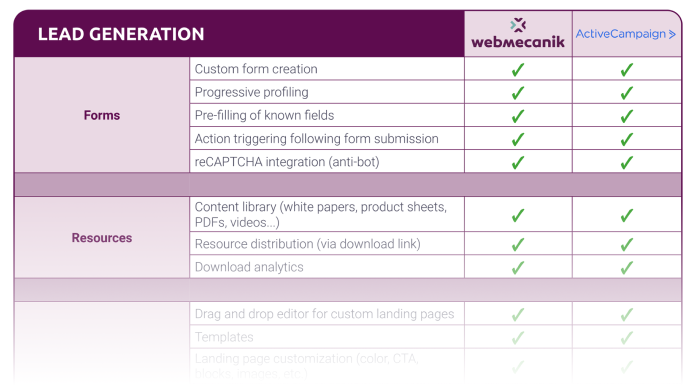
Download the comparison sheet to see what’s next
Get the full Webmecanik vs ActiveCampaign comparison with all features, pricing, and use cases.
How do you move forward with your decision?
Before making a choice, it helps to follow a simple method. This prevents you from being guided only by habit, sales messaging, or a sense of ease.
Start with your priorities
Ask yourself what you want to improve first:
- the quality of automated journeys
- audience segmentation
- lead nurturing
- qualification through lead scoring
- coordination with the CRM
- campaign management for marketing campaigns
This step helps you compare tools using the right criteria.
Test the solution’s consistency with a real use case
Nothing replaces trying it on a real use case. It’s often the best way to verify whether the solution is clear, flexible, and suited to the teams that will use it every day.
A good test also helps you see whether the setup stays understandable when scenarios multiply or when multiple teams need to step in.
Conclusion
Choosing an alternative to Active Campaign isn’t just about changing software. It’s selecting a marketing automation solution that can support your automated journeys, your lead nurturing, your segmentation, your lead scoring, and your campaign management within a clear, usable framework.
By comparing solutions using concrete criteria, you increase relevance and reduce the risk of choosing a tool that’s too complex or poorly aligned with your needs. In this logic, Webmecanik Automation can be an option worth considering for structuring a marketing automation program that’s clearer, more adaptable, and action-oriented.