
As you probably know in B2C marketing, personalization is the key to a successful customer relationship! Brands have no choice but to adapt and offer a unique, seamless, but above all relevant experience to consumers who are constantly being solicited.
The best tool for personalizing your communications is none other than marketing automation software. Thanks to it, you can automate your marketing processes on a large scale, while optimizing your marketing teams’ time.
Many think that these scenarios are reserved for e-commerce sites. But implementing them is not limited to just selling your products. You can apply them to drive-to-store or omnichannel loyalty strategies, and even tailor your campaigns according to your company’s objectives.
Here are 5 examples of marketing workflows to implement to capture, engage, and retain your leads, whatever your industry. ?
Why use marketing automation in B2C?
The event-based scenario to capitalize on key moments
A scenario dedicated to abandoned carts
Use the data you already have to create a re-targeting scenario
Re-engage your inactive contacts with this workflow
Turn your customers into ambassadors with the loyalty scenario
Why use marketing automation in B2C?
With marketing automation, you can turn repetitive and time-consuming tasks into automated scenarios, triggered according to the behavior or data of your contacts. The goal: save valuable time, but also deliver more relevant and personalized communication.
In the B2C context, marketing automation is a real lever for targeting the right people, at the right time, with the right message. By intelligently leveraging your customer data (age, location, purchase history, behavior, etc.), you are able to maintain a quality customer relationship that is more human and engaging.
The benefits of marketing automation in B2C are real. You optimize the profitability of your marketing campaigns, but also.
You improve your customer experience by providing personalized responses tailored to each stage of the journey (your conversion rate will thank you for this offering). And finally, you increase your chances of retaining your customers in the long term by creating an ongoing relationship.
The event-based scenario to capitalize on key moments
Create engagement and purchases?
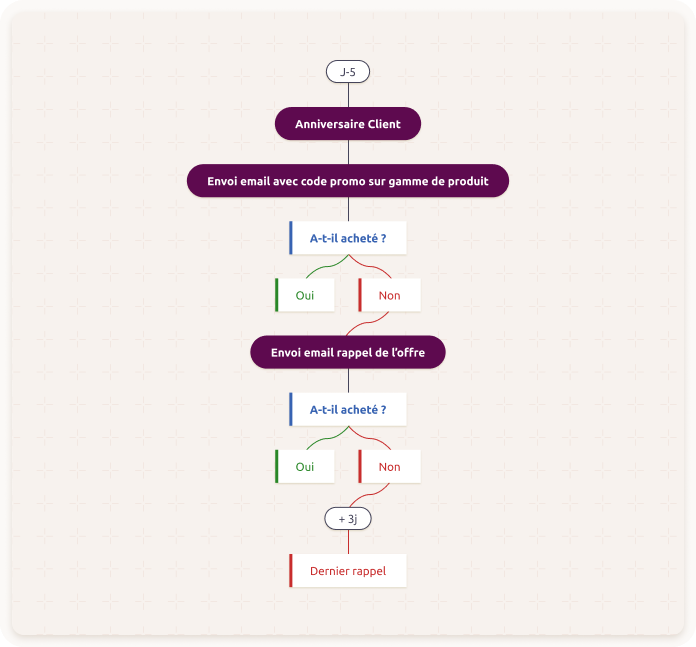
Events are excellent levers for creating a connection with your contacts. This is not just about promotional campaigns around recurring calendar events, but key moments personalized to the customer or your brand.
For example, your events can include:
- The customer’s birthday
- The brand’s anniversary
- A seasonal or calendar event (back-to-school, Black Friday…)
- The sign-up anniversary
?Webmecanik tips: ask for useful information right from the start of the customer journey (date of birth, gender, preferences), but in a natural way! You can do this via a progressive form, a pop-in, or when subscribing to a newsletter. This data will enrich your CRM and allow you to trigger personalized emails.
Example: a 50-year-old person who has provided their date of birth may receive, a few days before their birthday, an offer on an anti-aging range, with a personalized touch. This scenario creates a wow effect and boosts your open and click-through rates, especially if you offer something related to their favorite products.
A scenario dedicated to abandoned carts
Who has never filled a cart without ever validating it? Many companies are faced with this issue, and it represents one of the major challenges of e-commerce. According to FEVAD, it is estimated that nearly 70% of carts are never finalized. And yet, these users had clearly shown purchase intent. So how can you limit cart abandonment? Let’s start by identifying the possible reasons:
- Prices that are too high
- Shipping costs are a barrier
- The customer wants to compare with other sites
- The site requires account creation
- The contact does not (yet) trust
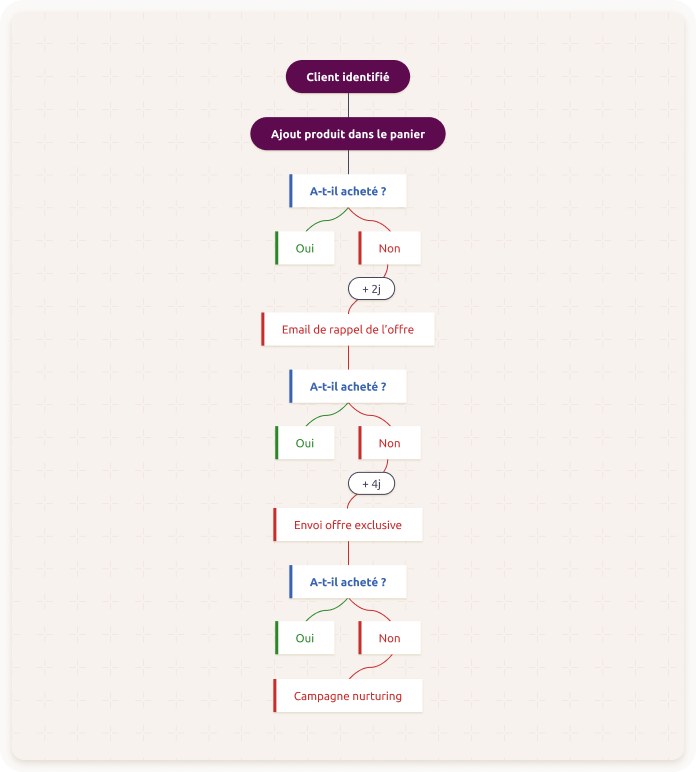
Once you have identified what may be the obstacle in your case, it is time to solve the problem. A customer may have thought they would complete the purchase later; this is the best moment to activate your cart recovery scenario. The objective here is to automatically follow up with someone who has abandoned their cart, while highlighting the pain points resolved. It is also entirely possible to offer other services with other benefits.
Be careful not to lose your contacts; this campaign must be well thought out. You need to remove your contacts’ barriers and help them take action, not drive them away. ?
Example workflow:
- Email 1 – D+1: product reminder with visual + benefits + social proof
- Email 2 – D+3: incentive to purchase with an exclusive benefit (discount, free delivery)
The benefit of this scenario? You improve your conversion rate without being intrusive. The little extra is that it fits easily into an email marketing strategy.
Use the data you already have to create a re-targeting scenario
Target contacts according to their behavioral data
One of the strengths of marketing automation is the detection of weak signals. A user may view a product page several times, download a guide, or watch a video… without actually making a purchase. Quite frustrating, isn’t it?!
This scenario is designed precisely to turn this simple interest into purchase intent by triggering a targeted campaign at the right time. Thanks to the scoring feature (available in your marketing automation software) and a good CRM, you can refine your scenarios and increase the ROI of your retargeting campaigns. ?
Scenario example
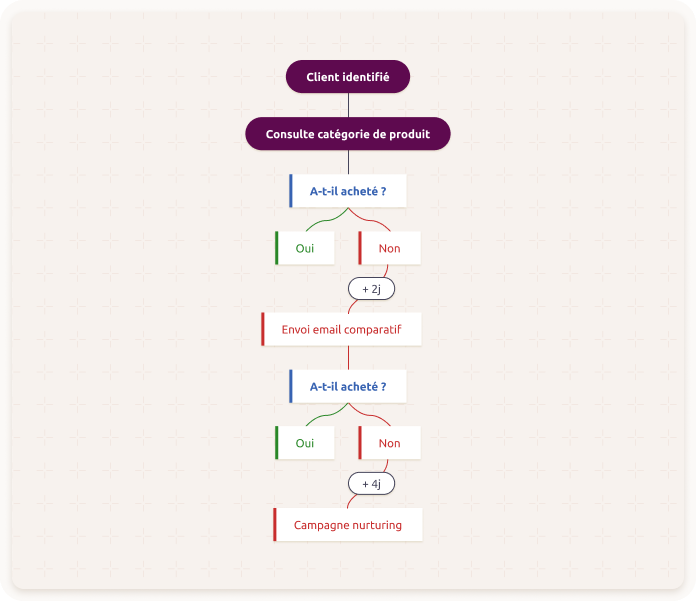
An identified contact (thanks to tracking or email) shows interest in a specific category, such as treadmills. As soon as a certain level of engagement is reached, a scenario is automatically activated with targeted content. This may include model comparisons, customer reviews, or even a promotional offer with a buying guide.
The objective here is to turn this interest into a purchase through personalized follow-up.
Re-engage your inactive contacts with this workflow
Over time, some of your contacts become inactive; they no longer read your emails, no longer buy, or simply no longer interact with you. This is normal, as sometimes we are no longer interested in a product or a brand.
To remedy this, you need to set up a re-engagement workflow. This automated scenario will allow you either to reactivate an inactive lead or to identify the contacts to remove in order to clean your database. ? And to go further, you can re-qualify promising leads with a new approach to increase your chances of conversion.
Steps to follow to set up this scenario:
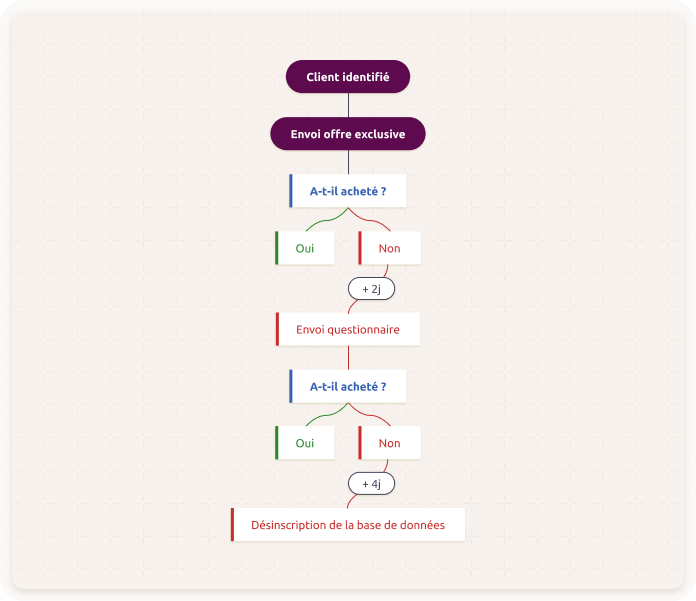
- First, start by segmenting your inactive contacts in your database according to inactivity criteria (no email opens, no purchases for 6 months, etc.). Then offer specific content or an offer to re-engage them
- You can ask them for feedback to find out why they no longer respond; you can do this via a questionnaire or a phone call.
- Finally, if you have no signal, unsubscribe them to improve the health of your database and boost the performance of your campaigns.
Keep in mind that an unhappy customer rarely makes it known. Inactivity is often the sign of it. You can view this scenario as a tool to assess the quality of your contacts. ?
Turn your customers into ambassadors with the loyalty scenario
A loyal customer is up to 5 times less expensive to convert than a new customer. This notion is often underestimated even though it is a real profitability lever. In addition to buying repeatedly, a loyal customer tends to increase their average basket and above all recommend your brand to those around them.
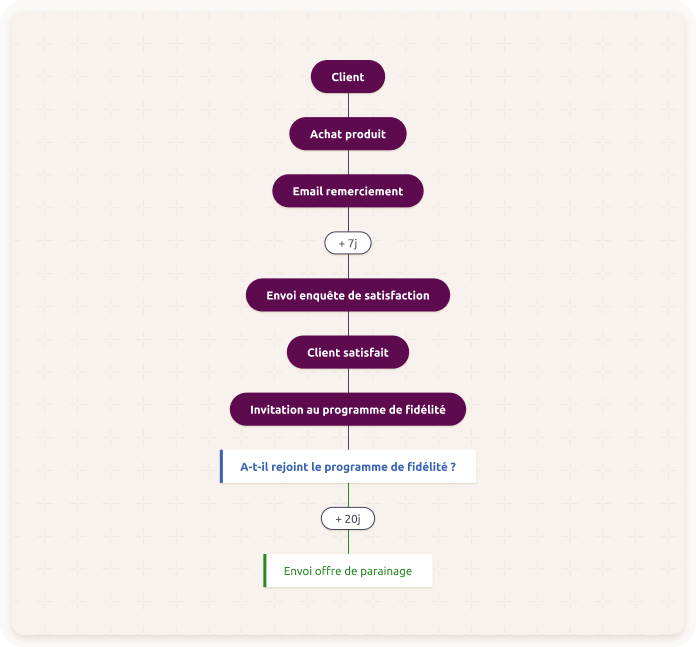
You must therefore maintain a connection with your customers so that they become ambassadors. But how does the marketing automation scenario come into play here? Well, thanks to the workflow, you can set up a loyalty journey that adapts to customers’ behaviors and preferences. It is possible to do post-purchase follow-ups, send offers dedicated only to your loyal customers, and set up a loyalty or ambassador program.
Thanks to the loyalty scenario, you save time, but you also strengthen the engagement of your loyal customers.
Actions to implement to turn your customers into ambassadors:
The first step is to send them a purchase confirmation email; take the opportunity to reassure them about the product and your brand. You can thank them, give them advice related to their product or service, or suggest complementary products (up-selling or cross-selling campaign). Next, set up private or exclusive sales reserved only for your loyal customers. Many possibilities are available to you; you simply need to adapt them to your industry and your targets, of course. ?
Conclusion
As you will have understood, marketing automation in B2C is not just a few emails sent automatically. It is a complete strategy centered on sending personalized messages according to the behavior, data, and expectations of each customer or prospect.
Setting up automation scenarios is good! Making them relevant is better! The goal is to offer your contacts a smooth, effective, and consistent experience at every stage of their journey. Whether it is from discovery to purchase, follow-up, or loyalty, and regardless of whether the person is a lead or a loyal customer.
The workflow examples shared here show just how much a well-structured campaign can transform a simple email into an action, click, conversion, reactivation… or even recommendation. The objective is to maximize the performance of your campaigns while optimizing your customer relationship.
By using the right marketing automation or CRM tools, your company can easily automate email sending, enrich its customer data, segment its leads, personalize its content, and above all have a better chance of increasing its conversion rates. Each message must contribute to the overall success of your B2C strategy.