
Last April 28, Stéphane Couleaud was invited by Les Experts du Web to a webinar on marketing automation as part of an Inbound Marketing strategy. Here’s a summary!
Overview of marketing automation
Our two experts began by explaining that the purpose of marketing automation is to “maximize marketing efforts and make them more effective.” Of course, there is the automation of marketing emails, but it goes beyond simple email marketing. It can also facilitate social media, advertising management, etc.
More and more companies struggle to align their teams and their sales processes. Marketing automation is there to streamline and increase their relational efficiency. Marketing automation is there to implement the entire inbound marketing strategy process: lead generation & sales opportunities, segmentation, lead scoring, etc.
Focusing on high value-added tasks, maintaining customer closeness, or even better understanding your prospects—the benefits of marketing automation are numerous. In other words, marketing automation supports your customer in solving their issue.
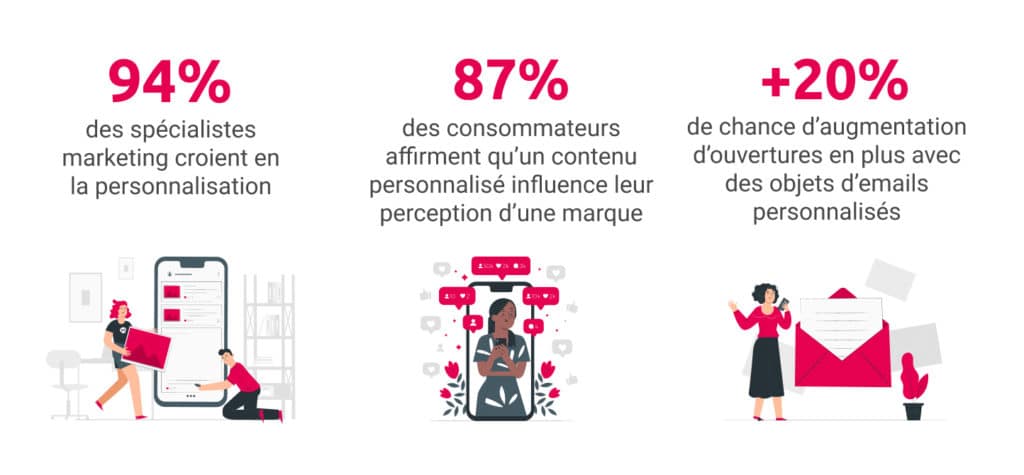
94% of marketers are convinced of the importance of personalizing their campaigns and their marketing communication. This shows that this type of process has its importance in a marketing strategy.
Source: codeur.com
And in practical terms? What do our two experts advise?
Support pages are tremendous opportunities
Marketing automation makes it possible to develop new opportunities. In addition to automating the customer relationship during the prospect acquisition phase, it also makes it possible to automate it during the loyalty and retention stage. For example, during the onboarding phase when the customer receives an email from the company’s director thanking them.
Working with the customer base to increase loyalty is a tremendous opportunity made possible by marketing automation. Increasing retention by 5% can generate +25% in revenue.
Thanks to FAQ/support-type pages, you will be able to categorize your existing content. For example, someone who regularly reads your support content can give an indication about your customer. You will be able to send them the right content to address their issue. It may also be interesting to call the person directly in order to help them understand their problem.
Synchronize your CRM with your marketing automation tool
Thanks to CRM/marketing automation synchronization, your CRM can become a real trigger for your marketing automation campaigns. When your prospect becomes a customer in your CRM, this can trigger onboarding scenarios. The reverse is also possible! If a contact you do not know enters a marketing automation scenario, they can also automatically enter your CRM and follow your sales pipeline by generating, for example, a notification to a sales representative. On average, a sales representative closes 40% of hot leads linked to CRM synchronization.
Distributing your marketing content on social platforms
In an inbound marketing strategy, distributing your content on social platforms is an excellent way to share your content and trigger your marketing automation scenarios. Be careful, however, to respect certain aspects so as not to produce the opposite effect.
It is often much more interesting to share your content manually in order to engage your community in a more personalized way.
Conversely, if you want to share posts with strategic content, automating distribution is a way to maintain a consistent content flow. Keep, of course, a degree of spontaneity.
Combining several acquisition channels for effective lead nurturing
The goal here is to provide your customer with only the information they need to address their issue throughout the entire sales funnel in order to lead them to purchase. To do this, it is important to plan your multichannel communication in order to implement a complete and well-balanced strategy that will target prospects more thoroughly and more intensively. The SEO / SEA combo is a good way to get a multichannel strategy off to a good start.
This is where marketing automation draws all its strength: you will be able to automate your customer relationship by offering, for example, content related to the content your prospect has just read or downloaded. In this way, you bring them into a lead nurturing campaign, develop your expertise, and guide your contact through your customer journey.
Marketing automation and the customer journey
In the customer journey, marketing automation is a lever that allows your customer to be supported throughout every stage of the customer journey. In fact, marketing automation actively contributes to improving their experience with your brand with the aim of implementing a highly effective inbound marketing strategy.
This personalization of the buying journey and the customer experience they will have with your brand will intrinsically improve your lead generation. You will be able, for example, to promote a particular product to your prospects or customers if they have shown a certain interest in it.
And what about data?
Data is what will enable your entire marketing automation process to function properly. It is the essential element that will allow you to personalize your message and boost your customer relationship.
You will be able to obtain this information through forms. Still with the aim of improving them, marketing automation will allow you to implement progressive profiling. The point is to keep getting to know your customers and prospects better. Thus, when a form is submitted, you will be able to hide the questions for which you already have the data. The form will then offer new questions to obtain new information and thus improve the quality of personalization.
Are you convinced by the power of marketing automation? Contact us and let’s imagine your first marketing automation scenarios together.