

It is highly likely that, as a marketer, you have implemented various marketing actions. However, are you really able to measure and effectively track the performance of each of these actions? This is where the marketing dashboard comes in!

Marketing dashboard: definition and benefits
The 5 commandments of the dashboard
The steps to create your marketing dashboard
What are the benefits of the Webmecanik Automation dashboard
To summarize marketing dashboards
Marketing dashboard: definition and benefits
A marketing dashboard is a visualization tool that allows you to track and analyze the performance of your marketing actions. Its ultimate goal: to help you make decisions and avoid relying solely on your intuition. The major benefit of using a marketing dashboard is being able to centralize all your key figures in one single place.
What is the purpose of a marketing dashboard?
It all depends on which side you are on! As a marketer, you need a resource that gives you visibility into your actions and your achievement of results. As a marketing director, having a single dashboard that summarizes all your results is always appreciated when you need to report back, especially during your executive committee meetings. It is a single source of truth gathered in one tool.
The 5 commandments of the dashboard
Adapted to your needs?
Your marketing dashboard is flexible, and that is a good thing! Adapt it to your team. Are your tasks mainly related to social media? You can then highlight related KPIs, such as engagement rates, impression rates, or your number of followers. Are you more website-focused? Track your site traffic, the number of sessions, etc.
Webmecanik’s advice: we recommend showing only between 5 and 10 KPIs.✅
Easy to read?
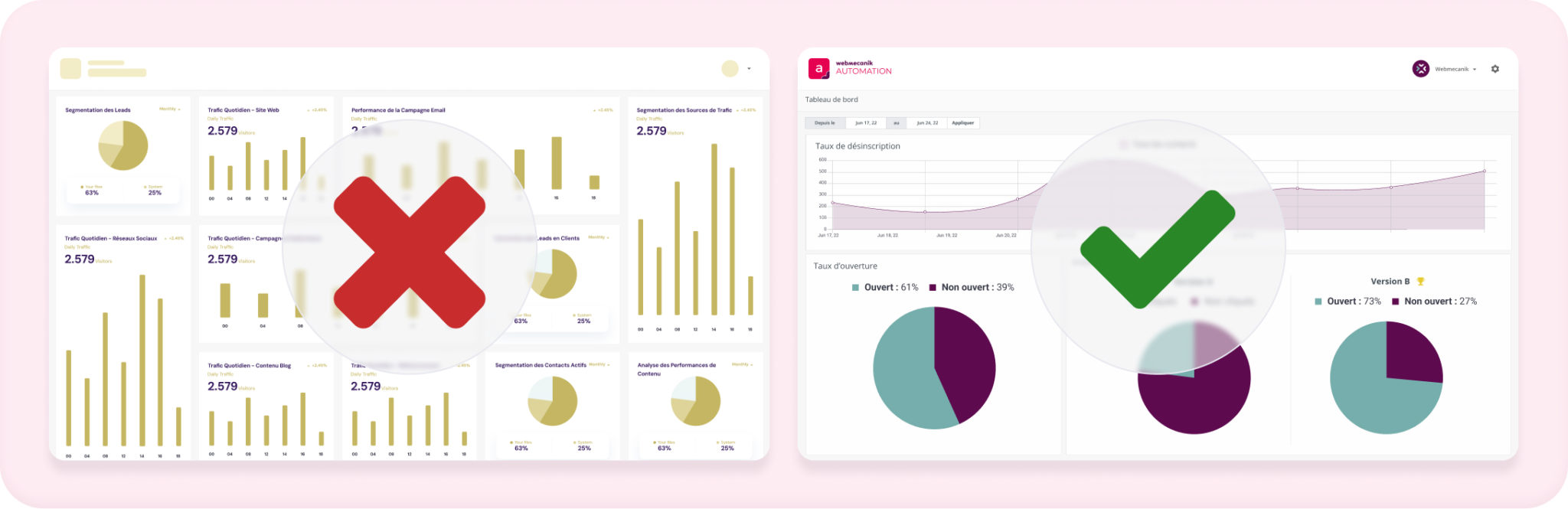
Whether you are building a dashboard for your team or for the members of your board of directors, it must be clear and easy to understand at a glance.
Flexible and scalable?
A good dashboard makes it easy to add charts and KPIs. It also makes it possible to work with several data sets. It must be customizable, collaborative, and interactive. Each team member must be able to personalize the dashboard by adding the figures that interest them in order to share important and relevant data. The dashboard must also be able to connect to all your tools to give you a complete view of your results.
Secure?
Access to the dashboard and its data must be controlled to avoid any information leak or mishandling of the data.
The steps to create your marketing dashboard
Set your marketing objectives (according to your strategies)
By setting clear objectives, you will be able to choose the structure and indicators for your dashboard. These objectives will be divided into several sub-objectives that will influence the structure and indicators of your dashboard.
Choose the KPIs you want to analyze
Once your objectives are set, it is time to choose your performance indicators. Each objective corresponds to specific KPIs that will allow you to track your progress and adjust your strategies (if needed).
For example, if your objective is to increase sales, you will track KPIs such as the conversion rate, revenue, or the number of qualified leads. If you are looking to improve customer satisfaction, indicators such as the customer satisfaction rate or the Net Promoter Score will be more relevant.
Centralize data (website, social media, emails, etc.)
Within your marketing dashboard, you can add different data from various channels. Your objective will allow you to determine which channels are necessary to collect the information to include in your dashboard.
Our advice: we recommend grouping themes together, YouTube / LinkedIn / Facebook in a “Social media” tab.
Choose your selection criteria
During this step, you will determine the criteria to consider when choosing the tool that best suits your needs.
- Features
- Ease of use
- Customization
- Integrations with other tools
- Data security
Update and optimize your dashboard
It is important to keep an eye on your data. Depending on how your needs evolve, a marketing dashboard is never static. Your objectives, your teams, and your needs evolve, which means that your dashboard must also be adjusted.
Analyze and interpret data
With your dashboard properly configured, it is now much easier and faster to identify your company’s trends. For more relevant analyses, I advise you to cross-reference your different data sets (they must be linked, of course). You can identify market trends as well as your customers’ preferences and behaviors. It will now be much easier to make decisions regarding your marketing strategy.
The different types of dashboard
There are a multitude of dashboards, but I will nonetheless present the 3 most frequently used.
Operational
This is the traditional dashboard. It presents data in real time and is updated frequently, or even continuously. Thanks to this dashboard, managers quickly identify deviations from objectives and make corrective decisions. The strength of the operational dashboard lies in its simplicity: it presents information clearly and concisely.
Strategic
Thanks to the strategic dashboard, it is possible to analyze performance indicators over the long term. Unlike the operational dashboard, the strategic dashboard offers a longer-term view, notably including financial indicators. This allows managers to have an overall view of global performance and identify growth levers.
Analytical
The analytical dashboard is the playground of data experts!
This type of dashboard makes it possible to analyze data to identify trends and offers a more in-depth view of past and current data. The analytical dashboard is interactive so that it can adapt to all the questions one might ask about the data. Mainly used by data scientists, it is then explained and made available to managers so that they can implement strategies.
What are the benefits of the Webmecanik Automation dashboard
Webmecanik Automation gives you access to a dashboard to analyze all your actions.
- Real-time updates of information
- A chart library (to be customized according to your needs)
- Detailed reports that allow you to analyze your strategies and your performance
- A simplified view of all the marketing campaigns you implement and by selected channel (email, SMS).
To summarize marketing dashboards
A marketing dashboard is essential for clearly visualizing your performance and helping you manage your actions. All you need to do is follow the steps to create good reporting. You optimize your marketing strategies and improve your operational efficiency. Adopt these tips to turn your data into a growth lever.