

Introduction
You’re already well established in your market. Your target is clearly defined, your marketing channels are in place, and you may have even carried out an audit of your past activities. But one question remains essential: are your marketing messages truly performing?
Whether it’s email, WhatsApp messages, SEA campaigns, social ads, or SMS, every message you broadcast must have a purpose. It could be to generate leads, build engagement, encourage action, or retain a customer. To do this, you don’t just need to create content—you have to analyze it, test it, and optimize it.
The different types of performance for marketing messages
In your marketing strategy, you’re most likely activating multiple channels. Each one has its own specifics, metrics, and goals. Understanding the performance of your messages therefore starts with a solid understanding of each lever.
Email campaigns
Email marketing remains one of the most widely used levers, especially in B2B. But for it to be effective, you need to track the right indicators.
Among the key KPIs:
- Send date and time directly impact open rates.
- Email subject line and sender name can influence opens.
- Open rate: the percentage of emails opened out of the total delivered.
- Click-through rate: the percentage of clicks on links contained in the email.
- Unique click-through rate: the number of people who clicked, regardless of the number of clicks.
- Unsubscribe rate: the indicator of disinterest.
- Bounce rate: the number of emails not delivered (full inboxes, invalid addresses, etc.).
SEA campaign
Your paid advertising campaigns, such as Google Ads, can be expensive! Choosing an external provider like an agency or a freelancer can be a good idea if you don’t have an Ads expert in-house. Both the choice of messages and the types of ads and visuals are important and should be tested continuously.
Here are the KPIs to follow:
- CTR (click-through rate): a key indicator for assessing the attractiveness of your ads.
- Conversion rate: how many visitors completed the expected action (form submission, download…).
- CPC (cost per click): lets you measure profitability.
- Quality score: a score assigned by Google based on the relevance of your ads.
Social ads campaign
You have a multitude of social networks at your disposal—Facebook, Instagram, LinkedIn, YouTube… All these platforms allow you to deliver highly targeted messages.
Indicators to analyze:
- Impressions: the number of times your message was displayed.
- Reach: the number of unique people reached.
- Engagement rate: likes, comments, shares, clicks.
- CTR: measures the relevance of your visual + text.
- Cost per result: how much a download, a video view, a page visit, etc. costs.
SMS and WhatsApp campaigns
This channel is often underestimated, but it’s a direct channel that works well for flash campaigns or important reminders.
KPIs to monitor:
- Deliverability rate: the percentage of messages successfully sent.
- Click-through rate (if link is included): measures the interest generated.
- Reply rate: useful for interactive SMS campaigns.
- Opt-out/unsubscription rate: keep an eye on it if you send regularly.
Performance analysis methodology
As you know, you don’t launch a campaign just for fun—you launch it because there’s a marketing objective behind it. Performance analysis is not the end goal of the campaign; it’s an ongoing process that starts at the very beginning.
It all starts with your objective, whether it’s to generate demo requests, download content, drive visits, retain a customer, invite people to an event, and so on. It helps you select the right indicators to track.
Once your objective is set, the channel you choose to communicate with is essential to achieve your goal. You need to pick the channel based on your audience’s behavior, the nature of your audience, and your objective. Depending on whether you need visibility, drive conversions, or send follow-ups, consider social ads, SEA, SMS, or marketing email campaigns.
Now that you’ve defined your objective and chosen which lever to activate, you’ll create your content. Your marketing message needs to be clear and engaging. Use a tone that fits your audience, craft a call to action aligned with your objective, and make sure your message is consistent with what you want to convey.
These basics seem obvious and almost simplistic. Yet experience shows that effectiveness is directly correlated with the rigor applied at every stage of the process. When you mix up the steps, it’s easy to miss your target—although it’s there, just next door—and you end up spending effort… that turns into wasted opportunities. ?
Example of marketing performance analysis
Marketing campaign
Marketing performance analysis means assessing the overall effectiveness of your message against a specific goal. Here are a few concrete examples of analyses to carry out depending on the campaign type.
Conversion campaign
The campaign’s objective is to generate demo requests or contact inquiries
Number of targeted contacts: 2,000
Email objective: booking an appointment via a form
Number of contacts who reached the goal: 150
Success rate: 7.5%
Analysis: the conversion rate should be compared with your historical campaigns and your market. This result can be excellent—or just average—for others.
Tip: optimize and run an A/B test on the email subject line or the CTA that could improve results.
Nurturing campaign
The campaign’s objective is to move leads forward in the conversion funnel
Number of contacts in the scenario: 5,000
Email objective: download a white paper
Email click-through rate: 12%
Download rate: 6%
Analysis: good click rate but low conversion afterward. It may be useful to optimize the landing page or revisit the proposed content to better reassure visitors and encourage them to share their information. Also verify that the promise aligns with your ICP (Ideal Customer Profile).
Customer retention campaign
The campaign’s objective is to improve post-purchase engagement
Number of targeted customers: 800
Email objective: encourage subscription to an insurance extension.
Open rate: 45%
Click-through rate: 18%
Engagement rate on the page: 10%
Analysis: encouraging results—possibly very good. It’s possible to strengthen them with an automated follow-up sequence.
Again here, select relevant KPIs and avoid limiting yourself to metrics that are hard to act on.
Good segmentation will then allow you to deliver more targeted—therefore more effective—messages. Finally, it’s important to document the results obtained in a tracking table or directly in your marketing CRM. This lets you build on your learnings and optimize your future campaigns.
Here’s an example of a tracking table:
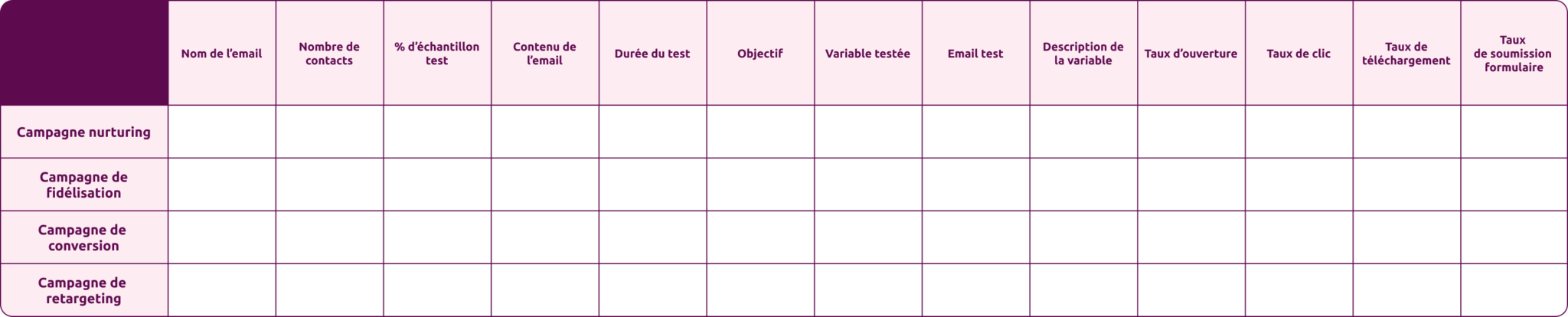
Email A/B Test
As mentioned earlier, I recommend testing your marketing messages. This helps you understand what works best and what you can improve. Use the email A/B testing option! Here’s the methodology:
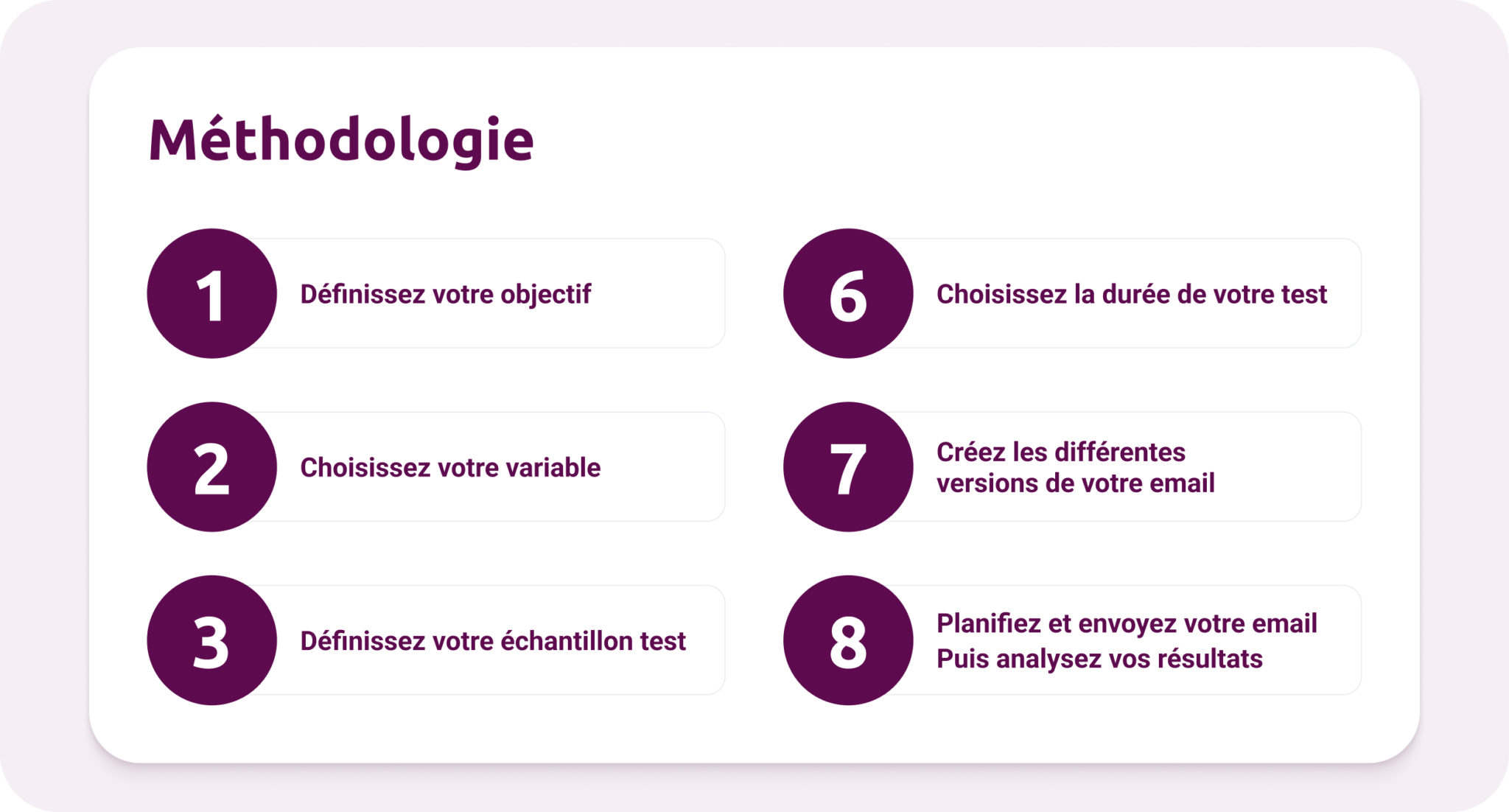
First, define your email objective, for example your message whose goal is to generate event registrations.
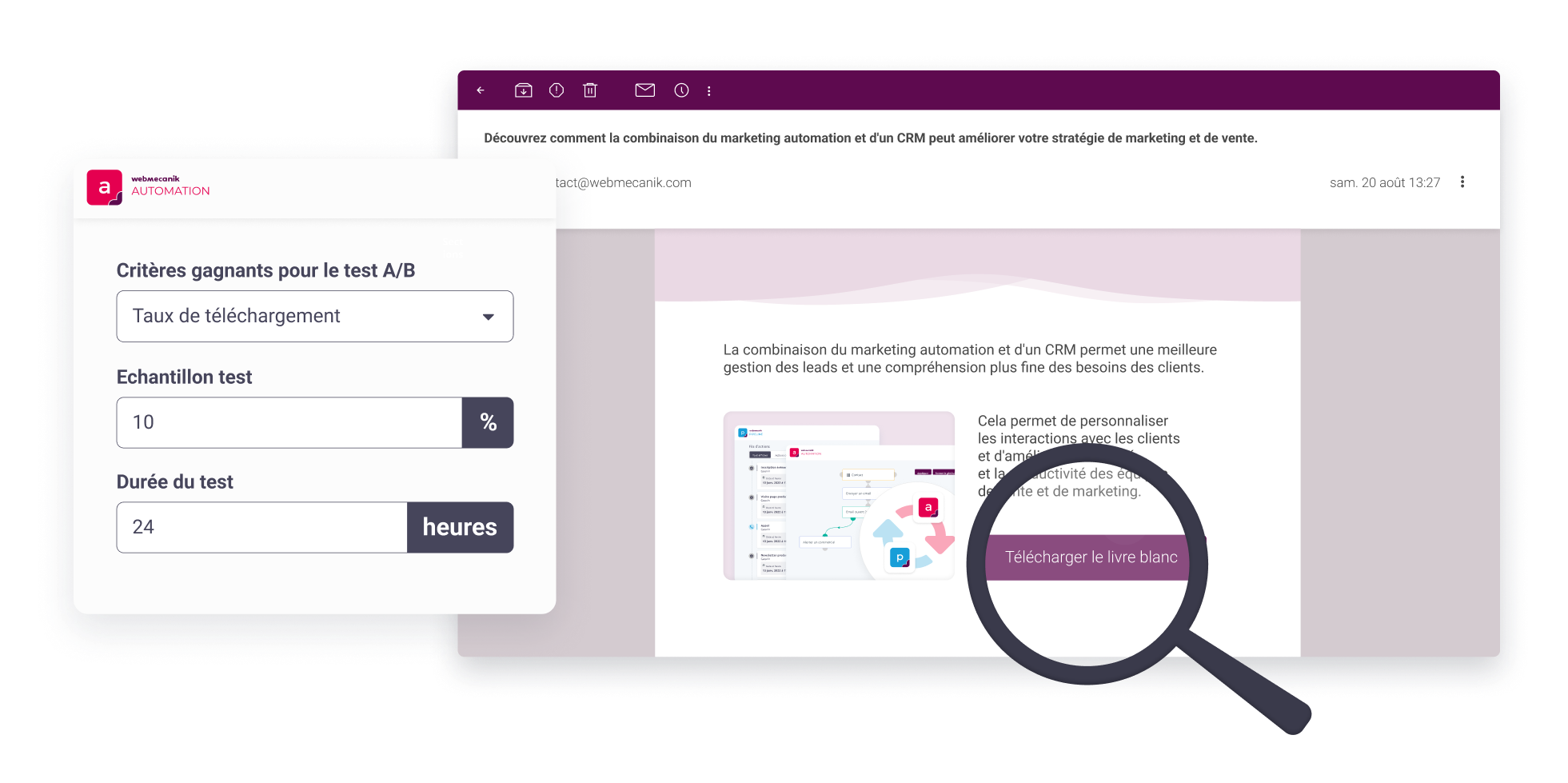
So you’ll set up a CTA, and you decide to create a variant based on it. Before sending your email to your entire segment of contacts, you’ll test it with a sample of 10% of your segment. You send the “test” emails one week before sending to the other contacts. Once you’ve sent the test emails, you analyze the results. In our example, you’ll analyze which CTA the contacts clicked on the most and which generated the most registrations. If you’re used to sending emails with a marketing automation tool, it’s possible that your tool makes it easy to set up A/B testing. In Webmecanik Automation, it’s possible to implement A/B testing, allowing you to then launch the best-performing campaign across your entire contact segment. Bonus: use the A/B test + AI option!
The test variable
Let’s get back to the analysis: the variable you tested is important (subject line, call-to-action, visual, etc.), and you can measure the results you obtained using the main indicators—open rate, click-through rate, download rate, and form submission rate. These data will help you identify what works and optimize your next campaigns. If you use a marketing automation software, it’s possible that multiple performance tracking features are included, such as reports, and—like in Webmecanik Automation—the Heatmap functionality for emails. This feature helps you identify the areas of an email that generated the most interest (clicks).
To go further, you can create a best practices guide for yourself and your team based on the results you’ll obtain throughout your tests. As your marketing campaigns progress, they will become more effective. Don’t hesitate to repeat your A/B testing campaigns to check how your campaigns’ behavior may evolve over time.
Conclusion
The performance of your marketing messages isn’t limited to analyzing a single campaign. It fits within a broader approach: continuous learning. Every piece of data collected, every indicator analyzed, and every test performed deepens your understanding of your customers, refines your strategy, and brings you closer to your goals.
Measuring, understanding, and adjusting your marketing actions allows you to turn your various messages into engagement drivers. Each communication channel has different objectives and therefore its own analyses.
This is also where marketing automation really makes sense. You automate not only sending, but—most importantly—you can steer your performance in real time while keeping personalization in your marketing messages.
You’ve understood it: tracking the performance of your marketing messages means taking a proactive, ROI-driven approach—where content becomes a strategic lever rather than just another communication channel. Listen, test, and adjust; that will give you the keys to perform. ?