

What happens on your site can be useful to you!
The data from your website is of no use, or rather its only use is to be able to draw information from it.
Knowing that you are traveling at 73 km/h is not very useful.
- First, you need context: “you are in a car“, your speed is already a bit more useful but still not very interesting.
- “speed in a car is regulated“
- “you are on a road where the maximum authorized speed is 50 km/h“
- “visibility is good“, “there is no obstacle in front of you“, here is other data which, taken in isolation, is still not very interesting.
There is, however, potentially one useful piece of information “you are driving at an unauthorized speed”.
This information can allow you to make a (good) decision

Too much information kills information
We often try to refine (“you are driving at 73.458 km/h”) or pile up (“you have driven 438 km since the last fill-up”, “the outside temperature is 12°C”) data, thinking that it will be useful, that it will naturally take on meaning or that one day we will process it to get something out of it. Alas, this accumulation of extremely detailed data is often useless.
On a website
We also have a lot of data (Google Analytics, completed form, visitor subscribed to a newsletter, …). We also have data that comes from marketing or sales: prospects, amount billed to a customer, quotes in progress, etc. Even if we had simple access to all this data, it would only be useful once we managed to extract useful information from it.
The right time
If we manage to extract useful information from all this data, this information still needs to arrive at the right time so that we can make a (good) decision. The information “you were driving at 73 km/h on this road and you therefore have to pay a fine” is still a bit … frustrating.
On a website
Without a tool, it is difficult to know how the prospects or customers who visit it behave, so it is difficult to make a decision based on their actions. The right information at the right time for the right target. In marketing, we apply this to our prospects and/or customers. The right information must also reach us at the right time so that we can make good decisions. A daily report containing all the previous day’s data helps mitigate the issue of reacting quickly, but does not necessarily help with making the right decision, as data analysis can be complex. If the report contains information, decision-making is made easier, but we still do not have the ideal solution.
Defining KPIs
Defining the few pieces of information we need to make decisions and being alerted when useful information arrives, that is what becomes useful. To do this, it is useful to define KPIs (Key Performance Indicator) and to define thresholds that must (or must not) be crossed.
Each company has its own KPIs and its own thresholds.
General alert
For the most critical KPIs, the alert must occur in real time. This alert must be able to be picked up immediately by the people likely to make a useful decision in response to this alert. Data collection is therefore not an end in itself, but merely the beginning of a process that makes this data useful. It is better to collect little data and get the most out of it. Choose carefully where you store this data, because it becomes essential once you know how to derive information from it.
Alerts will allow you to make the decision at the right time
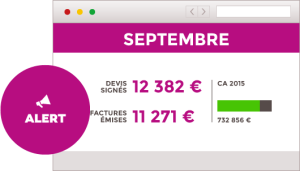
At Webmecanik, we are working on a tool that allows you to transform this data into information and use this information with your own KPIs.
These KPIs will be visible in real time and alerts may be triggered to warn you that action needs to be taken.