
In 2018, the company Getresponse published its report with figures on email marketing. More than 2 billion emails were analyzed, across 126 countries and 19 different industries. To help you optimize your email marketing strategy, we have highlighted the key figures from these email statistics.
These figures confirm that the 2018 Inbound Marketing priorities are the same as in 2017. It is important to integrate marketing automation into your inbound marketing strategy because email marketing remains a preferred channel for people.
LOCATIONS & INDUSTRIES
1. Email marketing figures in Europe vs the rest of the world
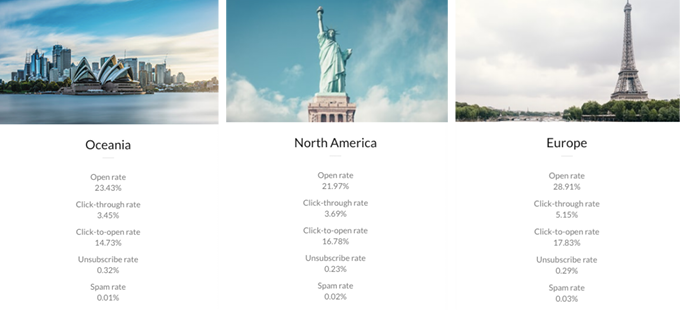
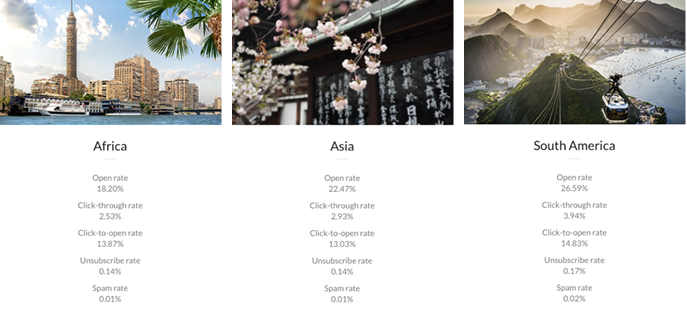

First, the analysis of email marketing results by continent reveals that it is important to focus on the geolocation of your contacts when addressing a truly global audience. Indeed, we note that results differ depending on the continent.
For example, Europe clearly outperforms North America in open rates and click-through rates. In addition, Oceania, with a population 4 times smaller, sends almost as many messages as Africa with 1.3 billion inhabitants.
Let us now focus on the averages in Europe and worldwide. We note that email marketing performs better in Europe, with an open rate and a click rate above the global average. Nevertheless, it should still be noted that the unsubscribe rate as well as the spam rate are slightly above the global average. We can conclude that email marketing is still an appreciated channel in Europe; however, the content shared is not necessarily what the targeted audience is looking for given the current unsubscribe rate in Europe.
Would you like to reach these scores, or even exceed them for your email campaigns, and are you wondering how to do it? Here is the right advice to increase the proportion of emails received
Try changing your offer, play with calls to action and rethink the design of your emails. We also encourage the use of double opt-in; lighter lists mean better results, and email deliverability is much better. It is also worth mentioning that, due to the new GDPR laws in the EU, we should see growth in double opt-ins in European countries.
On this subject, we would like to remind you that with the implementation of the new strict GDPR regulations, email marketing statistics in European countries will improve over the coming years. Indeed, this regulation requires clean contact lists, whereas in other parts of the world there is practically no regulation concerning email marketing, which most of the time results in lower-quality lists, impacting email statistics. For this, you need to know how to interpret email figures while taking into account the impact of bots.
FREQUENCY & TIME
1. What is the best time to send your emails?
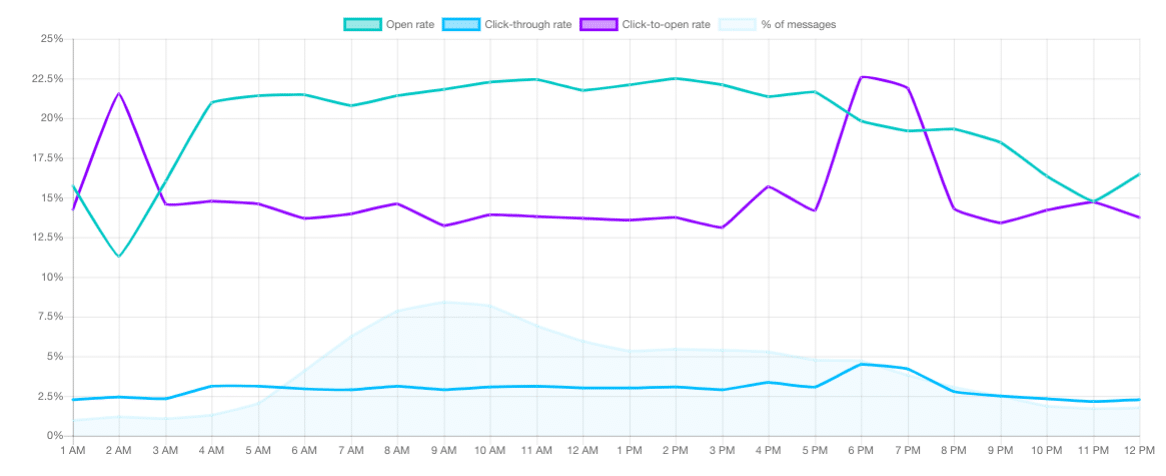
Each of us would like to know the ideal time to send emails in order to obtain the highest engagement rate. Nevertheless, to be honest with you, to the question: What is the best time to send your emails? My answer is: it depends!
In general, there seem to be two time slots you could focus on.
The first slot is around 11 a.m. – A few hours after arriving at work, people have already had their coffee and have already started their professional tasks. At this time, they are more receptive to receiving all kinds of information.
The second slot is around 2 p.m. – This is the time slot that saw the greatest increase in terms of average open rate. We could hypothesize that this is the case because recipients have just returned from lunch and are checking the emails that arrived during their lunch break.
We also note that later in the afternoon, at 6 p.m. when most of us are heading home, this is when the click-through rate is highest. In e-commerce, this could mean that, especially during the holiday period, you could capture your audience’s attention even later in the day, when they are most likely to make an online purchase, for example.
In conclusion to this section, do not forget that every audience is different and that consequently you should know your audience as well as you know your competitors.
2. What is the best day to send your emails?
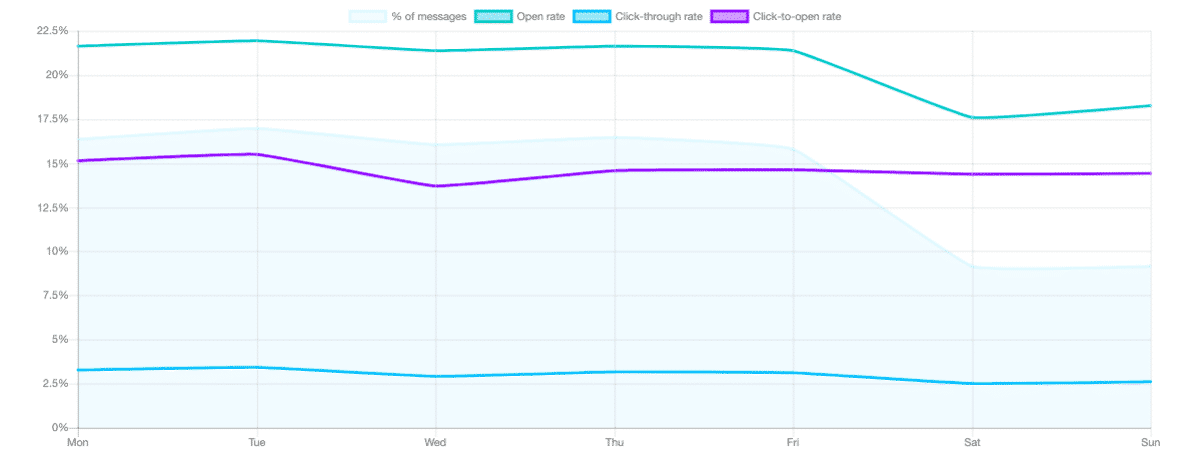
Another question frequently asked by marketers: What is the best day to send emails? Once again, the answer is not that simple! It will always depend on the audience you want to reach and how they behave (when do they have time to read your messages and act on them?). When looking at the highest average open rates, Friday comes out on top. Nevertheless, if we are looking for the highest average click-through rates, which is the indicator closest to a conversion, then Tuesday remains the best-performing day.
We believe that Tuesday is the best day because most of us have a lot of emails and projects to catch up on Monday. After clearing the inbox and planning out the whole week, you should be in a position to check your messages and take part in communication by the time Tuesday arrives.
To get a concrete answer to this question, we recommend running an A/B test and seeing for yourself. Check whether Tuesday and Friday are also the best days for you. To do this, monitor open rates and click-through rates. Do not forget to include conversion rates in your decision-making process, because that is what you are really trying to improve.
In conclusion to this section, we remind you that the relevance of your emails remains the key to high engagement.
Strategies & Methods
1. Average results by message type
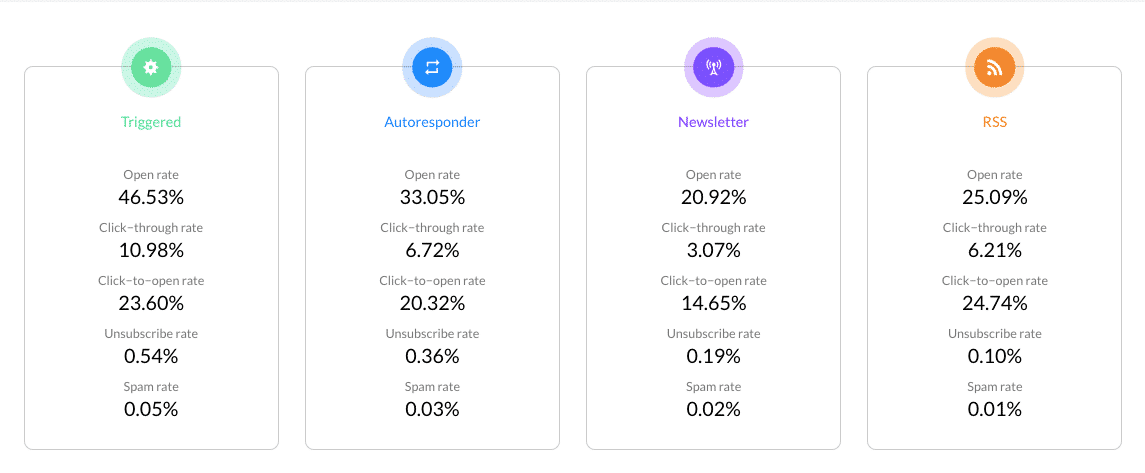
As we mentioned just above, relevance is the key to high engagement!
And to be relevant, you need to know your audience (mainly its needs, habits and preferences). That is why marketing automation workflows deliver the best results. Thanks to marketing automation, you can collect important data throughout the customer journey and use it to segment your contact lists in order to personalize your marketing communication.
Read also: 13 email marketing mistakes to avoid to increase engagement
Read also: Email builder & marketing automation
2. Should your email subject line follow a certain length?
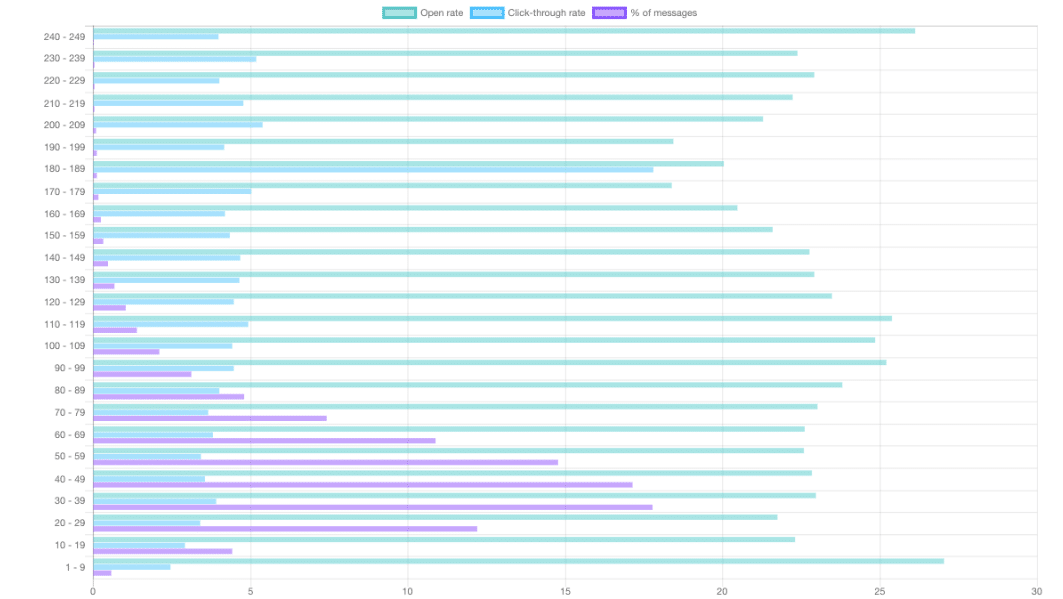
Your subject lines must be compelling enough to encourage people to open the email. So, in most cases, it is not about the length of the subject line, but about conveying the right message. Indeed, if the content is relevant to your audience, then you will achieve a high open rate. Do not forget about display on mobile devices: fewer characters are shown and, consequently, some of your keywords may no longer appear in your subject line.
3. What is the impact of adding emojis to your email subject line?
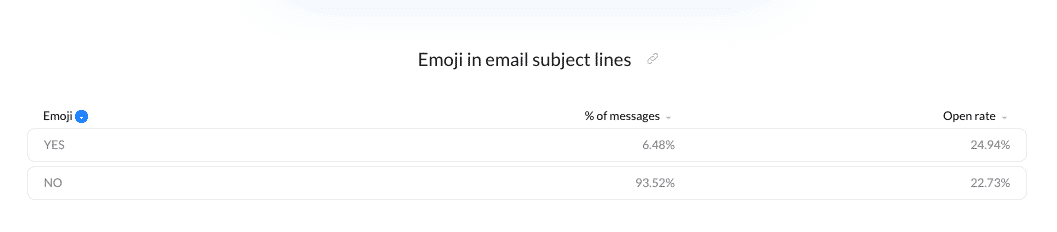
First of all, the use of emojis in email campaigns is low. Indeed, this is still a fairly recent trend; consequently, only 9% of marketers have already added one or more emojis to their subject line.
So, do emojis have a positive impact on open rates? These results prove that they do: we see an open rate of 26.74% for emails containing an emoji in their subject line, compared with 24.63% for subject lines without emojis. So if this communication style matches the expectations of your audience, do not hesitate and ride this new trend.
4. What is the impact of personalizing your email subject line?

Although 87 % of marketers do not personalize the subject line of their emails, this in no way means that personalization has no impact on your email marketing results.
On the contrary, we find that personalizing an email subject line improves the open rate. Indeed, customers are different from one another and these differences go beyond demographic data. Sending standard emails not only highlights a lack of creativity and strategy, but also constitutes a waste of time, energy and money. So be thoughtful, and take the time to show your contacts that they truly matter by offering them a subject line and email content tailored to their specific needs.
In conclusion, email marketing is still relevant in 2018, and yes, despite its 30 years of existence, email marketing is still internet users’ favorite channel for interacting and has nothing to envy from the new generation: social networks. Indeed, email marketing remains a preferred and almost indispensable marketing technique nowadays. The reasons are simple: email marketing continues to be effective in terms of results, especially if you follow the new techniques and trends that will allow you to increase engagement in your email campaigns:
- Get to know your audience before anything else!
- Offer relevant and personalized content.
- Use clean, high-quality contact lists.
- Automate the sending of your marketing emails thanks to Marketing Automation.
- Be consistent.
- Multiply your calls to action.
- Do not hesitate to test your strategy: A/B testing.
The goal is to create a close relationship with your customers, establishing a climate of trust and attentiveness so that they feel privileged. To go further and discover how to use email marketing effectively, we have written an article on the subject: 13 email marketing mistakes to avoid to increase engagement!