

B2B companies: do you think you are publishing attractive content on your website, professional blog, social networks, newsletter, and through your guides and white papers in particular?
However, are you disappointed with the results obtained? Are you getting little traffic, poorly qualified visitors, too many curious people downloading your white paper when you were hoping for high-quality B2B prospects?
Then I invite you to ask yourself this question: is your content designed to attract and generate your dream prospects on your website? In other words: is your content designed to interest your prospects?
I invite you to take the following test in 8 questions to find out.
Indeed, only by questioning yourself can you organize a dedicated production team that truly generates traffic and prospects, by following the methodology explained on this page.
Question no. 1: do you put yourself in your prospect’s shoes?
- What are their difficulties?
- What are their Jobs-to-be-done, the missions and tasks they must carry out and are responsible for?
- What are their professional aspirations?
- How much influence do they have in the purchase decision? Are they the sole decision-maker, or do they ask other departments for input?
- What reliable information sources are they used to consulting?
A good understanding of your ideal customer is essential: it is about understanding the elements that are important to them.
Your content must indeed provide answers to the questions they are asking themselves.
Your prospect is not looking for your product or services, but first and foremost for anything that can help them do their job better in their own specific context.
There is nothing better than putting yourself in your prospect’s place to understand their challenges and offer them content that captivates them, not you!
Also read: What are the strategic challenges of inbound marketing?
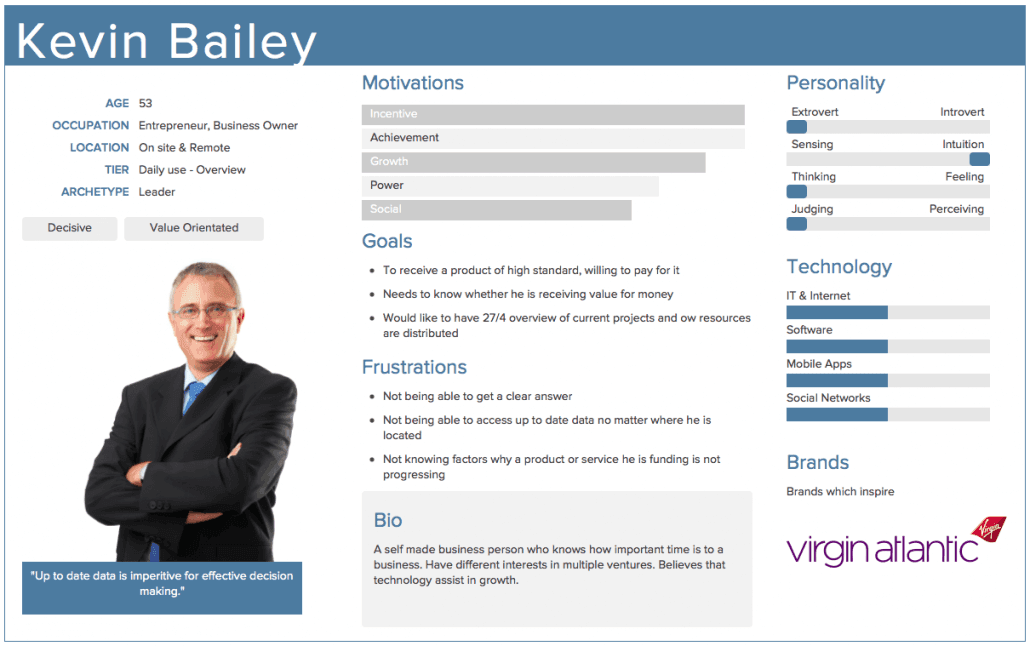
Example of a persona profile (ideal customer) in an image:

Question no. 2: do you research what they type into Google?
A keyword study reveals the questions your prospect is asking and typing into a search engine to find answers.
If you publish content based on guesswork, without taking their keywords or key phrases into account, you are unlikely to interest your prospect.
By focusing on relevant keywords related to your industry, you define a pragmatic content strategy to produce.
The content you publish then responds to your prospects’ concerns: your site attracts qualified contacts on a specific topic.
Several factors need to be studied;
- the search intent associated with a keyword,
- the monthly search volume,
- its place in the buying journey.
Also read: Inbound marketing embodies the revival of B2B marketing
Question no. 3: do you support them through the buying journey?
The more involved the purchase is (investment, software implementation time, etc.), the more complex the B2B buying journey can be.
Gartner illustrates this perfectly in its diagram:
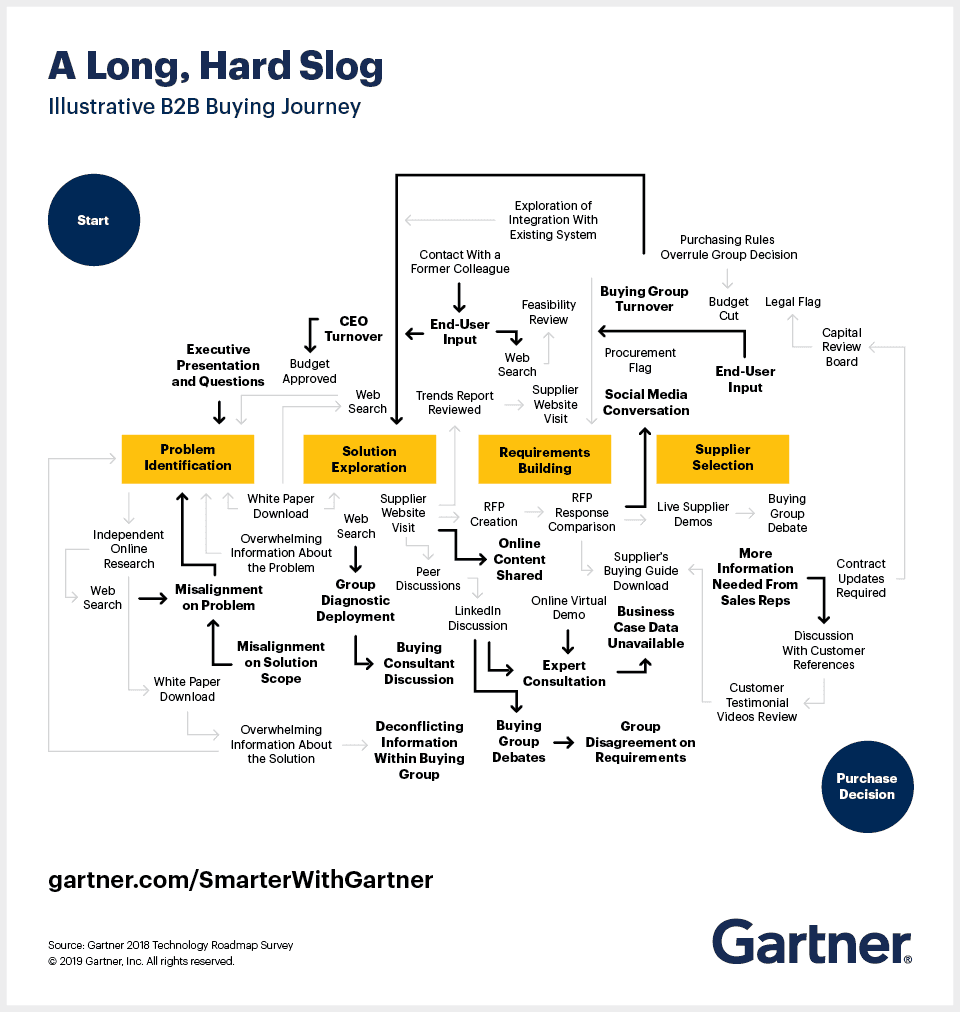
Gartner is an American company: its B2B studies are renowned, as is the advice delivered through its media outlet and business software comparison platform Capterra in France.
“According to Gartner’s study, ‘New B2B Buying Journey,’ content helps B2B customers progress through the buying journey and even improves the quality of the sales relationship to achieve:
• a purchase decision reached 2.8 times faster,
• a business agreement closed 3 times faster.”
Source: Gartner.com
It makes sense: your prospect therefore needs to consume information to understand all the aspects, benefits, and stakes of the solutions that can help them.
Articles focused on “definition,” “best practices,” and “checklist,” for example, represent content that leads the reader to become aware of opportunities to accomplish their mission more effectively.
It is essential to list all psychological barriers and objections in order to remove them. The customer needs to be reassured in their choice and feel confident about their purchase.
Question no. 4: do you comply with SEO rules and constraints?
The organic search performance of your content becomes effective if you follow several rules.
Well-ranked content generates 3 times more leads than search engine advertising.
Source: Content Marketing Institute
For your web pages and blog articles to rank among the top Google results and attract qualified traffic, you need to focus in particular on the following concepts:
- technical settings for your website,
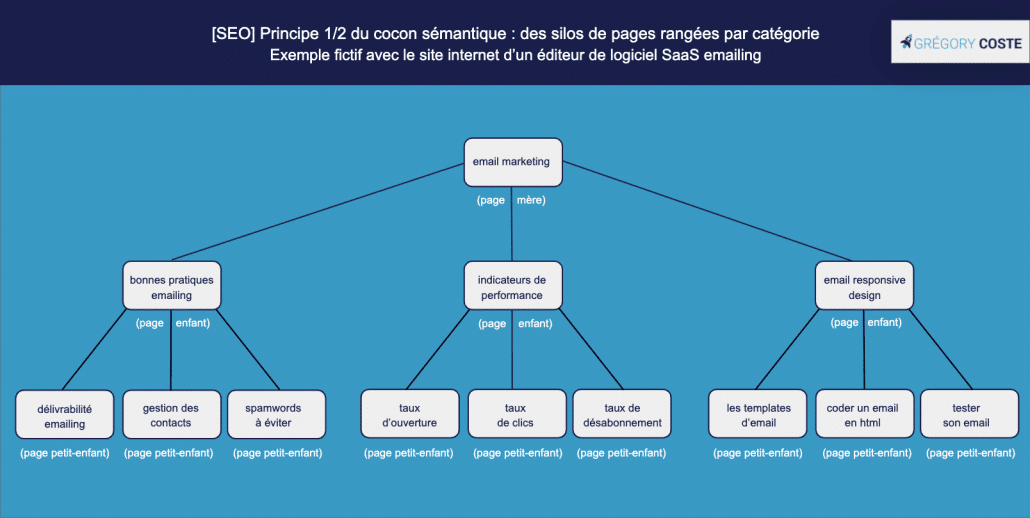
- semantic structure,
- internal linking,
- guest blogging on third-party sites.
Example of a semantic structure in an image:
Of course, your writers produce structured texts with a main title and subheadings. They fill in the Title tags and Meta description like seasoned SEO web writing pros.
Of course, your images include properly filled-in attributes and their file size is optimized.
Of course, you do not copy and paste the same text onto 2 pages of your site, or worse, onto a third-party site…
No, SEO and content are not just about keywords. You have to work hard to get results!
Question no. 5: does your white paper solve a real problem?
To convert unknown visitors into qualified prospects, you naturally offer a lead magnet (guide, white paper, etc.) on a page with a contact capture form.
And there you have it: you collect qualified contacts. Either you contact the hottest leads, or you send content to colder prospects to move them closer to a purchase in an educational way.
Is your lead magnet not generating any downloads?
5 reasons can explain it:
- You do not know your customer profile well, and the topic does not interest them.
- Your offer may be too focused on your company and not benefit-oriented for the prospect.
- Your download landing page with a form is not attractive.
- The landing page copywriting does not create the irresistible desire to download your guide.
- You are not driving enough traffic to your landing page.
By the way, here are 16 examples of video lead magnets to inspire you.
Question no. 6: is your editorial production regular?
Google and internet users like information that is not ancient history.
The fresher the content, the better.
For Google, you must demonstrate your expertise through your content, continuously.
The goal is to cover the entire set of business topics related to your activity, while of course answering the questions your prospects are asking.
Moreover, if you share excellent-quality information, visitors tend to subscribe to your newsletter or your educational content stream.
You build loyalty with an audience that regularly returns to your website: nothing is better for building a lasting relationship with your future buyers by educating them transparently.
The regularity of your publications is therefore an important criterion to respect!
Question no. 7: do you promote your content?
In addition to search engines, it is relevant to seek complementary traffic sources to attract your prospects to your website.
In terms of so-called free promotion, social networks such as LinkedIn are a place to publish and interact with your prospects. Your newsletter also helps bring visitors back at regular intervals.
By leaving comments on other sites, you can also suggest a page on your site in order to provide additional information to what is written.
In terms of so-called paid promotion, online advertising via Google Ads or LinkedIn Ads can be a way to attract traffic.
You can also promote your lead magnet to a qualified target audience on LinkedIn through advertising and private messages.
Finally, buying sponsored articles and backlinks, or listing your solution on a dedicated platform, are also possible options: all that remains is to study the relevant sites.
Question no. 8: does your team rely on proven processes?
The heart of the problem may lie within your team responsible for writing and producing content.
I often find that content production lacks methods in order to be regular, relevant, and effective for lead generation.
An effective team meets several criteria:
- it is trained in organic search and optimized writing,
- it has business knowledge related to your product, solution, or services,
- it knows the advantages and strengths of your product, solution, or services,
- it integrates your marketing strategy,
- it knows who it is writing for,
- it is equipped with high-performance tools,
- it works efficiently thanks to proven processes,
- it is valued fairly by senior decision-makers.
From experience, I know that all these criteria depend on work processes that must be thoroughly streamlined internally, step by step. High-performing teams do this.
Time to take stock
To conclude, I encourage you not to panic if you have identified many weak points to improve in order to optimize your content, and therefore your lead generation.
Save time, save money, and keep your peace of mind: call on a seasoned professional who is well versed in all these issues.
Your humble servant (an example chosen at random in a completely subjective way) lets you benefit from all of his tried-and-tested best practices in the field to support you while taking your specific context into account.