

Nowadays, the concept of lead generation is an integral part of marketing strategies. It is a pillar of digital marketing. Lead generation is a marketing process that serves sales teams. They will set up multiple operations to attract prospects. Depending on the brand’s strategy, lead generation is carried out through inbound marketing, paid advertising, partnerships, growth hacking, or events. Inbound marketing is one of the most important levers for generating potential customers. The goal of this strategy is to obtain your prospect’s information through lead magnets so that they can download a resource such as white papers, checklists, case studies, etc. The aim is to generate leads continuously. These leads will then be worked on automatically to become hot leads.
Aligning your lead generation goals with your business goals
Implementing lead generation goals
Lead generation generally applies in the B2B world and targets everyone from very small businesses to mid-sized companies and large groups. Implementing a lead generation strategy necessarily involves setting business goals, then breaking them down into marketing goals and finally into lead generation goals. In this article, you will discover how to define SMART marketing goals as well as examples of goals. You will also discover why you need to set goals to generate leads and how to do it. Happy reading!
After understanding the importance of setting lead generation goals, you will be able to define your objectives. You have probably already understood it, but these will mainly be linked to your website and your leads. Of course, nothing prevents you from setting different goals, but with inbound marketing as the common denominator.
To set your goals, you will need to determine your priorities according to the strategy you have decided to follow. This could be increasing traffic to your website, generating more leads thanks to rich content, or increasing your customers’ engagement with your company’s other products or services. It all depends on the decisions you want to implement. Let’s take a concrete example: you have decided, in your strategy, to prioritize your website. You can then set yourself a traffic goal for your website.
Lead generation strategies
Before setting lead generation goals, you need to understand why generating leads is a solution for a sustainable and effective B2B strategy.
First of all, a lead is a person who is interested in the product or service you offer. They are therefore more likely to buy from you. Indeed, if they are interested in your product, it means they have a problem in their company and want to solve it. The goal of your marketing strategy will therefore be to convince the lead that you are the solution that will solve their problem.
To make them understand this, you will implement an inbound marketing strategy of which lead generation is an integral part. It consists of attracting leads to your website, but also qualifying them and contacting them at the right time in order to send the right message, at the right time, to the right person. It is the opposite of outbound marketing. ☯️
Here I explain the definition of marketing leads as well as acquisition and retention strategies
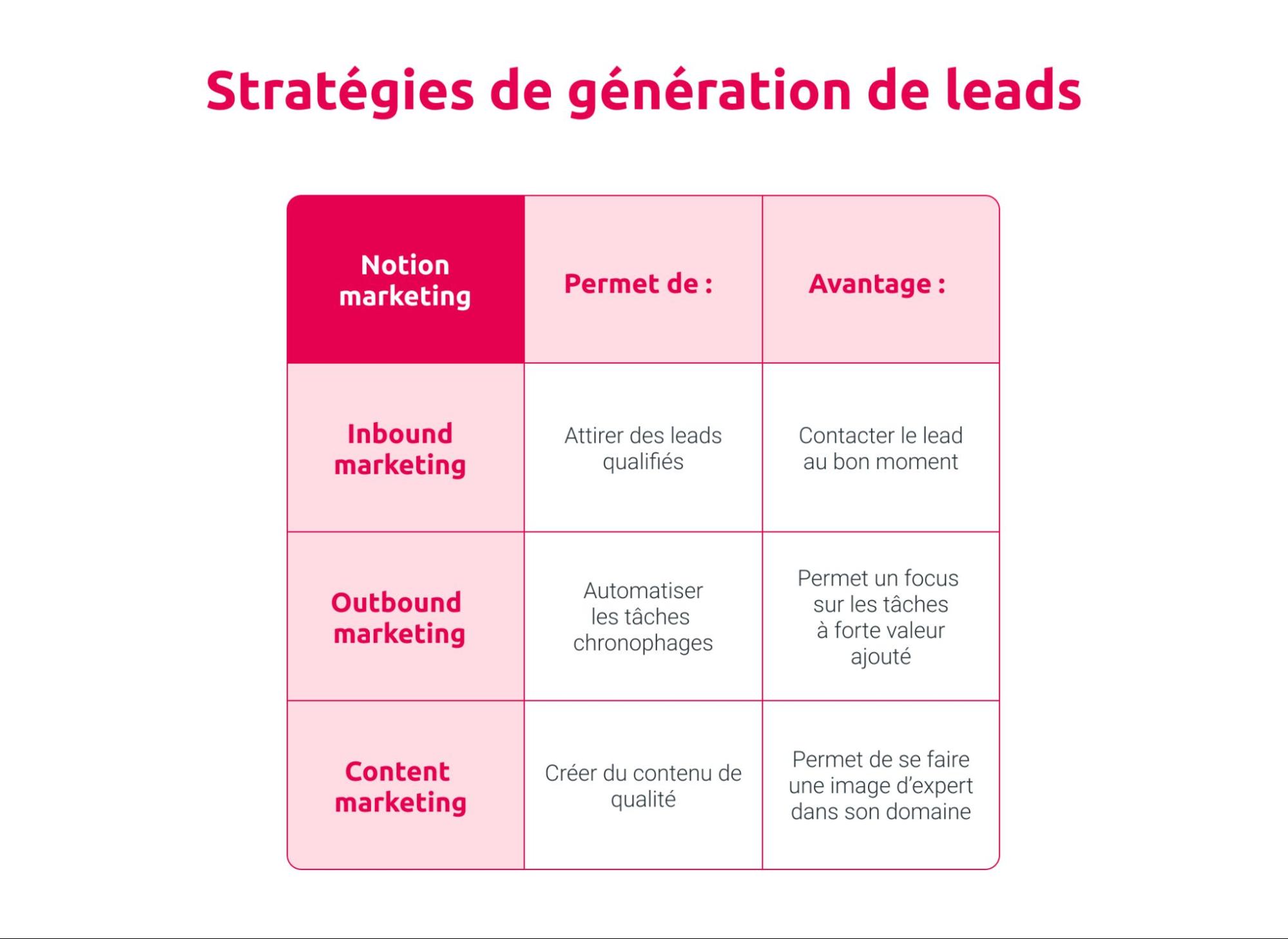
Lead generation is an integral part of inbound marketing, which itself is one of the three pillars of digital marketing alongside marketing automation and content marketing. The latter consists of creating relevant and useful content for your marketing persona. As a reminder, your marketing persona corresponds to your ideal customer. It generally corresponds to the leads you want to target through your content. To learn more about persona creation, you can download our persona kit to get a solid foundation.
The more precise and relevant your content is, the more you will project an expert image in your field. The richer and higher quality the content is, the more interested your lead will be in it and the more likely they will be to contact you to learn more. That is what content marketing is all about.
Finally, we also advise you to combine content marketing and inbound marketing with marketing automation. This consists of eliminating time-consuming tasks in order to focus on high value-added tasks. To do this, you create automated and personalized campaigns to send emails, newsletters, SMS messages, etc. You implement lead scoring, which allows you to qualify your leads through a scoring system, and you contact the right people with the right message at the right time.
To summarize, to generate leads effectively:
Also read: marketing strategy: lead generation on the internet & inbound marketing
I advise you to implement these three concepts in your marketing strategy: marketing automation, inbound marketing, and content marketing. By adopting the right tools available to you, you will adopt a winning strategy to generate leads continuously and effectively.
If you want to take this reflection further, consider using paid tools. For example, using Google Ads or social media advertising to boost an event or a high-value article can have very positive effects on your lead generation. It can therefore be very interesting to set goals not only for lead generation through inbound marketing but also for lead generation through paid tools.
This use will give your strategy and your goals a boost. While inbound marketing can sometimes take time to implement, Ads campaigns or social media advertising have a direct impact on your lead generation.
Integrating inbound marketing to generate leads
Inbound marketing is a strategy aimed at attracting leads to your company organically.
Several techniques allow you to carry out inbound marketing, particularly the creation of content that meets their needs at different stages of their buying journey.
You will mainly use channels such as social media or your website. You can implement search engine optimization (SEO). I also advise you to create marketing resources that will meet your leads’ needs. For leads who need reassurance, you can create business cases or case studies of companies that had the same issues as they did and how you managed to meet their needs.
Case study: successful lead generation strategies
To give you a more concrete example, let’s take the company CorpoTech. It is a company operating in the information technology sector. Their goal is to increase their qualified online leads to 500 per month using digital marketing tools, in order to support their growth and increase their conversion rate, all within six months (the goal is formulated in a SMART way).
The company was looking to implement an integrated digital marketing strategy to attract more qualified prospects and increase its revenue, given that their lead-to-customer conversion rate is currently 5%.
The resources they have:
As for the budget, they have €50,000 for digital marketing actions and the necessary tools. In terms of human resources, a dedicated team made up of two digital marketing specialists, a web developer, and a content creator.
The strategy includes the following elements:
- A site redesign was implemented to improve the user experience and optimization for search engines (SEO). This will include the creation of targeted content to attract visitors.
- Implementation of a blog, whose purpose is to strengthen positioning on target queries in search engines. This also helps create an expert image in our field.
- Launch of advertising campaigns, made possible in particular through Google Ads and Social Ads.
- Adoption of marketing automation. CorpoTech decided to implement automated campaigns in order to create lead nurturing. This option allows them to keep their prospects engaged until they convert into customers.
The KPIs they decided to track:
- The number of leads generated each month.
- The lead-to-customer conversion rate.
- Cost per lead
- Customer acquisition cost (CAC)
- Engagement with blog content (views, shares, comments)
What conclusions can be drawn after implementing this strategy.
Adjustments were made monthly throughout the strategy (as needed).
Once the 6 months are over, it is now necessary to measure the return on investment (ROI) and decide on the next steps based on the results obtained.
Setting SMART goals
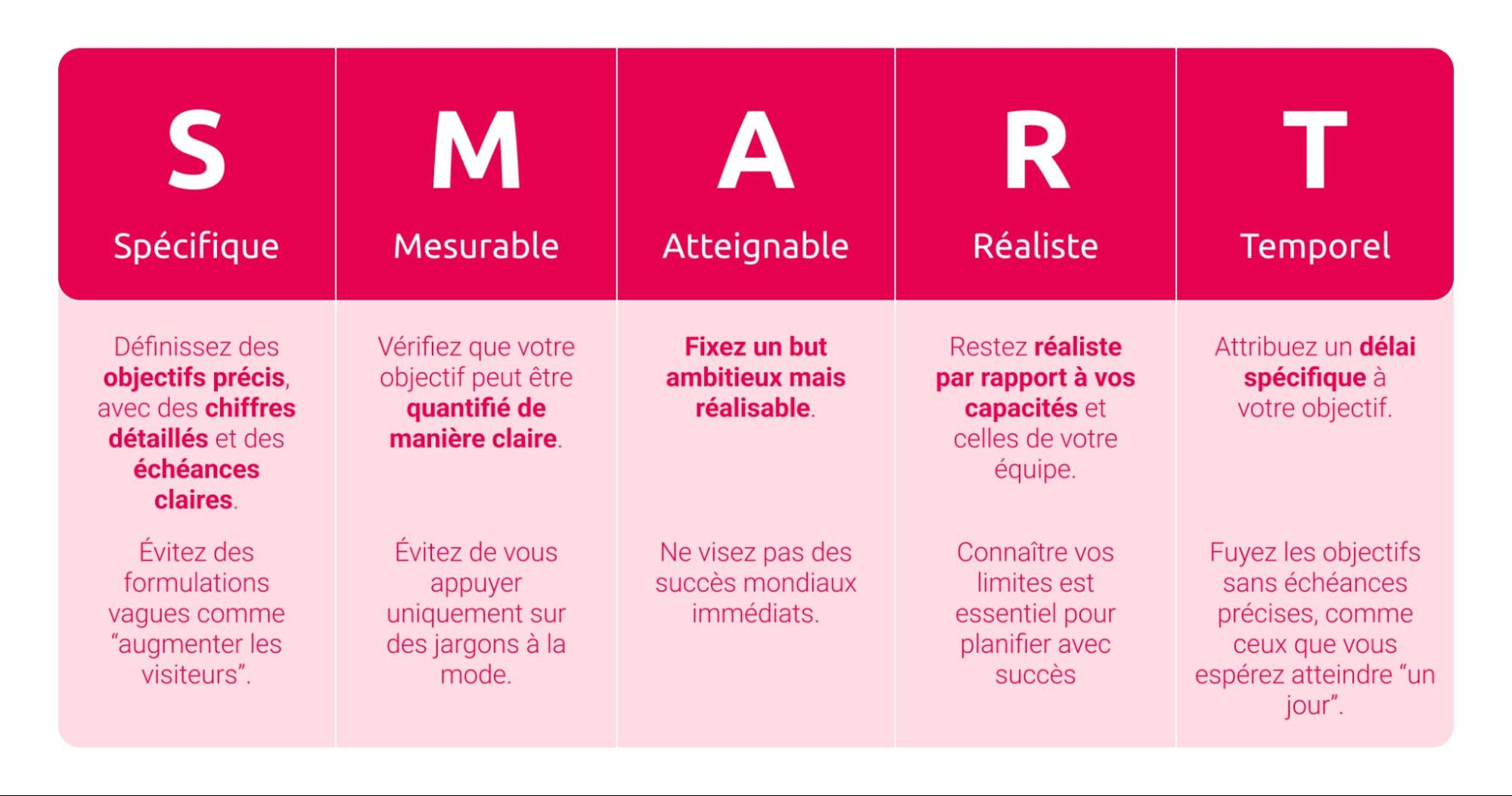
It is important that you understand the notion of business and marketing goals. This helps you set SMART lead generation goals. They are important for the success of your strategy. Let me explain! ?
Examples of SMART goals for lead generation
A SMART goal must be able to be summarized in one sentence; all the concepts mentioned above must be present. You can set goals internally but also externally. It is possible to classify your lead generation goals into two categories: qualitative goals and quantitative goals.
Qualitative goal
Qualitative goals are linked to elements related to the life of your company. For example, the satisfaction rate, in addition to being an essential KPI for your strategy, can be highlighted during your sales discussions. A good satisfaction rate is a strong element of reassurance for your leads but also for closing a sale.
Here are some examples of qualitative goals:
- Achieve an 80% satisfaction rate over year X
- Have a sick leave rate below 5% over year X
Each goal is specific to the strategy you want to implement. Some goals you set for yourself are more important than others. It is up to you to prioritize those that seem most relevant.
Quantitative goal
Quantitative goals, meanwhile, are based on your business results. These goals allow you to make important decisions for your company and for your business strategies. Here are my examples:
- Increase revenue by 20% over year X
- Increase company profits by 10% over year X
- Sell 10% more products during Christmas period X
- Generate 10% more leads over year X
The two categories can be closely linked; for example, a 20% increase in your revenue (quantitative) may allow you to invest in new equipment for your company (qualitative).
Aligning your lead generation goals with your business goals
Adopting SMARKETING
In order to set good lead generation goals, I advise you to adopt the smarketing strategy. This strategy simply consists of aligning your marketing and sales goals. By aligning these goals, you aim to improve your internal communication. This allows for better monitoring of lead generation and lead follow-up. The smarketing strategy ensures that each lead is nurtured and leveraged. This helps you optimize your conversion rate and your ROI. By connecting your sales team with your marketing team, you standardize your campaigns to target your MQLs and SQLs.
This happens from the moment your business goals are set. To achieve x€ in revenue, knowing my conversion rates, how many qualified leads do we need?
Examples of consistency between marketing and sales goals
To help you better understand the smarketing strategy, here are a few examples:
For example, you can decide to have a conversion rate of X%; the marketing team focuses on lead generation, notably through the various campaigns put online. The sales team, meanwhile, prioritizes converting these leads into sales.
Optimizing your sales funnel is a goal that connects your sales and marketing teams. The teams can collaborate to reduce the average time between first contact and closing a sale. Let me explain: the marketing department can generate more qualified leads through targeted campaigns, while the sales department can optimize follow-up and negotiation processes.
As a shared goal, you can decide to improve customer satisfaction. Marketers could work on improving communication channels and support content. Sales reps could focus on providing good customer support (before and after the sale).
Implementing lead generation goals
Using Key Performance Indicators (KPIs)
A crucial point in defining SMART goals is that they must be measurable. KPIs are essential for evaluating the status of your goals and the effectiveness of your lead generation campaigns. For example, if your goal is to increase the number of Marketing Qualified Leads (MQLs) and Sales Qualified Leads (SQLs), you will need to track specific KPIs, such as:
- Number of MQLs generated per month
- Number of SQLs generated per month
- MQL-to-SQL conversion rate
You can analyze these results using analytics tools such as Webmecanik Automation. Track the performance indicators that are most relevant to your strategy, but also those that allow you to adapt your inbound strategy and measure the achievement of the goals you had set for yourself.
Some of your goals will require you to process user data. Make sure you are therefore compliant with GDPR and data protection regulations. If you use software or tools to help you with your inbound marketing campaign, make sure the tools you choose also comply with these standards. Some tools are 100% transparent on the subject, others less so…
Which KPIs are relevant for measuring the effectiveness of your campaigns
To measure the effectiveness of your marketing and sales campaigns, it is essential to evaluate them using KPIs.
These performance indicators allow you to know what your strengths are, what your areas for improvement are, and which points you need to redefine.
Here are some indicators for your lead generation campaigns:
- Number of MQLs (Marketing Qualified Leads)
- Number of SQLs (Sales Qualified Leads)
- MQL-to-SQL conversion rate
- Cost per MQL
- Cost per SQL
- Click-through rate
- ROI (Return on Investment)
- Bounce rate
- Average session duration
- Retention rate
By tracking these KPIs, you will not only be able to measure the effectiveness of your lead generation campaigns, but also adjust your strategy to maximize results and achieve your MQL and SQL generation goals.
Defining the threshold to reach and the goal end date
The threshold to reach
Once you have defined the KPIs you want to track to measure the effectiveness of your goal, you must define the threshold you need to reach to meet your goal. Setting a threshold to reach is just as important as the goal itself because it allows you, at a given moment, to know whether or not you are on the right track to achieve your goal or, on the contrary, are a little below it.
We advise you to define two points: what figure do you want to reach and what timeframe are you giving yourself to reach it? These two pieces of information are not always easy to estimate. When making your estimate, keep in mind that your goal must be achievable and realistic (the A and R of your SMART goal ?). Do you want to reach a specific goal? For example, if you still want to generate more traffic to your website, you will need to set milestones to estimate how your goal is progressing. First, take your current results into account: how many qualified leads (MQLs) do you generate per day? Per week? Per month? How many of these MQLs turn into Sales Qualified Leads (SQLs) over the same periods? How many contacts visit your website and how many pages are viewed per day, per week, and per month?
It is also essential that you ask yourself about the resources available to you, meaning which resources do you want to invest in the success of your goals?
Also take into account possible obstacles that may slow down the progress of your goal: an employee leaving, a bug on your server, etc.
With all of these elements, you can define more precisely the number of SQLs you want to achieve per year.
Let’s take an example: you want to increase the number of Sales Qualified Leads (SQLs) generated by your website. Currently, you know that 12,000 people visit your site per year, with an investment of 12,000 euros, and that this traffic generates 1,200 SQLs per year (10% conversion).
You want to allocate 20% more resources to this goal and therefore hope to reach 15,000 visitors next year. By applying the same conversion rate, you hope to generate 1,500 SQLs (15,000 visitors x 10% conversion).
However, taking into account your employees’ vacation periods during the year, you estimate that it would be more realistic to lower your goal by 6%. You therefore set yourself a goal of 14,100 visitors (15,000 – 6%), which, with a constant conversion rate of 10%, allows you to reach a goal of 1,410 SQLs per year.
The goal end date
The last step in setting lead generation goals is to define a deadline to be reached. A goal with a timeframe will allow you to monitor its performance. Conversely, the absence of a timeframe can have an impact on the motivation and ambition of your employees.
Having a timeline for your goal will also allow you to organize yourself efficiently. You will be able to break down all the steps needed to achieve these goals. Use a projected schedule divided according to your goal to structure your organization as much as possible and thus obtain an overall view of the progress toward your goal.
Implementing SMART goals is an asset for your strategies. It allows you to have a precise view of what you want. Combined with effective KPI reporting work, you will be able to achieve satisfactory results and gain in efficiency and productivity.
You now have all the keys you need to set lead generation goals for your company. Whether through inbound marketing, marketing automation, or content creation, it is up to you to adapt your goals according to your resources and constraints in order to achieve your lead generation goals.