

To improve your SEO, it is useful to break down your SEO strategy into three parts: on-page SEO (which concerns your website), off-page SEO (which concerns the environment surrounding your site), and technical SEO. By reviewing these three elements, you can easily improve your performance, update your content, and remove what no longer works.
A quick reminder: SEO is the abbreviation for “Search Engine Optimization” (optimization for search engines).
Essentially, it is the way Google and other search engines find your website on the Internet. SEO consists of optimizing a website’s content to increase its chances of appearing in the top search results.
SEO is useful because it attracts more users to your website! By developing your SEO, you will increase your chances of being seen on the Internet.
Good SEO = increased traffic = more engaged users = more customers for you!
Discover our best tips here for improving your site’s SEO.

Introduction
Your content exists, it’s online, but you’re seeing underwhelming organic search results? It’s time to find a few simple techniques to improve your SEO and climb the Google rankings to at least reach the top 10 results and the first page of the search engine.
Also read: SEO definition and trends in 2023
First of all, it is important to look at your SEO strategy: it is a comprehensive plan aimed at improving your website’s ranking in search engines. To implement this strategy, you need to understand SEO and create a plan focusing on three major aspects: on-page SEO, off-page SEO, and technical SEO.
- On-page SEO is the process of optimizing the elements of the website itself. This means improving the content found on the pages of your website that you want to rank favorably.
- Off-page SEO is everything that is NOT directly on your website and that contributes to search engine optimization. (external links, reviews, social media)
- Technical SEO concerns what cannot be seen: your site’s indexing, its internal mapping, and its loading speed, among other things.
These three parts of your SEO strategy should be reviewed and reevaluated regularly to optimize your site.
How to improve your on-page SEO?
Let’s start with a few examples of on-page SEO: title tags, header tags, meta descriptions, keyword usage, internal links, and the sitemap are elements visible to the reader, and they must be clearly identified by search engines seeking to understand the content of your site. The clearer they are, the more likely you are to improve your website’s position in their rankings.
Key takeaway: the main goal is to provide an excellent user experience with accessible, easy-to-read content. For each piece of content, make sure you think about the design and structure of your text for an optimal user experience.
More concretely, let’s look at these on-page elements that must be handled very carefully. Keywords, content, tags, links… We’ll tell you everything.
Use the right keywords
What is your area of expertise? Why do you want to rank well on Google? As soon as you know your value proposition, go and research the associated semantic field. Then use a tool like UberSuggest to see whether the keyword is relevant and searched for by internet users.
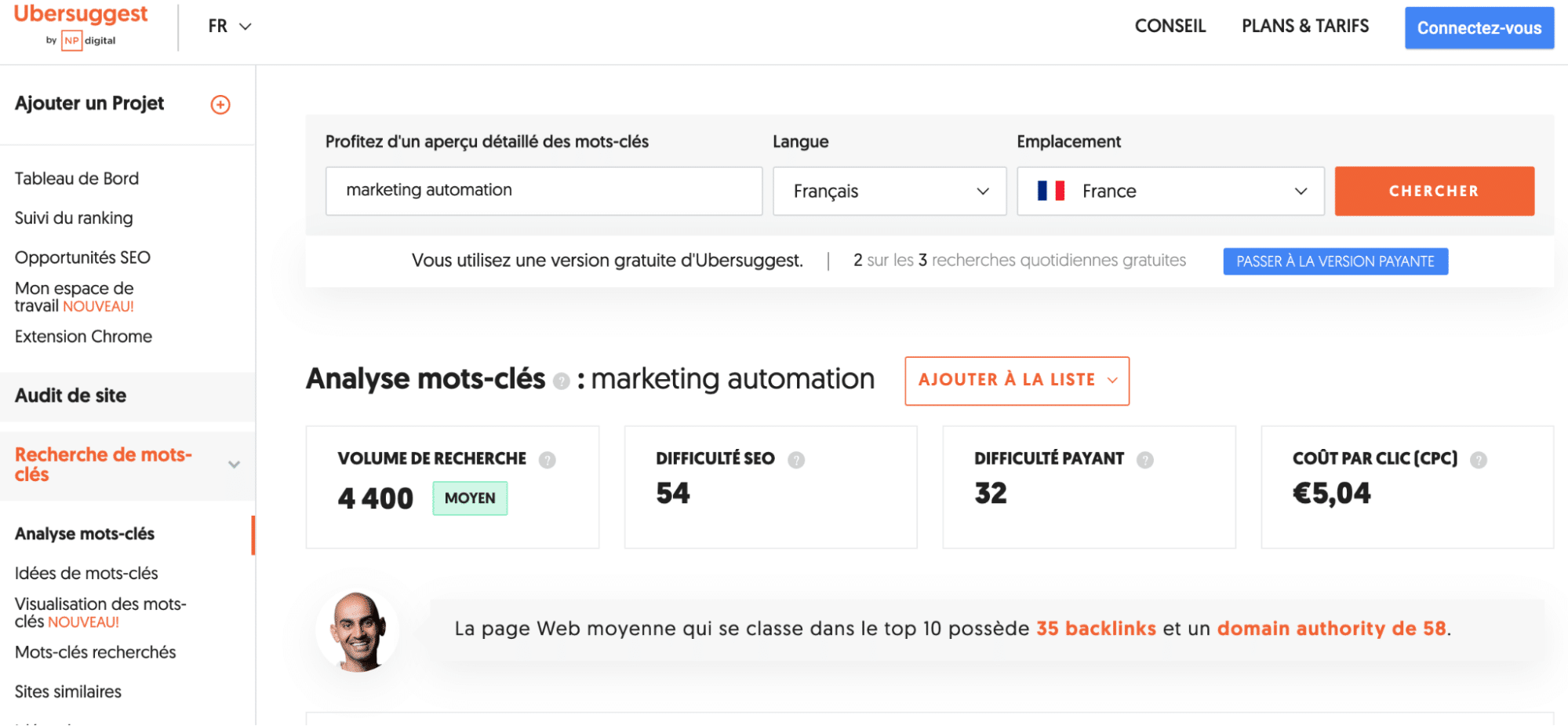
UberSuggest provides an overview of a keyword’s performance
For example, by typing the keyword “marketing automation,” UberSuggest tells us, among other things, its difficulty and search volume. It is by testing several keywords that you can see which ones perform best. Creating a list of keywords that are important for your business and testing them regularly will allow you to know the trends and see the developments in your field of expertise. These keywords should then be used in the titles, descriptions, and H1 and H2 tags of your content.
Create quality content
Content, content, content! Internet users are always looking for the most relevant and most recent content. Your website must therefore contain it! Creating high-quality content is essential for increasing organic traffic to your website.
Tip: reuse your content! To save time and climb a little in the SERP ranking, it is advisable to update aging articles by adding a new date or a new season to a text. For example, we titled one of our white papers: “Recycle your content to increase your profitability: 10 marketing automation ideas to test in 2023.”

In addition to the date, you can also work on local SEO. It corresponds to SEO specific to your location: your area, your region, your city, etc. Localizing your SEO is useful if you are a business owner, because it helps direct relevant traffic (local users) to your website. With local SEO, you inform search engines that you want to prioritize traffic coming from a specific place. This will allow people who are near you to find you online.
The structure and flow of your content are also important. Your content must be clear and easy to read! It is good to use headings, subheadings, and bullet points. This type of structure guides readers through your content and creates a good user experience.
And of course, this refreshed content will only improve your SEO if the keywords are present throughout your text. Your text should not be saturated with them, but the main and secondary keywords should appear frequently. This is at least as important as the relevance and usefulness of your text. You need to answer the user’s question to rank well!
Optimize tags
For search engines (and readers!) to better understand the content of the pages on your site, it is recommended to create very structured outlines, as we learned in middle school a very long time ago. ?
To help you, and because it improves your SEO, use H1 and H2 tags for headings, available in all word processing software, from Microsoft Word to Pages, including Google Docs.
In your site’s back office (where you enter your content), ideally you should fill in as many tags as possible: the meta description, the header, the category, image tags, alt text, caption… The goal is to map your site in the smallest details to make life easier for search engines that examine everything.
Create internal links
Your netlinking strategy (internal and external linking) must be solid. These are the links scattered throughout your text that point either to pages on your site (internal links) or to pages on other sites (external links). Internal links are part of on-page SEO, and external links are part of off-page SEO.
Internal links: be careful to direct your readers to articles that belong to the same theme as your article, or to the same content cluster. If you write a cake recipe, it would be inappropriate to direct your reader to another of your recipes that has nothing to do with pastries, for example.
To discover how to improve external links, go a little further down ?
To improve your SEO, we therefore advise you to review your links and, of course, eliminate broken links or those that are no longer relevant.
But your content also lives outside your site, and it is also your mission—should you choose to accept it—to monitor and strengthen what is being said about you outside your site. Discover here how to improve your off-page SEO.
How to improve your off-page SEO?
Off-page SEO concerns what happens outside your site, namely: the external links to which you send your readers, what is being said about you (or your product) on social media or even in the press, and customer reviews. These elements must be monitored carefully. If they are strengthened, it’s all upside for you, and it is then an opportunity to improve your positioning and branding to attract more customers.
In short: off-page SEO is the process of building links and promoting your site outside the content of your current site. The more your site is linked to other sites, the better.
So what are the benefits of off-page SEO?
- Increased traffic to your website
- High domain authority
- Better credibility
- Higher page rank
- Increased brand awareness
Not bad, right? Four points to know if you want to perform: create external links, share on social media, monitor reviews, and join an SEO platform.
Create external links
As discussed earlier, external links are part of off-page SEO. Like internal links (belonging to on-page SEO), they are also distributed throughout your texts, but this time they point to different sites that must have demonstrated their authority.
External links must direct your visitors to reliable sites that have a certain authority and credibility. When you mention a study and want to cite the source, for example, make sure you link to the site that conducted the study and not to a site that, like you, has only relayed the study. You can also exchange links with partner sites, which will strengthen your netlinking strategy.
To know a site’s authority, you simply need to see whether it is well positioned on Google when you type its domain name into the search bar. To go further and discover more precise statistics, use UberSuggest again. In addition to revealing domain authority, this tool also indicates, if the site ranks in the top 10, the number of referring domains it has and the number of backlinks.
Share on social media
Your site’s social media are part of off-page SEO and can be worked on to improve your overall positioning on Google. It is recommended to promote your website content on social media to improve page visibility and attract more traffic. Sharing your content on social media creates new links to your pages and helps generate backlinks.
Monitor reviews
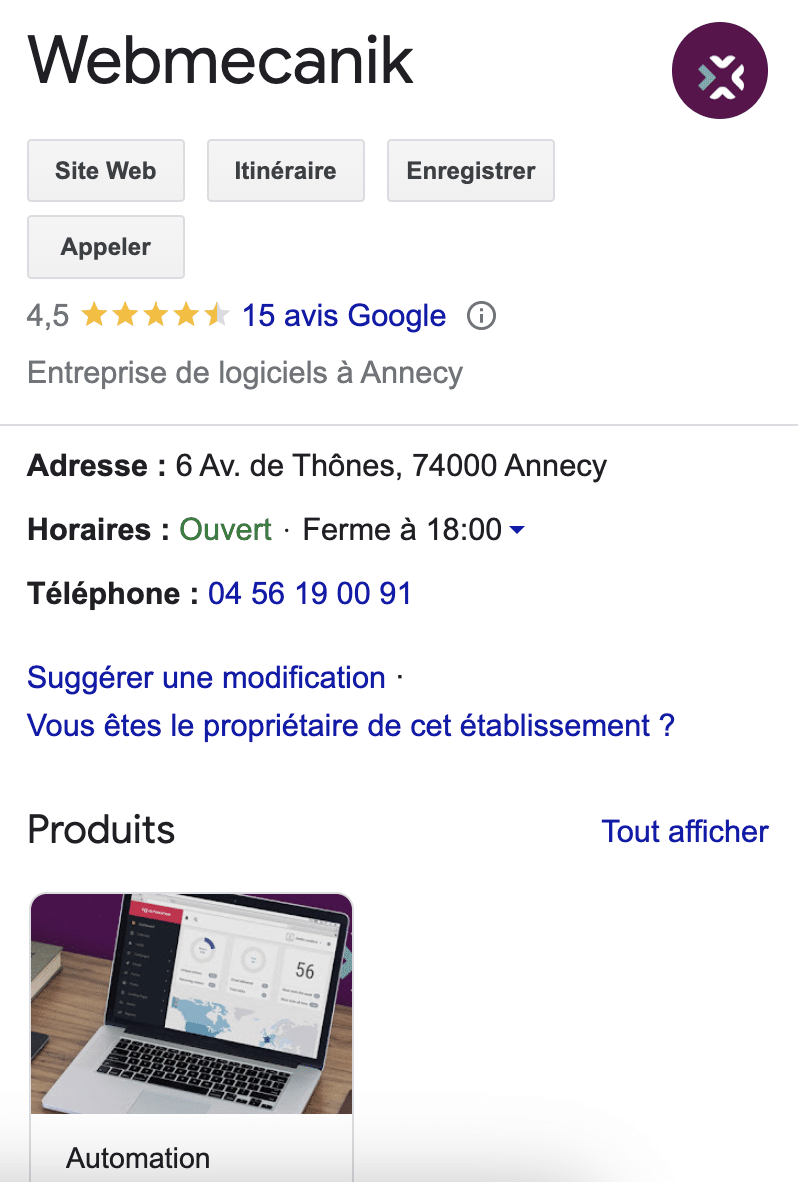
Often forgotten, sites that compile reviews are nevertheless essential to monitor in order to increase your visibility. The first of these? Google My Business! As a goods or services company, it is important to respond whenever there are positive or negative reviews on all the sites where you are listed.
Join an SEO platform
Do you know SEO platforms ? They are essential for analyzing and improving your SEO. These software solutions gather all your site’s statistics and allow you to visualize your successes and areas for improvement. Among them are SERanking, Semji, or Ahrefs. Many comparisons of SEO software are available all over the web. We advise you to study them to choose the tool that best suits your needs.
How can I further increase my company’s online visibility?
Properly and successfully implementing SEO is hard work. All the research, time, and reporting dedicated to it may require the services of experts in the field. If you want more online visibility than you currently have, or if you want to give your company a boost, joining an SEO platform can help you achieve these goals.
What is the purpose of a matching platform?
A matching platform connects professionals with their target clients. For example, if you are an accountant in Toulouse specializing in tax, and you join a matching platform, people in Toulouse looking for an accountant with tax expertise will find you!
A matching platform excels in SEO, and its main goal is to improve the search engine ranking of the professionals who use the platform. Matchmaking SEO platforms implement digital marketing and content creation strategies that also help professionals receive better online visibility and gain more clients.
If you are an accounting professional, a lawyer, an architect, a builder, or if you have your own agency, take a look at the Welink matching platform. Its ultimate goal is to help small business owners acquire more clients and increase their visibility.
Let us now move on to the submerged part of the iceberg that is technical SEO. It is essential for a good user experience and matters greatly to Google and the other SERPs. Here is a review of the points you absolutely must take into account to improve your SEO.
How to improve your technical SEO
Optimize loading speed
Technical SEO consists of improving the technical structure of your website. This means improving loading speed on mobile as well as on desktop computers.
Mobile optimization, crawlability (so that crawlers can browse your site without encountering broken links or dead ends), security, indexing… All these elements are essential for good technical SEO.
Tools like Google PageSpeed Insights allow you to test the loading speed of your pages. We also advise you to work on optimizing images and code to increase this speed! ?
Use structured data
Structuring your data allows search engines to better understand page content and improve the visibility of web pages. The Screaming Frog tool helps you see more clearly and identify your site’s map so you can make the necessary changes. Sites like Gloo Maps make it possible to create useful tree structures to help you find your way around.
Analyze your performance
After all this improvement work, let’s move on to analyzing your efforts! Track your website’s performance to identify optimization opportunities: traffic generation, time spent on your pages, number of links, etc. By creating an SEO report, you will be able to track your progress.
So how do you create an SEO report and how do you use it? SEO reports are a way to track your website’s SEO performance. It may be a summary of its overall SEO performance, or an SEO report used to focus on an observable result. For example, how many clicks a video you published on your site’s home page received, or how many users were directed to it organically through a keyword search.
What should the SEO report contain? The goal of SEO reports is to see which marketing strategies are effective and which need to be improved. You want to know what works and what doesn’t!
SEO reports analyze these aspects and more:
Behavior: This refers to the time users spend on your site and the depth of their browsing. Did a user visit your home page? Did they spend two minutes there and then leave the site? Knowing these types of behaviors allows you to adapt your website to make it higher-performing, more relevant, or more user-friendly.
Website traffic: Do most of your visitors come from Google searches, social media, or links from other websites? It is good to know where your visitors come from. If people are often directed to your website from Facebook, for example, but not as much from a Google search, you have the opportunity to improve your keywords on Google.
Backlinks: they increase traffic to your website. It is important to track the backlinks that users find and click on the most. Backlink health plays a role in your SEO performance. You want to make sure that websites containing a link to your site are trustworthy and safe.
What are the most useful SEO reporting tools? There are many tools for creating SEO reports. You will therefore need to do some research to discover those that best meet your needs and budget. We recommend two classics: Google Analytics & SEMrush.
Google Analytics is ideal for people who are new to SEO. Many of Google Analytics’ reporting features are free, such as real-time activity tracking, behavior capture, audience reporting, and marketing campaign tracking. A short, free, and essential video on how to use Google Analytics is also available online for everyone.
SEMrush is a powerful SEO reporting tool that covers everything from keyword research to campaign management. SEMrush offers several SEO plans at different prices. You will receive a complete SEO report in minutes, and reports can include content marketing metrics, advertising campaign results, social media effectiveness, keyword analysis, and more.
To conclude, SEO optimization is an ongoing process, and it is important to stay up to date on the latest trends and search engine algorithms in order to continue improving your website’s SEO.
If you want to develop your online visibility and get more clients, now is the time to take an interest in SEO, but also in other techniques such as marketing automation, which moreover goes hand in hand with SEO…