Digital League, an organization bringing together the digital community in Auvergne-Rhône-Alpes, invited Stéphane Couleaud, President of Webmecanik, on Wednesday March 29, 2023, to discuss employee retention in companies.
Surrounded by Mélissa Vallies (In Extenso), Servane Germain and Marilyne Longo (Malakoff Humanis), Stéphane Couleaud shared his feedback at this event, which took place at the Galiléo business incubator, in Chavanod near Annecy.
On the agenda? New HR challenges, financial levers to retain employees, and feedback. This talk, which started at 12 p.m., answered the questions of curious attendees who came to spend an enriching lunch break.
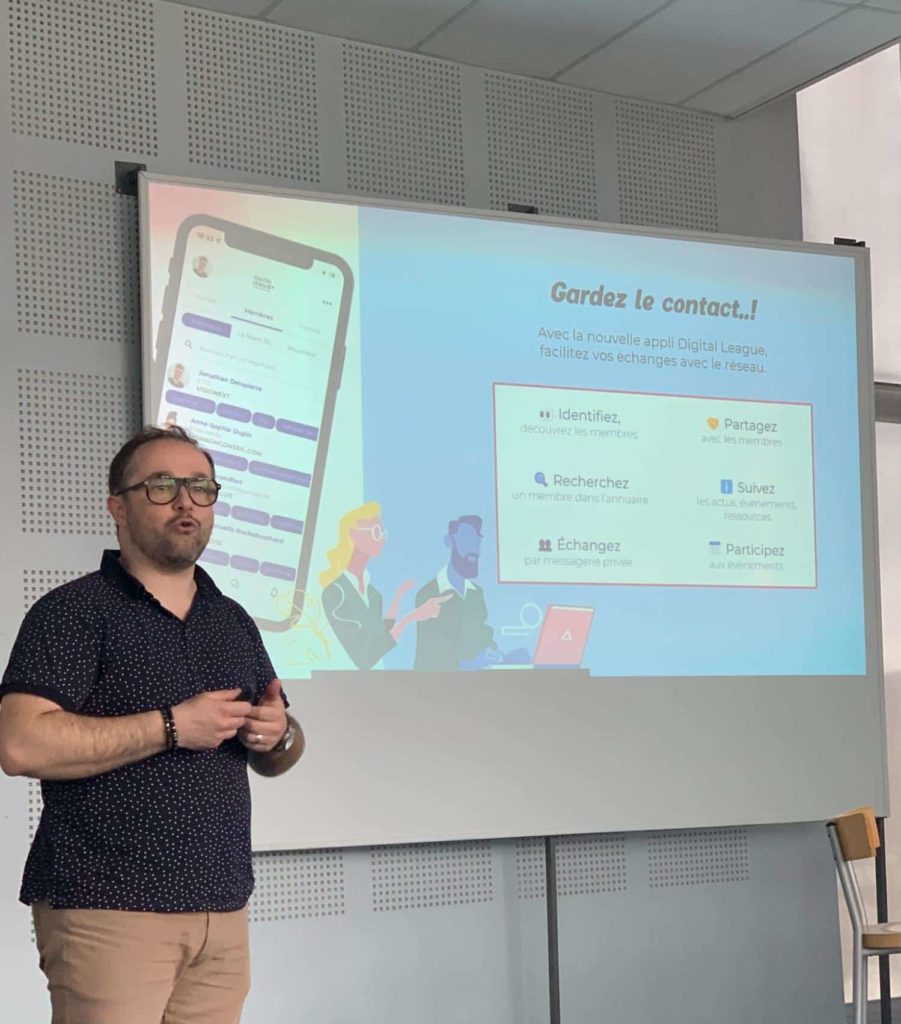
In Extenso gives you possible avenues
Director of the social business unit at accounting firm IN EXTENSO, Mélissa Vallies suggests several financial levers to put in place to support employees’ purchasing power, and not limit yourself to simple remuneration. The company must stand out and can commit to:
- a new bonus,
- an employee savings scheme,
- coverage of mileage allowances or mutual insurance beyond 50%,
- coverage of remote work expenses…
In terms of leisure, the company can also propose contributing to certain personal expenses to improve employee well-being by providing—even paying for—sports equipment for everyone, holiday or culture vouchers, and gifts and gift cards.
A contribution to personal services such as childcare costs is also a response to the needs of many employees, who will appreciate it and remain loyal to your team.
Finally, Mélissa Vallies recommends setting up an individualized social report, which allows the employee to see at a glance the salaries and benefits provided by the company each year.
The Malakoff study shows that employees have salary expectations
In the face of the “Great Resignation” that has been underway since the Covid-19 crisis and affects many sectors, Servane Germain and Marilyne Longo from Malakoff Humanis recommend strengthening young employees’ commitment by listening to them as much as possible.
According to the study conducted by Harris Interactive for Malakoff Humanis and cited during the event: 52% of employees say that their relationship with work has changed over the last 2 years, with expectations in terms of flexibility, but also expectations regarding salary and work-life balance.
The two speakers mentioned the 470,000 resignations from permanent contracts that took place at the end of 2021 and the beginning of 2022, and mainly concern young employees. The latter report a need for retraining, advancement, and rewarding pay. For HR teams, these new expectations are quite different from those of older employees. Indeed, young employees are particularly looking for favorable working conditions and an environment, as well as recognition and substantial professional development to continue progressing within the company.
For the two experts, the actions employees expect are: a good salary, a pleasant atmosphere, flexible work organization, and the possibility of working remotely. They also advise employers to get into the habit of congratulating employees and improving the onboarding of all employees: “Clearly, employees and companies are not really aligned. The financial element is very strong and it is important to survey employees. They need to be consulted; they are the key players in the company.”
Reduction in working time: the Webmecanik experience
Finally, Stéphane Couleaud joined the conversation by sharing his impressions after rethinking work organization in his company Webmecanik, the French publisher of Marketing Automation and CRM software.
Thanks to the implementation of the 4.5-day week and remote work, he observed better employee productivity and positive effects on the company: “This new organization came after the first lockdown. We had gained in productivity, even though control over employees had decreased. And it continued afterwards.”
Attentive to his employees, Stéphane Couleaud explained to the audience the ins and outs of this reorganization at Webmecanik: “We wanted to reward our employees and we offered to do so in three ways. Either through a financial bonus, through a material benefit, or through time savings. The majority chose the latter benefit, and more specifically an extension of the weekend. That is how it was decided to stop working on Friday afternoons. Nothing legally required us to do so. We had to work to make it possible, in terms of contracts, insurance… We also had to adapt on certain points. For example, our technical support must be reachable continuously. But we organize ourselves with a rotation system, so that these employees are not penalized. More than two years later, we can see the positive effects.”
Following this event organized by Digital League and thanks to these concrete solutions for retaining employees, digital players in the Auvergne Rhône-Alpes region will now have the opportunity to rethink their strategy and instill genuine well-being at work. In short, a new way to attract and retain their valuable talent.