

Marketing automation expert and CEO of Webmecanik, Stéphane Couleaud looks back at the major CRM and Marketing Automation trends that will shape 2023.
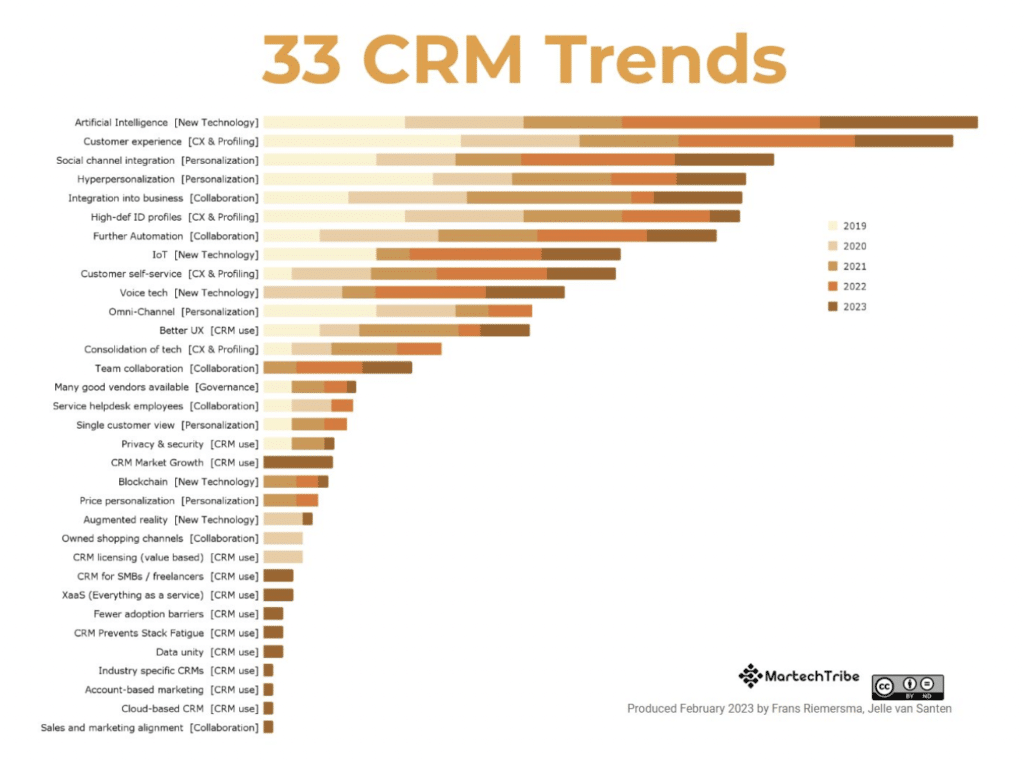
Frans Riemersma & Jelle Casper van Santen from Martech Tribe carried out remarkable analytical work based on reading trends through more than 117 articles published by analysts and gurus of Martech CRM (Customer Relationship Management) and Marketing Automation from 2019 to 2023.
They identified 36 trends for Marketing Automation and 33 for CRM.
With – the icing on the cake – a year-by-year evolution to detect what is just a passing fad (remember the Metaverse craze in 2022), and what is a genuine long-term trend that endures, or even intensifies.
I offer you an exegesis of Martech Tribe’s findings, along with a very personal conclusion.
The 4 CRM & Marketing Automation trends
Personalization: the strongest Marketing Automation trend
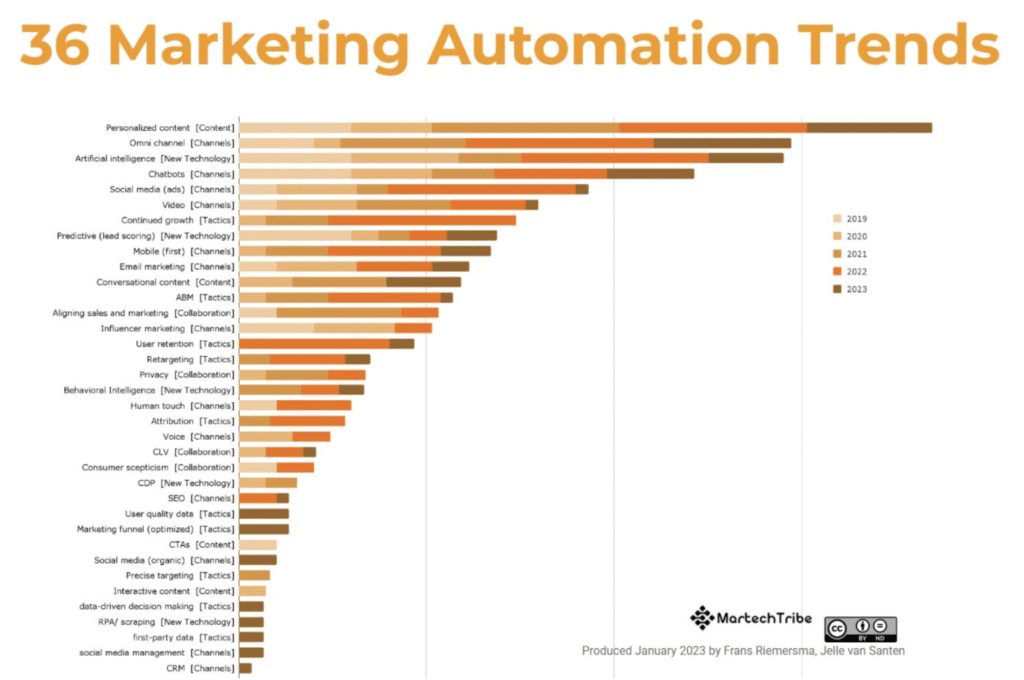
Personalized content continues to be the strongest trend in the use of Marketing Automation platforms.
To drive business growth, marketing departments face several challenges in terms of content personalization on SaaS Marketing Automation platforms. The goal is to create highly targeted and personalized content that reaches a qualified audience among their customers and prospects.
- Defining the right strategy means sharing relevant personalized experiences for personas or target audiences, while ensuring alignment with overall marketing objectives. Easy when you are a startup, more complicated for a matrix-based large group present on 5 continents.
- Personalized content means that the data I have in my ERP- or CRM-type software must be accurate, reliable, and up to date. There is nothing worse than personalizing fields with incorrect data, such as calling David by another first name, or worse, data that has nothing to do with him, such as his company (“Dear Nestlé …”), or even an empty field. Finally, the segmentation and scoring associated with a contact must also be relevant in order to send the right content to the right person, but above all at the right time in the buying cycle or customer journey. Here too, sending an onboarding scenario to a prospect who is discovering your first white paper would be just as inappropriate as offering a demo appointment to a customer who has been loyal for years.
- The choice of the right SaaS Marketing Automation platform guarantees the success of your content personalization strategy. The platform must have a highly customizable email and landing page builder, real-time dynamic segments, the ability to score and remove points based on behavioral elements but also on the CRM (a prospect becomes a customer), and forms with auto-completion or progressive profiling (I only ask for the information I need and/or am missing).
- Measuring the success of your content personalization strategy through metrics is crucial to ensure that you are getting the desired results. Define clear, measurable, and useful metrics or KPIs (key performance indicators) tailored to your business. Beware of vanity metrics!
- the engagement rate of people who interact with your content by clicking links, sharing content, or commenting on posts,
- the conversion rate such as filling out a form, making a purchase, or subscribing to a newsletter,
- the average time spent on a page measures the relevance of your content to your audience,
- return on investment (ROI) takes into account the revenue generated by the content versus the cost of producing and distributing it,
- measuring customer satisfaction to understand which personalized content correctly meets your audience’s needs.
Multichannel: the holy grail of marketing
Managing multichannel remains the holy grail of marketing, and its orchestration is the key to success.
Each channel has its own strengths and limits. A multichannel marketing strategy may consist of (non-exhaustive list) chatbots, social networks, videos, mobile apps, email and SMS, print, or even voice.
The first challenge, here again, is aligning them with your overall marketing objectives, measuring them, and carrying out iterative analyses.
The second challenge is maintaining a unified brand voice that is consistent across all channels and reflects your brand values.
- Chatbots are an effective way to engage in dialogue with customers and answer their questions in real time. Use chatbots to automate customer service tasks and provide personalized recommendations based on customer data.
- Social media platforms offer a range of tools and features to interact with your audience. Use social networks to share relevant content, launch promotions, and interact with your customers. Choose the most relevant platforms for your target audience and focus your efforts there.
- Video is a highly engaging and shareable format used to promote products, showcase features, and tell stories. Create videos optimized for different channels, such as social networks, emails, and mobile, and use them to communicate your message across multiple touchpoints.
- Mobile devices are now the main way to access the Internet. Make sure that your website, your emails, and any other content are optimized for mobile devices, and consider creating mobile applications or mobile-specific content to engage with your audience while on the go.
- Email marketing remains the main tool because of its power to nurture prospects and generate conversions. Segment your audience to send targeted messages that resonate with each group.
- While we are now overwhelmed by digital, print is (once again) becoming an excellent communication tool that remains firmly anchored in consumers’ memories. On condition that it is combined with the behavioral tracking of marketing automation, which makes it possible to extend the customer experience into the real world. After using a configurator (automotive, real estate, machine tools), send a printed brochure of the car model or apartment that was configured (add a few forgotten options!). When you have important corporate information or the launch of a new product, send a personalized postcard to your current customers. Discover the offer for sending printed mail integrated with marketing automation with La Poste and Webmecanik.
- Voice assistants allow interaction through the creation of customer service or voice-ordering capabilities. Click-to-call is used as a quick and effective CTA to be called back and obtain personalized information rapidly. In particular by insurers and in e-commerce, combined with a high-performing and well-trained call center.
Use API technology – or Zapier in no-code mode – to connect channels and create a seamless customer experience. For example, use data collected on social networks to enrich your email marketing campaigns or use chatbots or popups to provide a consistent customer service experience across different channels.
Create a content calendar: create a content calendar that outlines the content and messaging for each channel. This will ensure that your message is consistent and coordinated across different channels.
Conversational: enter generative AI, conversational content is on the rise! Enter generative AI?
Generative AI is useful for creating conversational content. One of the main advantages of generative AI is its ability to produce text that sounds natural and conversational, which makes it well suited to chatbots, virtual assistants, and other conversational interfaces.
For example, generative AI can be used to create personalized chatbot interactions that adapt to the user’s needs and preferences. This can help improve the user experience and increase engagement with the chatbot. In addition, generative AI can be used to generate responses to customer requests or support requests, thus reducing employees’ workload on repetitive questions and improving response times.
Generative AI is also used to create content for social media, blogs, and other digital platforms. By analyzing user data and trends, generative AI can produce relevant and engaging content that resonates with audiences. This can help companies and organizations reach a wider audience and strengthen their online presence. However, it is important to make sure that the resulting content is accurate and matches your editorial guidelines. Maintaining the consistency of your communication remains essential to the relationship of trust you maintain with your audience.
Many other applications still largely remain to be invented for each business vertical and each customer journey touchpoint, notably for automatic translation of texts from one language to another, which facilitates communication between people beyond language barriers. Or speech recognition to transcribe and analyze speech, making it possible to understand and respond to voice commands and requests directly through an ecommerce site or an administrative service.
Be careful not to give sensitive information from your company and your customers to a platform like ChatGPT (Microsoft) or BERT (Google).
Data: what’s new in 2023
Data is the newcomer in 2023! Discover data quality, data-driven decision-making, and first-party data.
Reconciling data quality, data-driven decision-making, and first-party data allows you to make informed decisions based on reliable and accurate data. It is also an essential raw material for your company’s independence and for understanding your customers’ needs.
Establishing data quality standards is the first step. This involves defining what good data looks like, how it should be collected, and how it should be analyzed. In short, establishing a process that excludes the integration of data whose origin is unknown and whose content is not under control.
Then collecting first-party data is essential. First-party data is information collected directly from your customers or your audience, without an intermediary. This data is more reliable and accurate than third-party data because it comes directly from a source you control.
To make informed decisions, data analysis tools help you identify patterns, trends, and useful insights. Be careful not to pass this highly confidential data on to your competitors. To do this, there are several open-source alternatives to Google Analytics that offer similar features and capabilities:
- Matomo (formerly known as Piwik) is a free and open-source web analytics platform that provides real-time insights into website traffic and user behavior. It offers many of the same features as Google Analytics, such as page views, visits, bounce rates, and goal tracking.
- Open Web Analytics (OWA) provides detailed insights into website traffic and user behavior. It offers real-time tracking of page views, clicks, events, and conversions.
- AWStats is a free and open-source log file analyzer that provides detailed insights into website traffic and user behavior. It can be used to analyze web server logs and generate reports on page views, visits, visitors, etc.
Finally, ensuring data privacy and security includes implementing data protection measures, such as encryption and access controls, to protect against unauthorized access and data breaches.
Comprehensive hygiene around your data and the people who handle it gives you a head start over your competitors.
Technological changes during CRM and Marketing Automation deployment
Artificial intelligence, IoT and voice technology
IoT and voice technology are creating new opportunities for businesses and consumers. As these technologies evolve, we are seeing applications and new use cases emerge. Here is a quick overview of what each of these technologies offers and what to expect from them to improve CRM performance.
The IoT – Internet of Things – refers to the interconnected network of physical devices, vehicles, and other objects that are integrated with sensors, software, and network connectivity. These devices communicate with each other and with people, creating a vast data network that can be analyzed and used to improve efficiency and productivity. For a CRM, improving the customer experience is key, notably by providing real-time personalized recommendations based on past preferences recorded in the CRM and customer behavior analyzed by marketing automation solutions. For example, an IoT-compatible CRM system could send automatic notifications to customers when their favorite products are delivered to the warehouse again, without going through a series of manual entries or scans. Conversely, one can imagine updating contact profiles in the CRM with data about their movements and behaviors, in short, their “life pattern” or “life agenda”.
Voice technology is the use of speech recognition and natural language processing to create human-like interaction with computers and other devices. This technology is used by virtual assistants such as Amazon Alexa and Google Assistant, speech-to-text transcription services such as Apple SIRI, and embedded navigation systems. Voice assistants combined with CRM data will probably provide customers with personalized recommendations based on their previous purchases or troubleshooting and support assistance for connected devices based on usage.
First-party cookies and CRM
The decision to abandon third-party cookies by web browser publishers – notably Google Chrome, which plans to disable them by the end of 2024 – has several consequences for businesses, advertisers, and consumers. Without third-party cookies, users will have more control over their online data and will be less vulnerable to tracking and data collection by third parties. This is part of a broader regulatory effort – such as the European GDPR, which is inspiring other regulations around the world – aimed at improving user privacy and data protection.
Third-party cookies are traditionally used by advertisers and marketers to track user behavior across the web and serve targeted ads. Without third-party cookies, businesses have limited access to this data and must rely on other methods, such as first-party data or contextual targeting, to deliver personalized experiences.
First-party cookies are created and controlled by the company’s website or application and provide valuable data on customer behavior and preferences. This data is raw material that CRM benefits from in order to create more accurate customer profiles and deliver personalized experiences.
Recommendations for products or services based on a customer’s previous purchases or browsing history are more effective; marketing campaigns are contextualized to a customer’s preferences in terms of language, currency, or shipping location, which facilitates overall accessibility to information, and ultimately the retention of contacts on content.
The three benefits of integrating CRM and marketing automation solutions
A highly advanced integration of SaaS CRM and Marketing Automation solutions, in “Best-of-Breed” or “all-in-One” mode, offers in my opinion several decisive advantages in such a complex marketing context.
Improved customer relationships
By keeping track of all customer interactions and data in a single data warehouse, your company will better manage the hygiene of its data, and your marketing and sales teams will better understand your customers’ needs and preferences.
Unified and streamlined sales and marketing processes
An all-in-one or strongly integrated solution helps you work with unified sales and marketing processes, from lead generation to customer loyalty. This results in a more effective and efficient sales and marketing team. And in improved performance in converting your leads into acquisitions, but also greater performance in cross-selling & up-selling across your existing customer base, which contributes to accelerating your Lifetime Value (LTV or total customer value). Through a centralized platform, sales teams and the marketing team will collaborate, share information, and coordinate efforts more effectively.
Optimized return on investment
By having a single marketing repository, you identify the most effective campaigns and your marketing teams will make better decisions based on your data and not on third-party data. With a highly integrated or all-in-one platform approach, your marketing can easily evolve to meet your new needs during your different growth stages (“startup”, “scale-up”) without requiring significant investment in additional infrastructure.