What is a communication channel?
The importance of communication channels in marketing
The main communication channels
How to use communication channels effectively?
What is a communication channel?
A communication channel is a means by which a company can convey messages to its customers or prospects. This can include various media, such as traditional media, digital media, or even word of mouth.
The importance of communication channels in marketing
As you already know, communication channels now play a crucial role in marketing. They enable companies to reach their target audience effectively and relevantly, by providing them with the appropriate information at the right time and in the most suitable way.
In a world where a multitude of communication channels are available, their use has become ubiquitous, whether in B2B or B2C. These channels are essential for implementing various marketing communication actions, such as prospecting campaigns or customer relationship management.
Given the variety of channels available, prospects and customers now need to choose the medium that suits them best for sending or receiving a message. This is why companies face a crucial challenge when choosing their communication channels. They do not simply choose a single channel for everyone, but select several communication channels to adapt them to the individual preferences of prospects or customers as well as to the specific objectives of each communication.
The main communication channels
Communication channels are varied; they can include media or non-media communication channels, as well as channels that are part of inbound or outbound marketing strategies.
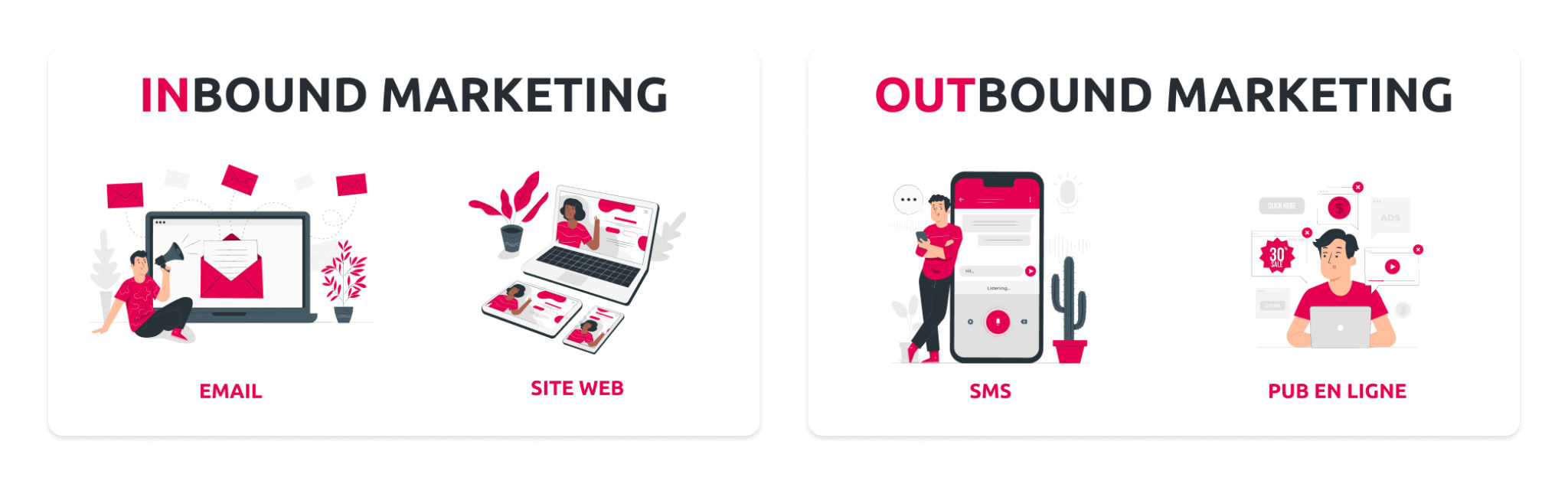
Channels related to inbound marketing strategies
Channels used for inbound marketing operations attract customers to a company, product, or service by providing valuable content, thus creating positive experiences. This includes email marketing, websites, blogs, landing pages, pop-ins, SMS, and influencer strategies.
Email marketing
Email marketing, including newsletters, remains one of the pillars of the communication channels used in marketing. It is the most widely used channel in the world. Thanks to marketing automation methods, email marketing makes it possible to further personalize email content and tailor each individual’s email journey, which helps increase conversion rates. To help you, we have created a page dedicated to email campaigns.
Websites
The website, meanwhile, is the showcase of your company. You showcase your products/services, your company, your employees and partners, etc. It is therefore important that it be polished at every level, that is, from a technical point of view but also in terms of user experience. In a way, your brand image is at stake.
SEO
SEO (Search Engine Optimization), or organic search, is essential for organically attracting prospects to your website. This involves optimizing your keywords for search engines, which improves your site’s ranking in search results and increases its visibility among your target audience.
The blog
The blog is a valuable tool for making yourself known organically. Indeed, thanks to SEO techniques integrated into your blog articles, you can improve your online visibility. In addition, by providing informative articles to your prospects, you position yourself as an expert in your field, thereby strengthening your credibility and authority with your audience.
Landing pages
Landing pages play a crucial role in converting visitors into leads or customers. They are specifically designed to capture visitors’ attention and encourage them to take a specific action, such as filling out a form or making a purchase. By offering relevant content and highlighting the benefits of your offer, landing pages can maximize the effectiveness of your marketing campaigns and significantly improve your conversion rates. Careful design, a clear message, and compelling calls to action are essential to ensure the success of your landing pages.
Pop-ins
Pop-ins are interactive elements that appear on a web page to draw visitors’ attention to a specific offer or action to be taken. By using pop-ins strategically, you can capture your visitors’ attention at the right moment and encourage them to take a desired action, such as subscribing to a newsletter, benefiting from a discount, or taking part in a survey. If you’re interested in the subject, read our pop-in marketing page
Social media
Social media plays an increasingly important role in companies’ communication strategy. Indeed, these platforms offer a unique way to engage directly with your target audience, share relevant content, and build a community around your brand. By interacting regularly with your followers on social media, you can strengthen your brand awareness, build audience loyalty, and generate qualified leads. The choice of social network depends on your personas and therefore on the platforms where your prospects and customers are. You will naturally choose LinkedIn if your targets are professionals and executives, and rather TikTok or Instagram if your targets are private individuals under 30.
As you have understood, the inbound marketing strategy is the preferred method for establishing an authentic relationship of trust with your prospects and customers. It encourages a gentler approach and generally generates more qualified leads, because they are the ones who show a natural interest in your products or services by coming to you.
Channels related to outbound marketing strategies
Outbound marketing channels are those that involve a proactive approach by the company to reach its target audience. Unlike inbound marketing, where customers come to you, outbound marketing consists of going to potential customers. These channels include advertisements on search engines or social media as well as SMS campaigns. Television could also be included in this category.
Although outbound marketing is often considered more intrusive than inbound marketing, it remains an essential element of any overall marketing strategy, making it possible to reach a wide audience and actively promote the company’s products or services. If you would like to learn more about the outbound marketing strategy, consult our dedicated article.
SMS
SMS is a fast and effective way to communicate with customers, by sending them special offers, appointment reminders, or important information. The advantage of this communication channel is that it offers a very high engagement rate. Indeed, mobile phones have become an essential part of our daily lives, so it is difficult to miss advertising messages. If this communication channel interests you, we recommend our page dedicated to SMS campaigns.
SEA
SEA (Search Engine Advertising) consists of displaying paid ads on search engines such as Google. This communication channel makes it possible to quickly reach a wide audience by targeting specific keywords. With SEA, you can increase your online visibility, generate qualified traffic, and effectively measure the performance of your ads.
Social Ads
As with websites and SEA, there are paid campaigns for social media that allow you to create ads to showcase your brand, product, service, event, etc. The advantage of this communication channel is that you can target by audience rather than by keyword.
Podcast / Radio
Podcasts and radio occupy a prominent place in today’s media landscape, offering a powerful communication channel for companies. These platforms make it possible to broadcast engaging audio content, reaching a wide audience and offering an immersive experience. Podcasts and radio thus offer the opportunity to share customer use cases by inviting them to share their experience, and to educate listeners while strengthening brand awareness.
How to use communication channels effectively?
For an effective marketing strategy, it is essential to wisely integrate and coordinate the use of different communication channels. This ensures a consistent experience for customers at every touchpoint with your company.
The right channel
Using the right communication channel is essential to effectively reach your target audience. Each channel has its own characteristics and advantages, and it is important to choose the one that best matches your message and your audience. For example, if you are targeting a young and active audience, social media may be the best choice for distributing your content. On the other hand, if you want to share detailed or professional information, an email or a blog article may be more appropriate.
By understanding the preferences and habits of your audience, you can select the most relevant channel to maximize the impact of your communication. And to go further, think about cross-channel: a contact may have different uses depending on the message and the moment.
At the right time
In addition to choosing the right channel, it is just as crucial to send your message at the right time. The effectiveness of your communication can vary depending on when your audience is most receptive. For example, if you send a promotional email late in the evening or during holidays, there is a strong chance that it will go unnoticed. On the other hand, by planning your campaigns so that they coincide with the times when your audience is most active and engaged, you considerably increase the chances that your message will be noticed and well received. An analysis of data and statistics can help you determine the best times to distribute your content and thus optimize the effectiveness of your communication. With Webmecanik Automation and its artificial intelligence, benefit from your emails being sent automatically at the best time to maximize your chances of conversion; that will already guarantee the best open rate.
In summary, communication channels in marketing offer a range of opportunities to effectively reach and engage your target audience. Whether through inbound or outbound strategies, it is crucial to select the right channels and use them at the right time to maximize the impact of your communication.
Inbound marketing, focused on creating valuable content and organic engagement, helps develop a trusting relationship with prospects and customers. At the same time, outbound marketing offers proactive solutions for reaching a wide audience and actively promoting your products or services.
By wisely integrating these different approaches into a marketing automation tool, you can create a consistent and memorable experience for your audience, thereby strengthening your presence in the market and driving your company’s growth.