

Are you implementing different strategies? Are you aware that their performance needs to be measured? You therefore use different performance indicators. KPIs are essential for your actions; they allow you to understand your strengths and the areas you need to optimize. Key performance indicators, also called KPIs (Key Performance Indicators), can be implemented continuously or in a specific way.
In what context should performance indicators be monitored?
The main types of performance indicators
How to choose the right performance indicators?
In what context should performance indicators be monitored?
Performance indicators play an essential role in a company’s overall strategy, particularly in marketing. They are essential for assessing the reach and effectiveness of the initiatives undertaken, whether in sales, marketing, production, finance, or management. KPIs make it possible to measure whether objectives are being achieved, refine processes, and make decisions.
Their regular monitoring makes it possible to collect relevant data, thus forming part of a continuous improvement effort that is essential to constantly improve company performance.
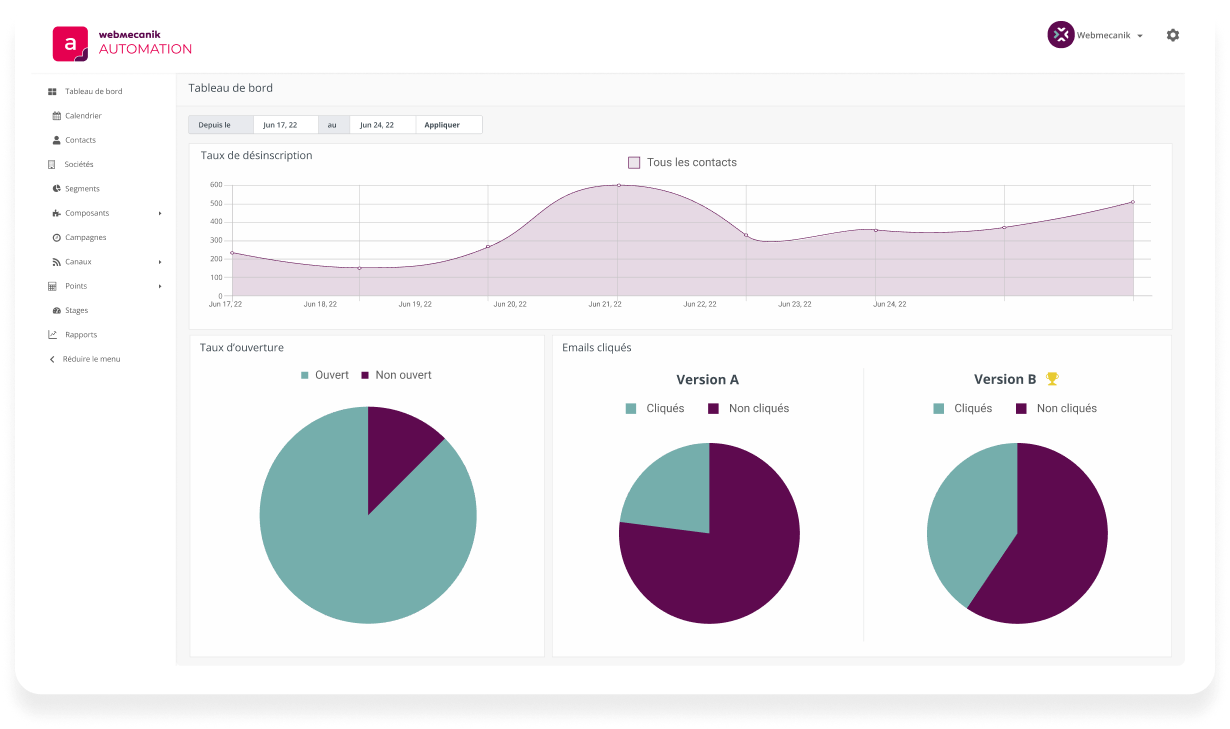
With Webmecanik Automation, monitoring and analysis of marketing KPIs are easily accessible via the dashboard. This offers a clear perspective on the effectiveness of your marketing automation campaigns. Indicators such as email open rate, click-through rate, and unsubscribe rate are carefully tracked to measure the impact of your marketing actions. In addition, features such as A/B testing are used to finely adjust content according to your audience’s preferences.
The main types of performance indicators
Performance indicators, or KPIs (Key Performance Indicators), are essential for measuring and improving the effectiveness of the various functions within a company. Here are some typical examples of KPIs grouped by category.
Indicators of marketing performance:
- Cost per acquisition (CPA): indicates the average cost to acquire a customer.
- Conversion rate: the proportion of visitors who complete a defined action.
- Cost per lead (CPL): the average cost to acquire a prospect.
- Marketing ROI: return on investment from marketing campaigns.
- Click-through rate (CTR): percentage of people who click on a link relative to the total number of views.
- Bounce rate: percentage of visitors who leave the site after viewing only one page, without interacting.
- Impression rate: measure of the extent of exposure of the content you publish.
Website performance indicators
- Number of unique visitors : number of different people who visited the site.
- Average session duration: average time spent on the site during a visit.
- Pages per session: average number of pages viewed per visit.
- Traffic sources: source of site visitors, visible in particular through UTMs.
Social media performance indicators
- Engagement (likes, shares, comments): measure of user interactions.
- Community growth: increase in the number of followers or subscribers.
Email performance indicators
- Open rate: percentage of recipients who open a sent email.
- Click-through rate (CTR): percentage of recipients who clicked on one or more links in the email.
- Conversion rate: The percentage of recipients who completed a desired action (purchase, sign-up, download, etc.) after clicking on a link in the email.
- Unsubscribe rate: percentage of recipients who unsubscribe from your database after receiving an email.
- Bounce rate : percentage of emails that were not delivered to the recipient’s inbox. This may be due to an invalid email address.
Marketing KPIs are essential for marketing teams, product managers, and marketing directors. They use these indicators to measure and optimize the campaigns put in place. Sales teams can rely on these performance indicators to assess lead quality (MQL → SQL).
Sales performance indicators:
- Sales volume: number of products or services sold over a given period.
- Sales growth rate: increase in sales volume over a period compared with a previous period.
- Sales cycle duration: time required to close a sale from the first contact.
- Revenue (CA): total revenue generated.
- Number of sales : total number of transactions completed.
- Conversion rate : proportion of leads that become customers.
- Customer acquisition cost (CAC): average cost spent to acquire a new customer.
- Customer lifetime value (CLV): estimate of the revenue a customer will generate throughout their relationship with the company.
Sales performance indicators are used by sales teams and sales directors to measure and optimize the performance of sales activities.
These KPIs help evaluate sales objectives but also adjust the sales strategies put in place.
Financial performance indicators:
- Gross margin: revenue minus the cost of goods sold.
- Profitability: percentage of profit achieved relative to revenue.
- Return on investment (ROI): calculates the profit or loss generated by an investment, expressed as a percentage of the initial cost of the investment
Financial KPIs are mainly used by finance directors, accountants, and financial analysts. Thanks to these KPIs, they assess a company’s economic health. This data is often required by investors, lenders, and regulators to assess the company’s financial viability.
How to choose the right performance indicators?
You must choose the KPIs that are essential to your strategic objective. Different criteria are available to help you choose your KPIs, including relevance, reliability, simplicity, and also their ability to help teams (marketing and sales) make decisions.
You must align your objective with your performance indicators. Each KPI must be relevant to what you want to measure. How can you ensure that the KPIs you have chosen are relevant? The indicator must provide you with insight into what you have put in place, whether positive or negative. A KPI must be useful for the team that uses it and the people it is intended for.
The importance of KPIs
As explained above, KPIs are important for evaluating and analyzing the performance of your company’s various strategies. Each indicator must be carefully selected to align with your objectives. This data supports operational adjustments and contributes to continuous improvement. This point is essential to the company’s growth. Tools such as the dashboards in Webmecanik Automation or other software allow real-time monitoring and analysis. You will have, for example, visibility into the number of unique visitors, click-through rates, and conversion rates, etc. These features simplify the management of your campaigns and the measurement of their impact.