
Managing sales opportunities is a very important component of any company’s success. A sales opportunity represents sales potential that, if managed well, can turn into a loyal customer.
In this article, we will explore how to identify, track, and maximize sales opportunities to improve your sales performance. We will also look at how to use a CRM, develop prospecting and retention strategies, and effectively train your sales teams.
Understanding sales opportunities
3 steps to managing your sales opportunities
Understanding sales opportunities
Definition
A sales opportunity is an opportunity to sell a product or service to a potential customer. They are essential to business development because they are the foundation of sales growth and customer retention.
Identifying opportunities
Before anything else, you need to know how to properly identify and qualify the sales opportunities that come your way. To do this, it is important to know your market and target customers well.
Common techniques include analyzing customer needs, monitoring market trends, and using CRM tools to track interactions with prospects. A well-configured CRM centralizes all relevant information about your prospects, making them easier to identify and monitor.
Also identify the type of opportunity in front of you. A customer who may be ready for an upsell on your tool and a new lead who has barely heard of you are not the same thing and do not call for the same strategy.
3 steps to managing your sales opportunities
It is essential to manage sales opportunities well in order to convert prospects into customers and ensure the development of your business.
Organizing opportunities
Have a sales pipeline tailored to your business
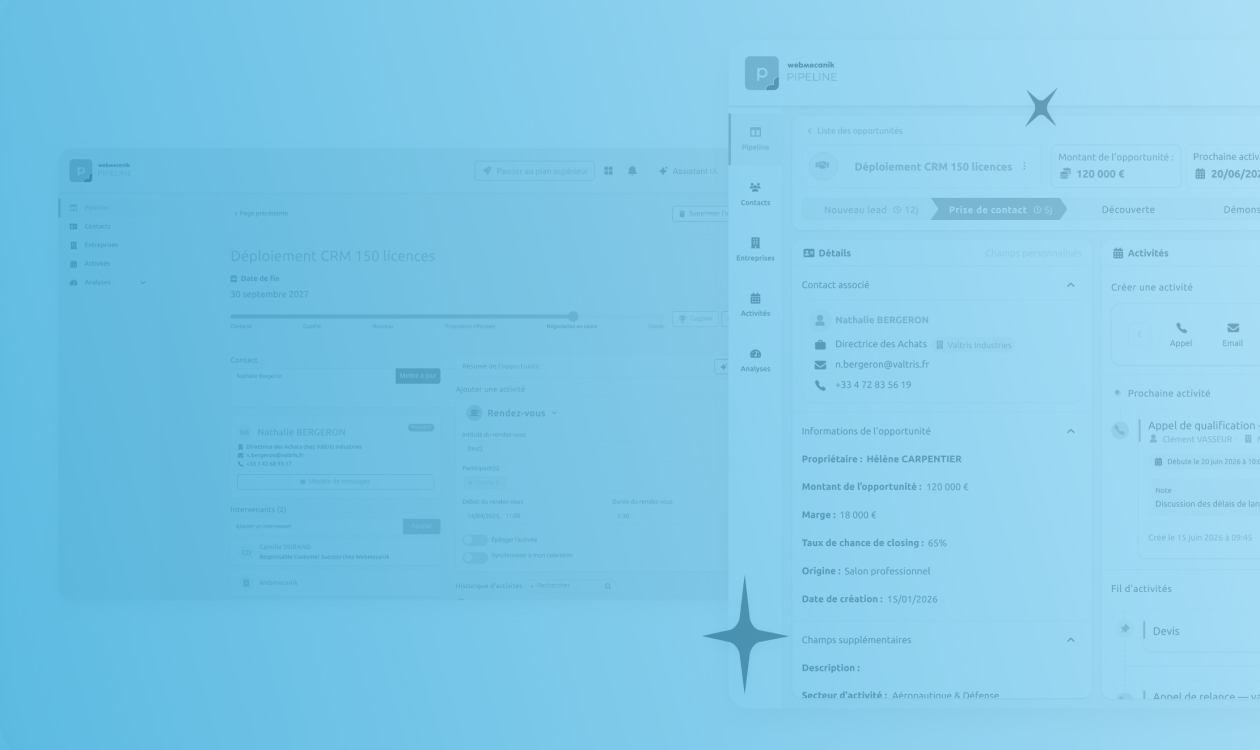
A sales pipeline is a visual representation of the stages your prospects go through before becoming customers. It is essential to create a sales pipeline that accurately reflects your company’s sales process. Start by defining the specific stages of the sales process, such as “Initial contact,” “Qualification,” “Proposal,” “Negotiation,” and “Closing.” Adapt these stages to the specific features of your industry and your products or services to ensure structured and clear opportunity management.
A well-defined pipeline makes it easier to manage priorities and resources, enabling your team to track the progress of each opportunity accurately.
To learn more, feel free to watch our dedicated video: How can you optimize your sales pipeline?
Enter as much information as possible about opportunities
It is essential to collect and record as much information as possible for effective opportunity management. The more data you have, the better you are able to understand your prospects’ needs and adapt your approaches. Be sure to record contact details, company details, prospects’ specific needs and obstacles, as well as the history of interactions. All this information should be grouped together in your CRM for easy access and updating. This in-depth knowledge of your prospects will allow you to personalize proposals and communications, which will increase your chances of closing sales.
Update your opportunities
Regularly updating opportunities in your CRM is essential to maintaining an accurate and current view of your sales pipeline. Update the information as soon as a new interaction takes place or new information is provided. Record any status change, such as moving from one stage to another or adding new information.
Use automatic reminders to make sure opportunities do not remain inactive for too long.
Up-to-date data ensures informed decision-making and allows you to respond quickly to changes, adjusting strategies accordingly.
Monitoring opportunities
Plan the next actions
It is essential to anticipate and plan the upcoming steps in order to maintain momentum and move opportunities toward closing. Create a schedule of actions to be taken for each opportunity, with precise dates and objectives. Rank actions in order of priority according to urgency and importance. Use CRM tools to schedule automatic reminders and alerts for each step. This structured planning keeps prospects engaged by avoiding periods of silence and improves the efficiency of sales teams by planning ahead.
Keep a history of interactions
Maintaining a complete and detailed history of interactions with each prospect is essential for effective follow-up. Document all communications, including phone calls, emails, meetings, and notes. Keep the entire history in the CRM, accessible to the whole sales team. Use this history to analyze interactions and adapt your approaches based on prospects’ responses and feedback.
A detailed history provides the necessary context for each interaction, even if different team members interact with the same prospect, and makes it possible to adjust and refine sales strategies based on past interactions.
Analysis and continuous optimization
Performance analysis
To improve your sales processes, regularly analyze the performance of your actions. Use analytics tools to assess the ROI of your campaigns and identify areas for improvement. Performance analysis involves examining key performance indicators (KPIs) such as the conversion rate, the time needed to close sales, and the average transaction value. By reviewing this data, you can identify trends, strengths, and weaknesses in your sales strategies. For example, a drop in the conversion rate could indicate the need to revise your sales pitch or improve prospect qualification.
Process optimization
Adapt your strategies based on the results obtained to maximize the effectiveness of your sales force. If a prospecting method does not generate the expected results, try a different approach. For example, if telephone prospecting does not produce enough leads, consider investing more in digital marketing or inbound marketing. Use customer feedback to understand their needs and adjust your offering accordingly. Feedback from your salespeople is also valuable for refining your sales techniques. They can provide insights into frequent customer objections and the aspects of your product or service that need more clarification. Continuous optimization relies on a feedback loop where data and feedback fuel constant improvements, thus ensuring continuous progress and ongoing adaptation of your sales methods.
Using a CRM
A CRM (Customer Relationship Management) system is essential for effective sales opportunity management. It allows you to track interactions with each prospect, maintain a history of communications, and plan the next steps in the sales process. CRM systems also help you forecast sales and analyze the opportunities managed by your teams. This allows you to manage an opportunity from its creation to its closing.
And by customizing your CRM to your business, it will reflect your sales processes and therefore be easier for your teams to use.
To learn more about customizing your CRM, watch our video:How to adapt your CRM to your business
Discover how Webmecanik Pipeline can support you in managing your sales opportunities.

Conclusion
Effectively managing sales opportunities involves rigorous organization and precise follow-up. By setting up a sales pipeline tailored to your needs, entering and regularly updating information about opportunities, and planning the next actions while keeping a detailed history of interactions, you can maximize your chances of turning prospects into loyal customers and ensuring your company’s growth. Use the CRM tools and practices described to structure and optimize your sales opportunity management processes