
Sales follow-up is the key to the success of any sales strategy. It helps turn prospects into loyal customers and maximize conversion opportunities. In this article, we will explore best practices, essential tools, and effective strategies for high-performing sales follow-up.
The importance of sales follow-up
How to implement effective sales follow-up?
Don’t forget after-sales service and customer loyalty
The importance of sales follow-up
Why is sales follow-up essential?
Sales follow-up is essential for building a relationship of trust with your prospects and customers. Regular follow-up helps create and maintain a strong connection, which is essential for strengthening customer relationships. In addition, it helps increase the conversion rate by keeping prospects interested throughout the sales process. By optimizing your resources, you can focus on the most promising prospects, thus maximizing the effectiveness of your sales team.
The consequences of poor sales follow-up
Poor sales follow-up can lead to certain consequences, such as losing prospects. Ignoring or neglecting prospects can quickly cause them to lose interest or push them to look for alternatives from your competitors. In addition, inadequate follow-up management can harm the perception of your brand, leaving a negative impression that could be difficult to reverse.
How to implement effective sales follow-up?
Take stock
Before implementing a new sales follow-up strategy, it is important to understand your current situation. Take stock of your organization and that of your salespeople to identify strengths as well as aspects to improve or eliminate. Here is a list of questions to guide your analysis:
- What are our sales follow-up objectives? Are they clear, specific, and measurable?
- How is our sales follow-up process currently structured? What tools and methods are used? Is the process clearly defined and documented?
- Which practices or tools have already proven effective?
- What are the weak points of our sales follow-up?
- Are there steps that take too much time or tasks that are often forgotten?
- Are we using a CRM and, if so, is it suited to our needs?
- Does the CRM make it easier to track leads and opportunities? Do the current features meet our expectations?
- How do we segment our prospects? Do we use relevant criteria for segmentation?
- Does our team collaborate effectively?
- What are the main expectations of our prospects and customers?
Set clear objectives
To ensure the success of your sales follow-up, it is necessary to define what you want for your prospects and determine the resources available to you. The key lies in setting precise, ambitious, and achievable objectives.
You have probably already heard of SMART objectives (Specific, Measurable, Achievable, Realistic, and Time-bound), but their effectiveness is undeniable. Setting SMART objectives helps you turn your aspirations into concrete actions.
For example, imagine that your objective is to increase your conversion rate by 15% in six months. To achieve this, you will need to implement targeted strategies, such as reducing the average lead follow-up time to just 24 hours. This means structuring your actions, optimizing your responsiveness, and maximizing your conversion opportunities.
With clear objectives and a detailed action plan, you will give your sales team the direction and motivation needed to excel. So, are you ready to take on the challenge and turn these objectives into tangible successes?
Find the right solutions
Once you have defined your objectives, the next question is fundamental: how are we going to achieve these sales follow-up objectives?
Use a CRM customizable to your business
To begin with, effective tracking of prospects and customers inevitably involves using a CRM. However, it is not simply a matter of having a CRM, but of having a CRM that can adapt precisely to your business. A well-chosen CRM can significantly transform your management of sales opportunities.
Here is how:
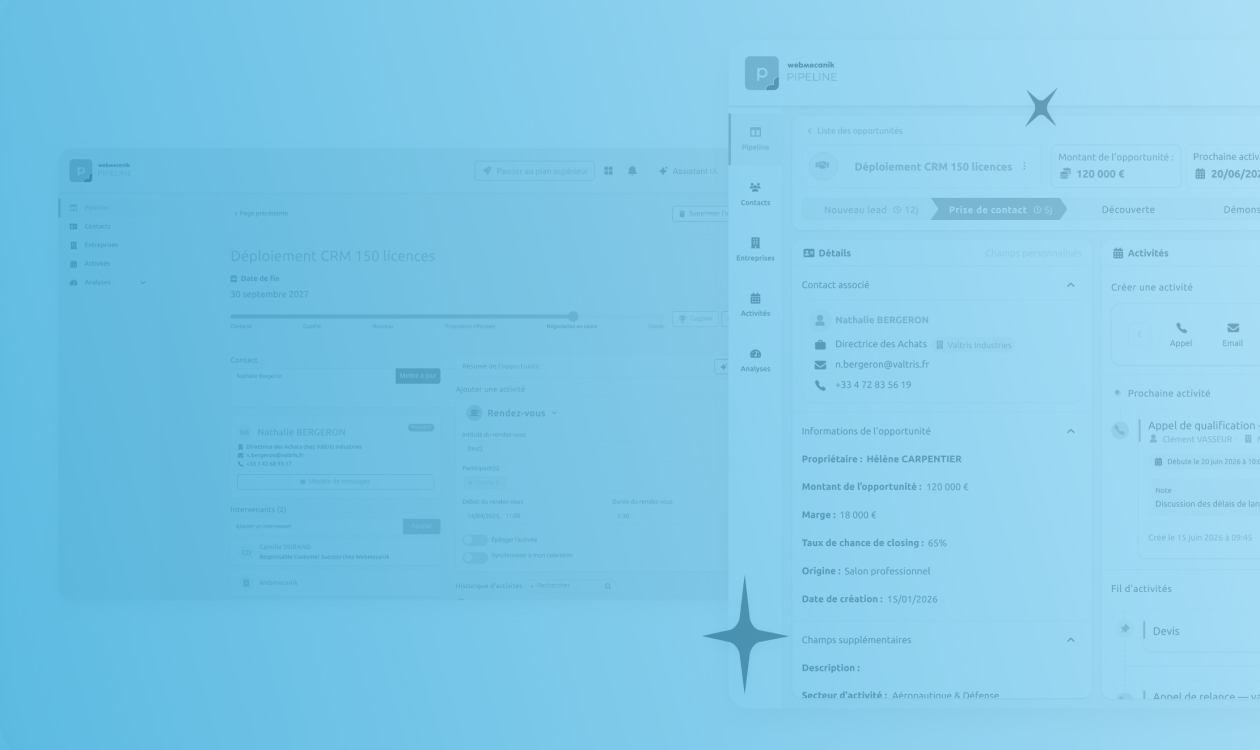
- Customizing the sales pipeline: add the specific stages of your sales funnel to your sales pipeline. This allows for more structured and effective sales follow-up, giving you a clear overall view of the status of your opportunities at any given time.
- Customizing contact and company records: use the CRM to collect as much information as possible about your prospects and customers. In particular, by integrating custom fields into your contact and company records, which allows salespeople to fill in all existing fields. Having as much information as possible will also help you segment your prospects according to relevant criteria.
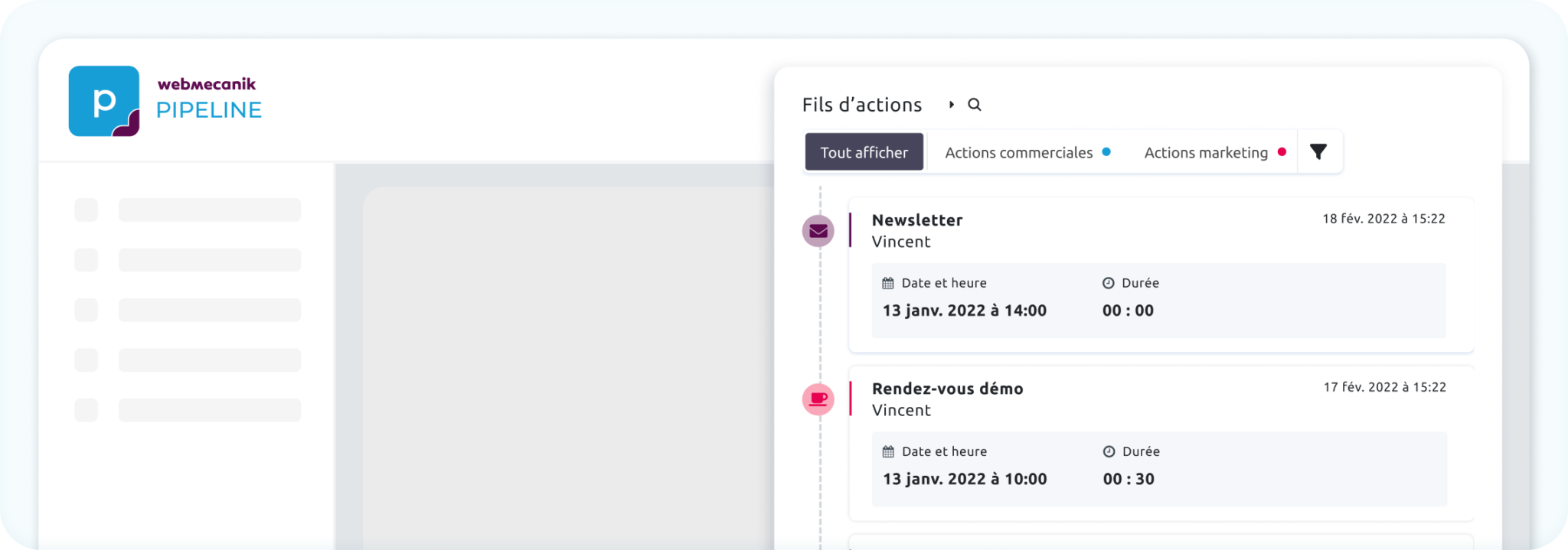
For example, you will be able to identify those who have an ongoing opportunity but do not yet have any activity scheduled, or those who have already had a won opportunity in the past. This segmentation makes it possible to personalize your sales actions and target your team’s efforts where they will have the most impact. - Activity tracking: integrate your different types of activities directly into the CRM software. This may seem trivial, but this feature saves your salespeople valuable time. They can add notes, schedule appointments, or record activities in just a few clicks, even when they are on the move. For example, if you are used to meeting your prospects over business lunches, you can easily add this type of activity to your CRM.
By fully leveraging the capabilities of your CRM, you enable your sales team to work more efficiently, focus on high-value tasks, and improve customer relationship management. Ultimately, this leads to increased conversions and better customer satisfaction.
Train your teams on the new methods
Once your new sales follow-up organization is in place, it is essential to train your teams so they develop the right reflexes. Organize regular training sessions to update their skills on the latest sales techniques and CRM tools. Make sure that each team member:
- Masters CRM tools: Train them to use all of Pipeline’s features to optimize lead follow-up. At Webmecanik Pipeline, e-learning training courses are included in your subscription to help salespeople use and fully understand the tool.
- Trains in sales techniques: Offer workshops on sales best practices, negotiation, and time management. These sessions are an opportunity to strengthen your team’s skills and prepare them for all situations.
- Stays up to date with market trends: Organize webinars and conferences so they stay informed about the latest trends and technologies. This will allow them to stay at the cutting edge and integrate best practices into their daily work.
Don’t forget after-sales service and customer loyalty
Sales follow-up should not be limited to the moment of sale. In fact, since 2019, customer experience has become a real competitive advantage for better satisfying consumers and building loyalty. Indeed, retaining a customer costs 5 to 10 times less than acquiring new prospects.
The 3 key benefits of after-sales follow-up:
- Making your sales and marketing investments pay off: the longer your customer lifetime, the more your sales and marketing investments pay off. A 5% increase in the retention rate can boost your profits by 25% to 95% (according to studies by Harvard Business School and Bain & Company). To maximize this profitability, it is essential to:
- Analyze customer behavior using your CRM data to understand your customers’ preferences and purchasing habits.
- Adapt your offers by proposing personalized promotions and offers to encourage loyalty.
- Turning your customers into brand ambassadors: loyal customers are the most likely to recommend your company to people around them. As a result, you benefit from the free advertising generated by your “ambassadors,” which reduces your customer acquisition cost.
- Leveraging the potential of Upselling and Cross-selling: thanks to loyalty, you can generate additional sales by increasing the average basket, purchase frequency, or by offering upgrades. A satisfied customer is more likely to make repeat purchases from the same brand. Indeed, the probability of selling to an existing customer is 60 to 70%, whereas the probability of selling to a prospect only rarely exceeds 5 to 20% (Source: White House Office of Consumer Affairs). To optimize this strategy, you can offer complementary products.
Even for after-sales service and retaining existing customers, good sales follow-up is essential! It will allow you to have all customer information and history and therefore adapt the message accordingly.
Conclusion
By following the steps above, you can establish effective sales follow-up that improves your conversion rates, optimizes your resources, and strengthens relationships with your customers. With tools like Webmecanik Pipeline, you have the features needed to make your sales follow-up strategy even more effective.
To learn more about how Webmecanik Pipeline can transform your sales follow-up, contact us for a free demo and start maximizing your sales opportunities today!