
Prospecting and lead follow-up are a key part of the sales process, and the effective use of message templates can turn your prospecting efforts into success. Message templates, available in certain CRMs such as Webmecanik Pipeline, allow sales reps to save time, ensure consistency in their messages, and optimize their response rates. Here are some tips and tricks to make the most of message templates in your sales prospecting.
The benefits of using message templates for sales prospecting
3 tips for creating high-performing message templates
Practical examples of using message templates in a CRM
What is a message template?
To begin, let us remind ourselves what a message template is in CRMs. A message template in CRMs (Customer Relationship Management) is a pre-designed format used to standardize and simplify communication with prospects or customers. These templates allow sales reps to save time by using reusable messages, while ensuring consistency and quality in communications.
The benefits of using message templates for sales prospecting
Using message templates in sales prospecting strategies offers many advantages, allowing sales reps to maximize their efficiency and improve their conversion rates. Here is a breakdown of the main advantages:
Time savings
One of the main advantages of message templates is the considerable time savings they offer. By using pre-established templates, sales reps can avoid repetitive writing. Rather than creating each prospecting message from scratch, sales reps can simply select a suitable template and customize it quickly. This eliminates the need to think through every message, which speeds up the communication process.
Consistency and quality
Message templates ensure consistency and quality of communication, which are essential for brand image and credibility.
- Message standardization: each message sent from a template follows a defined format and tone, thus ensuring uniformity in overall communication. This helps maintain a professional and consistent brand image.
- Reduction of errors: by using templates, the risks of typographical errors, grammar mistakes, or awkward wording are minimized. This reduces common errors and improves the perceived quality of messages.
Easy personalization
Despite their standardized nature, message templates can be easily customized for each prospect. Here is how CRMs facilitate this personalization:
- Integration of dynamic fields (or variables): CRMs allow dynamic fields to be inserted into message templates, such as the prospect’s name, the company name, or information specific to the prospect. This makes each message personalized and relevant, which increases the chances of a positive response. These variables come from your CRM and are automatically filled in with your contact’s information.
- Adaptation to context: templates can be adjusted according to the prospect’s context, such as their industry, needs, or specific pain points. For example, a template can be modified to include references to particular projects or problems that the prospect mentioned previously.
3 tips for creating high-performing message templates
To maximize the effectiveness of your message templates via a CRM for your sales prospecting, here are four essential tips:
Use dynamic fields for personalization
Integrating personalization fields or variables into your templates makes each message not only relevant, but also deeply personalized, thereby increasing your chances of getting a response. For example, you can insert fields for the prospect’s name, the company name, or information specific to their needs, history, or previous interactions with your company.
This personalization helps create a more authentic connection and shows the prospect that you have taken the time to understand their needs. Make sure your CRM data is always up to date so that these dynamic fields work properly and reflect accurate and current information.
Humanize your interactions
Even with message templates, it is essential to keep a human touch. Even if you are the one sending the email with the template of your choice, prospects need to feel and recognize your personal touch with almost the same intensity they would have felt during your meeting.
Include clear and relevant calls to action
One of the most important elements in your message templates for prospecting is having a well-defined call to action (CTA). It guides the prospect toward the next step to take, thereby increasing your chances of conversion. Use strong and specific action verbs, such as “Book a demo”, “Download our free guide”, “Contact us today”, to encourage the prospect to act. Position your CTA strategically, generally at the end of the message, so that it is easily visible and compelling.
Adapt to the situation
It is essential to adjust your message templates according to the situation. Whether it is for a first prospecting message, a recap after an initial meeting, or a message for sending a quote, your wording must be adapted. Create specific templates for each situation and, if possible, for different business sectors. Some sectors have their own jargon and communication preferences. For example, in the technology sector, it may be relevant to mention technical terms.
Adapting your message according to the situation and the sector not only improves the relevance of your messages, but also strengthens the trust and interest of your prospects.
Practical examples of using message templates in a CRM
Message templates in a CRM can support sales reps in various aspects of their work. Here are some practical examples illustrating the use of this feature:
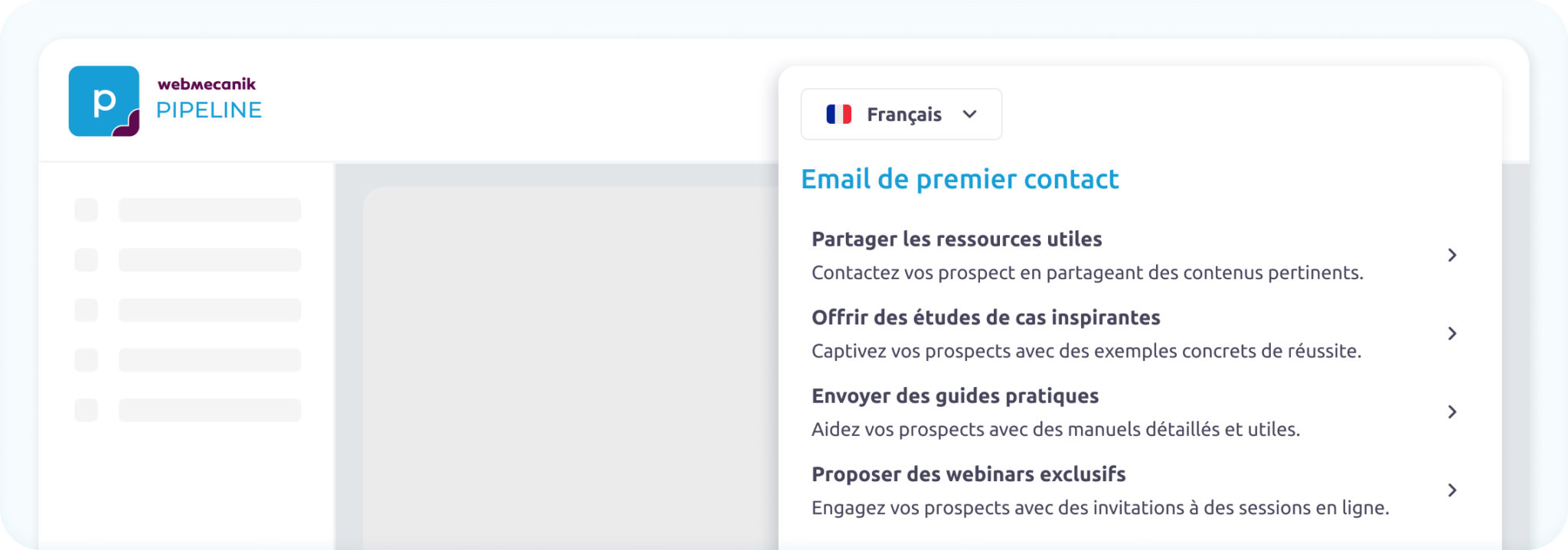
Email prospecting
Sales reps can use a predefined message template to contact a potential customer, but it is essential to personalize it. These first contacts are decisive. By adapting the content of prospecting messages to the specific characteristics of each prospect (industry, company size, interests), sales reps can make their communications more relevant and increase their chances of getting emails opened.
Follow-up after a meeting or a call
After a meeting or a call with a prospect, sales reps can use a predefined message template to send a personalized follow-up. This template is pre-filled with information about the discussion, the key points covered, and the agreed next steps. For example, the template can include sections to summarize the discussions, offer additional resources, or schedule a next meeting. This helps maintain contact with the prospect and move forward in the sales process smoothly.
Responding to inquiries
When a prospect submits a request via the company’s website, sales reps can use a message template to respond quickly and in a personalized way. This template includes relevant information about the requested products or services, as well as suggestions for scheduling a demonstration or a more in-depth discussion. For example, the template can be configured to include details about the specific requested products and links to additional resources. This ensures that the response is not only quick, but also useful and engaging.
Communication during the sales cycle
Throughout the sales cycle, sales reps can use message templates to communicate with prospects at key moments, such as appointment confirmation, follow-up after a product demonstration, or sending additional information. These templates are personalized according to the stage of the sales cycle, the prospect’s previous actions, and their individual needs. For example, a template can be designed to send a summary of the demonstration with links to additional resources or to remind them of the product’s key benefits. This personalization helps maintain the prospect’s interest and encourage their progression toward conversion.
Conclusion
By using these message templates strategically, sales reps can improve their efficiency while offering personalized and relevant interactions with prospects and customers. Message templates save time, strengthen message consistency, and increase conversion rates.
At Webmecanik Pipeline, we offer advanced tools and features to help you create and use effective message templates. Integrate these tips into your prospecting strategy and observe the improvement in your results.
Happy prospecting!