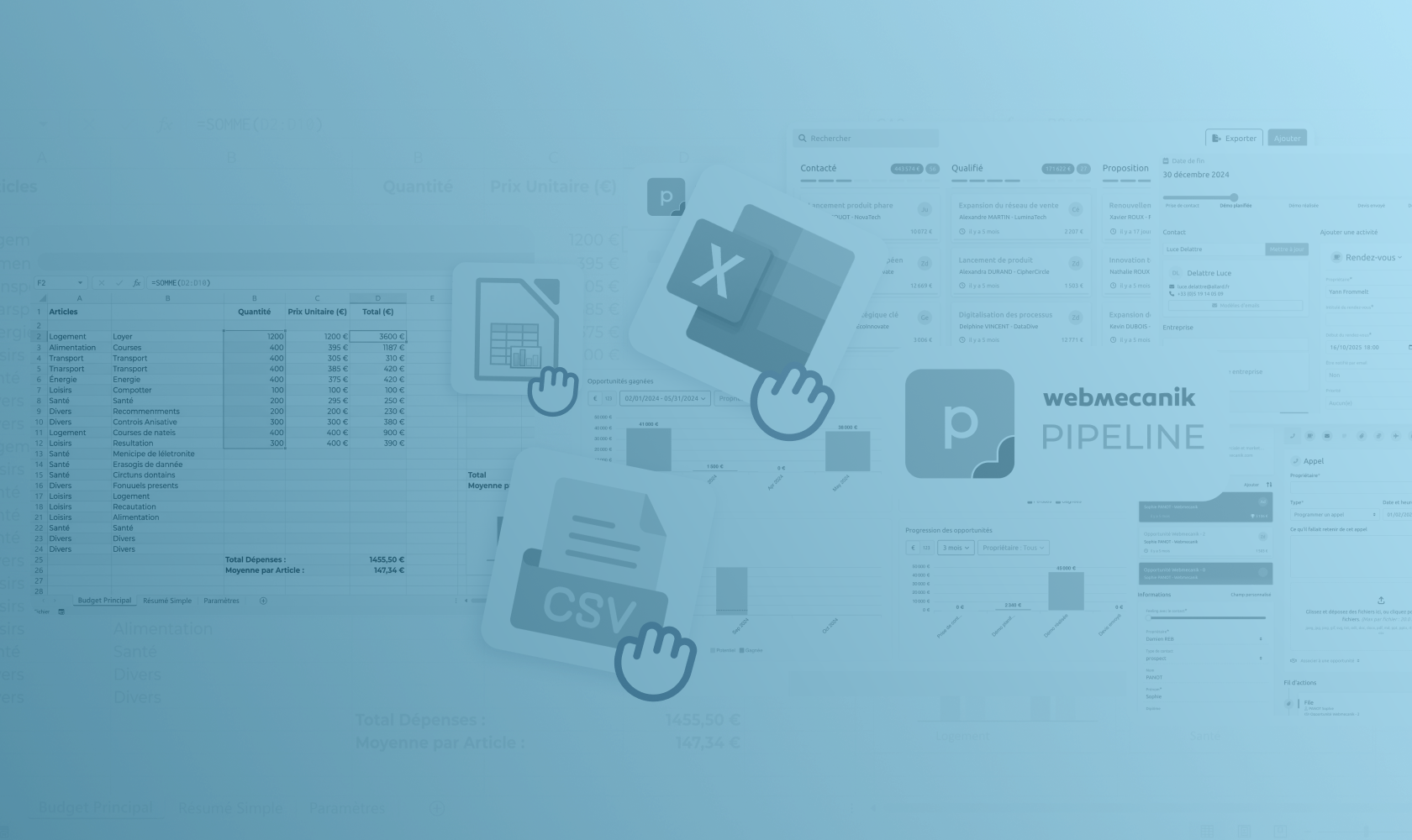

Replace an old fashion Excel spreadsheet by a sales pipeline, good or bad idea? Come on, who is still using Excel? So leave your Excel spreadsheets (it also works for Google Sheets, we saw you!) and build the new Rolls-Royce of your sales people on your brand new (and maybe even free) CRM solution.
Sales pipeline: what is it?
Definition
A sales pipeline is the path that a prospect takes to become a customer. This path, including all the key steps for the transformation of a contact into a customer, is essential to gain visibility on current opportunities, but also to better understand your market. By setting up a sales pipeline on a CRM software, you will have the necessary data to understand and know the expectations of your prospects, the qualities of your sales representatives and the points to improve.
Tips: don’t confuse sales pipeline and sales funnel. The former contains the sales offers, and the latter defines the steps through which the offers pass. They are related and parallel, but still different.

What is the purpose of your sales pipeline?
Your sales pipeline has several uses. For your sales people, it is a real must have to get organized: upcoming follow-ups, deals to be closed during the week, the month, etc. For managers, it is a tool to help to improve the efficiency of their team. It is also the right place to forecast the growth of the next few months. It is therefore the heart of your sales process, which has a real impact on customer’s relation.
Statistics
According to Harvard Business Review & InsideSales (2015 study), managing a sales pipeline brings 28% more of revenue and multiplies by 21 the chance to qualify a lead.
How to use your sales pipeline?
Tracking your projects
One of the most popular uses of a sales pipeline is project tracking. By looking at your pipeline, you will know at a glance the different opportunities in progress and where they are in the different stages of your sales cycle.
In other words, at each stage of your prospect’s life, he will move from one column to the next one for a visual and ultra practical rendering!
Prioritize opportunities
Once you have a global view of your opportunities, you can prioritize them. Contacting the prospect at the right time of their thinking is essential. The pipeline allows you to better understand your prospect’s standard path, to adapt and therefore act at the right time.
Understand the buying journey
We already talked about it, the buying journey is the key to your sales pipeline. It is both essential to build a sales pipeline and the pipeline is an opportunity to better understand the steps and appointments needed to convert a contact into a customer. Generally speaking, there are 5 stages to the customer journey:
1- The need recognition phase
2- The information search phase
3- The comparison/benchmark phase
4 – The decision phase
5- The loyalty phase
Tailor your actions
Prioritizing opportunities allows you to adapt your actions on an ad hoc basis. However, you can also draw generalities and conclusions to adapt your sales process more deeply and improve the customer relationship.
Build your sales pipeline
The right questions
- Which CRM solution?
Building a sales pipeline requires the implementation of a suitable CRM, which offers pipeline management functionality. Choosing a CRM is a crucial but complicated step, as the market for CRM solutions is so complete. Some are free, others are very expensive, some are very complete while others favor synchronization with other key software. You must t ask yourself the right questions, in particular :
- who will use the software?
- What features do you need?
- What software do you use on a daily basis that will integrate with your CRM?
- What is your budget?
- how do you manage your data, where are they stored, are you subject to the GDPR?
What steps?
In general, the main steps of a sales pipeline are
- Prospecting and qualified lead generation
This is the entry of contacts brought by several sources into the CRM. These are people who have been identified as potentially interested, but who have never been in contact with the sales team. However, if you have good marketing campaigns, you certainly already have a lot of information on these contacts.
- Qualification
Here, it gets a little more complex. This is the first contact, the first real sales action: call, appointment, etc. Behind this, the goal is to qualify a real need according to the BANT method. A commercial opportunity that deserves the time of your sales team.
- Evaluation
This is the most complex step, the most changing from one business to another. The idea is to collect all the answers to your questions that are useful to build a commercial proposal. It is a step that is useful to prepare beforehand so each sales person has a template of questions which are specific to your business. The objective is to create an adapted sales proposal.
- Commercial proposal
This step speaks for itself! You draw up a quote, a commercial proposal to present to the prospect.
- Closing
The signature, the purchase, the commitment, this time it’s concrete, it’s no longer a prospect but a customer!
- Loyalty
Last step, now that this customer is yours, keep him! Use marketing automation campaigns for example.
Tips: even if you are a real sales expert, chances are you won’t sign 100% of your prospects (I know, it hurts). Also include a column for lost leads that may deserve a follow-up in a few months.
The 3 key steps to build a pipeline
1) Gather the data
To begin a sales pipeline, start by gathering and segment your data. The prospects, customers, any information you may have about them (phone, email, but also company, position, meeting minutes, etc.). These details will have a place in your pipeline. Define, based on this, if it is not already done, the ideal prospect. This will be essential for the next step!
2) Identify the key steps
This is the most important moment: what steps do you implement in your pipeline? Be as precise as possible, as intuitive and general as possible so that the whole team can easily take it in hand and fill it in on a daily basis. To do this, define the inevitable points through which the business relationship passes before reaching its goal. These are often the key moments where you can also lose some qualified leads.
3) Keep your pipeline up to date
Now that you have a nice new sales pipeline, you need to bring it into life and analyze it! It’s essential that everything is filled in. If it is well-built , your team should quickly adopt it because it is a real time and energy saver! Define regular analysis points (month? quarter? year?) to readjust the steps of the pipe if necessary and to orient your support to the team.
You now know everything you need about creating a sales pipeline that works. The key to positive results is to keep it active, so mobilize your entire team for successful teamwork and increased results! So what conversion rate are we aiming for this year?