
As you probably already know, in B2B, every interaction counts! A good marketing workflow not only saves time, but above all turns interest into engagement… and then into sales. ? There are of course many workflows that can help turn these leads into customers: the classic sales workflow, the onboarding campaign, customer support, events, social media, a well-configured chatbot, or even an ambassador campaign. What if your campaigns could go even further? Imagine intelligent scenarios, capable of automatically adapting to each contact, at the most opportune moment. ? I’ll tell you more below!
Social media as a selling machine
The sales workflow
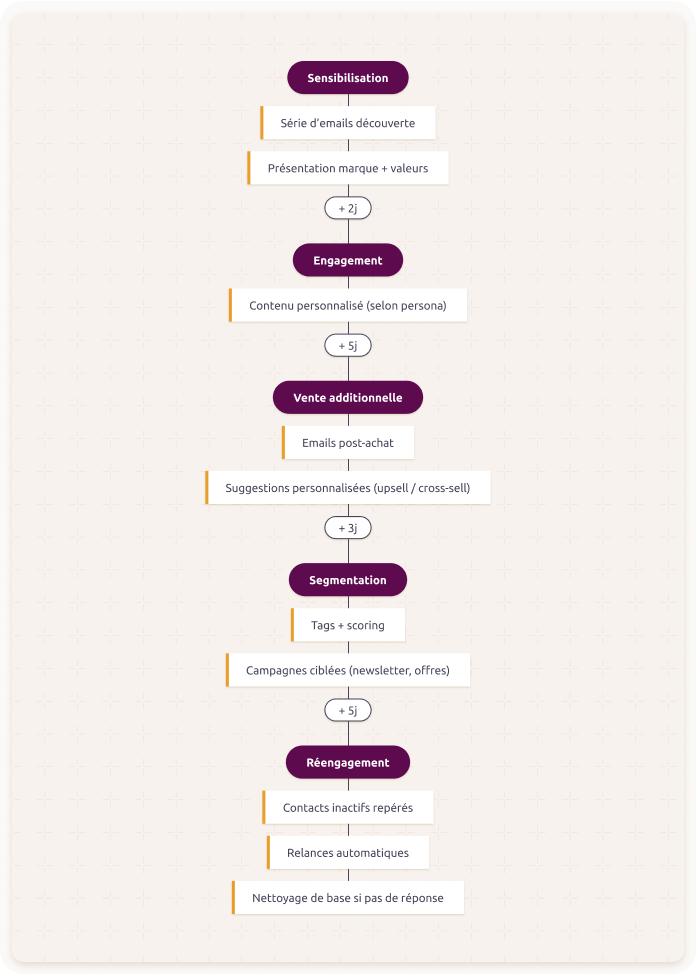
Selling effectively in B2B relies on a structured two-step strategy: the “selling machine” and the “invisible sales machine”. The selling machine includes your web pages, your marketing resources, your publications, etc. The hidden part (invisible sales machine) is your marketing automation tool. This is the tool that allows you to set up the 5 steps I’m going to present to you: awareness, engagement, upselling, segmentation, and finally re-engagement.
Phase 1 – Awareness
The goal here is to attract the prospect’s attention, present who you are, your values, and start building a relationship. You can use drip marketing, meaning a series of emails designed to introduce your brand.
Phase 2 – Engagement
This is where you will try to create interaction with your visitors. This phase helps prepare for the sale by offering personalized content based on the persona you are targeting. The length of this stage depends on the buying cycle, meaning that the higher the average basket value, the longer the phase lasts (to be adapted to your business sector, of course). The goal here is to help your prospect identify their need and see how you can meet it. The engagement phase serves as the foundation that leads to a sale.
Phase 3 – Additional sales (upsell / cross-sell)
Once the sale is completed, it’s time to increase your customer’s basket value. How? By creating a strategy in post-purchase emails, for example: suggestions for complementary products, premium offers, additional services… You can refine your suggestions based on behavioral data (product already purchased, viewed, etc.). Thanks to this information, you make more relevant recommendations and maximize your chances of additional purchases.
Phase 4 – Segmentation
As briefly mentioned in the previous phase, information about your contacts is valuable data. This data allows you to segment your contacts. Thanks to this segmentation, you can create “broadcast” campaigns. These are one-off sends such as a newsletter, a special offer, etc. It is more targeted than a standard automated sequence. The idea is to address each segment with a message tailored to its maturity level, needs, or profile.
To optimize your segmentation, use tags or even scoring. The goal of this phase is to offer the right content, to the right person, at the right time. ?
Phase 5 – Re-engagement
Not all your contacts will remain active all the time. Over time, some stop opening your emails or clicking on your content. That’s normal, but you shouldn’t ignore them. The re-engagement phase is used to identify inactive contacts and send them campaigns to re-engage them. And if that doesn’t work, you can remove them from your database. This allows you to keep a clean database, get better open rates, and avoid sending emails that will never be read. You can automate this step. For example, if a contact has not opened any email for 6 months and does not respond to two follow-ups, they can be moved to a separate list or deleted.
The onboarding campaign
Congratulations on this workflow: your lead has become a customer! But the experience is only just beginning. The onboarding scenario aims to support the customer’s first steps so they can quickly get value from your solution. This moment is key because it is often where the perception of whether the promise has been delivered… or not, is decided. ?
In B2B, onboarding is especially important for complex or SaaS solutions, with a trial period or subscription. It helps prevent abandonment linked to poor onboarding, strengthens loyalty, and reduces pressure on customer support. The objective is not only to deliver a product, but to make the customer competent and autonomous by offering them a smooth and personalized experience. This involves educational content, progressive follow-up, and human interactions to reassure them.
The customer support campaign
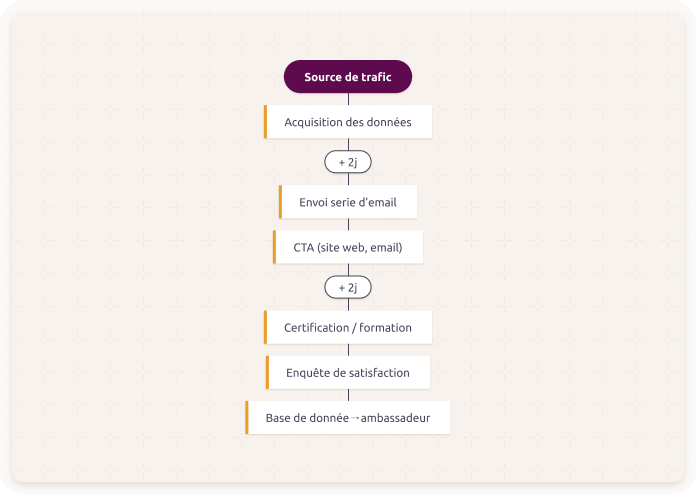
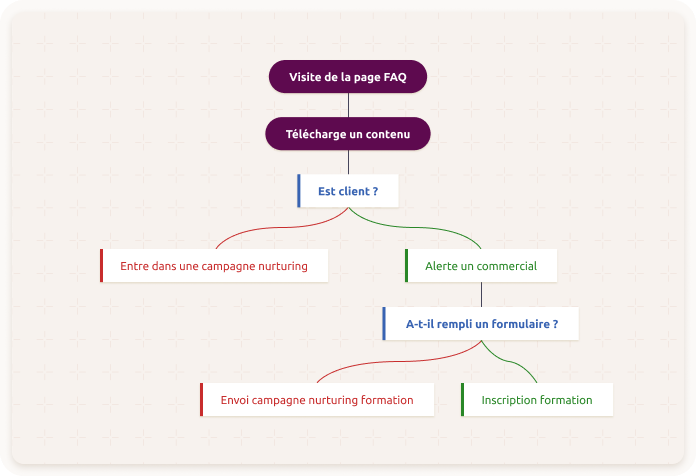
This scenario automates part of customer support. The idea is to remain responsive, even without immediate human intervention. You save time and your customers feel better supported. Start by integrating a knowledge base into your tool, website, or another platform (FAQ, tutorials, videos, articles). This allows customers to find answers quickly, without having to contact support every time. You can also automate responses to frequent questions with predefined emails or messages, sent according to customer actions (opening a ticket, searching the FAQ, etc.). Also consider setting up follow-up after resolution: a short message or satisfaction survey sent after a ticket is closed, for example. This shows that you remain attentive and are looking to improve. ⭐
The event campaign
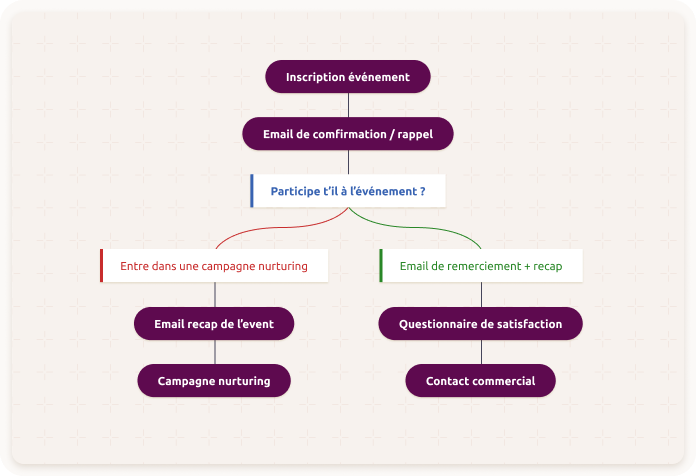
Organizing an event, whether online or in person, is a very good way to generate qualified leads. But for it to be truly effective, you need to manage communication well before, during, and after. This is where a marketing workflow really comes into its own. You can automate the key steps: sending invitations, reminders for registrations, participation confirmation, and reminders before the big day. This helps you avoid forgetting important steps, while maintaining a constant connection with your contacts.
After the event, continue the relationship. Send a thank-you message, a summary of the highlights, or a replay if it was a webinar. It is also the right time to offer bonus content or an offer reserved for participants.
?Also remember to segment your contacts according to their behavior:
- Those who registered but did not attend.
- Those who participated.
- Those who did not respond.
You can then tailor your messages to each group, for example: follow up with absentees, send an offer to participants, or suggest another event to those who were unavailable. The goal here is to create a smooth experience, stay top of mind with participants, and maximize commercial results after the event.
Social media as a selling machine
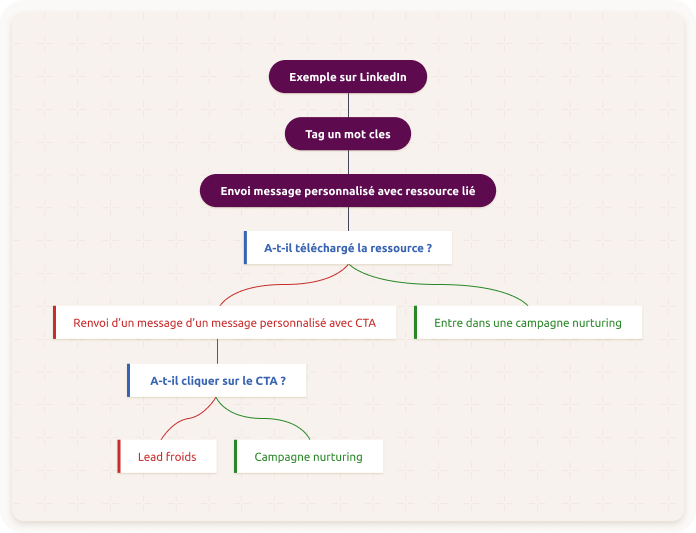
Marketing automation is not limited to emails, SMS, or landing pages, it can be a real support for your social media strategy. For example, you can send targeted emails to invite your contacts to follow your pages, like a post, or sign up for a live session. It’s a good way to create links between your channels and strengthen your online presence. It is also possible to set up retargeting campaigns. If a contact becomes inactive in your emails, you can target them through ads on Facebook, Instagram, or LinkedIn. This helps re-engage cold contacts. ?
The chatbot as a scenario
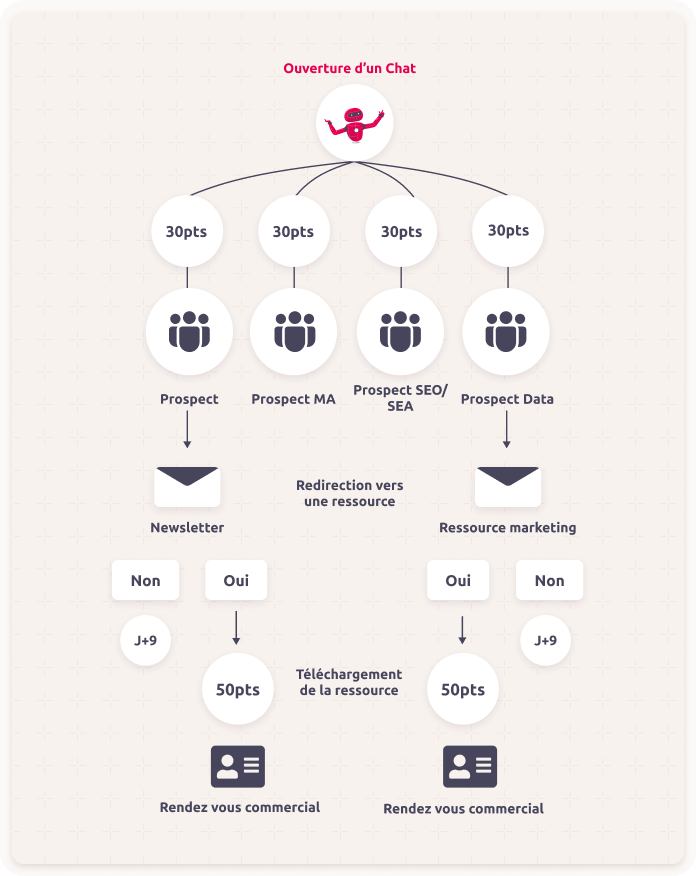
A well-configured chatbot can become a real asset for your prospecting. Available 24/7, it can welcome your visitors, answer their first questions, and above all qualify leads in real time.
Depending on the answers given, it can direct each prospect to the right resources: a white paper, a demo video, an FAQ, or even booking an appointment with a salesperson if the need is already clear.
The big advantage is that everything happens instantly and smoothly, without human intervention at every step.
You can also connect your chatbot to your marketing automation tool to segment leads according to their answers, interests, or maturity level. With a lead scoring system, you can more easily identify “hot” contacts to prioritize.
The goal of this phase is to create a smooth experience for the prospect, better targeted prospecting, and more conversions as a result, while saving your teams time.
The ambassador campaign
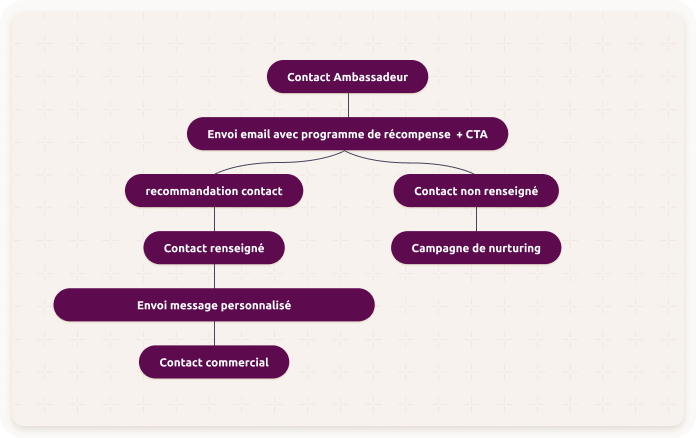
A satisfied customer is good. A customer who recommends you is even better! Your customers can become your best ambassadors, provided you give them the right tools and a clear framework. With an ambassador or referral program, you turn their satisfaction into a real growth driver. The idea is simple: encourage your customers to talk about you, share their experience, and recommend your products or services to those around them. Offer them ready-to-share content (links, messages, visuals), and set up a motivating reward system: vouchers, access to exclusive content, discounts, etc.
You can also segment your ambassadors according to their level of involvement:
- Relays: those who occasionally share your content.
- Active ambassadors: those who talk about you regularly, generate leads, or generate sales.
Remember to track the results: number of recommendations, conversion rate, sales generated. This allows you to identify your best ambassadors… and pamper them even more.
Go further with intelligent campaigns
What if you could go even further with your campaigns? Thanks to our artificial intelligence, it is now possible!
It all started with our feature for sending emails at the ideal time for each contact. This option has proven itself with +8 points in email open rates. We therefore decided to go even further by creating “intelligent campaigns”.
Webmecanik’s AI analyzes each contact’s behavior to trigger the right marketing actions at the right time: emails, messages, integrations, webhooks… Whether you are in the acquisition, nurturing, upsell, or loyalty phase, the AI chooses the ideal timing to maximize engagement.
You can choose between two optimization modes:
- Within 24 hours : the action is sent during the contact’s best time slot.
- Within 7 days : the AI identifies both the best day and time for engagement.
In concrete terms, this means better-delivered messages, more responsive contacts, and therefore more effective campaigns! ? By sending each action at the right time, you improve engagement, increase open and click rates, and encourage conversions.
And above all, you stay in control of your strategy. The AI only steps in to adjust the timing. You remain in control of the content, the objectives, and the scenarios. ?