
With the aim of constantly improving the user experience of your customers, you have put in place a communication strategy. If you have researched this topic, you have probably noticed that two terms kept coming up and seemed to be at the heart of a communication strategy: multichannel or cross-channel? In this article, discover the difference between these concepts and understand the importance of defining your communication channels.
Multichannel communication vs. cross-channel communication
Multichannel communication involves using different communication channels to promote your brand image and products in a way that is tailored to your targets. Each channel is independent and has very little impact on the other communication channels. There is sometimes a different target for each channel.
Cross-channel communication is an evolution of the multichannel strategy. Each communication channel is connected to the others in order to benefit from each of their advantages and make the most of their capabilities. The clearest example is using a website to gather information about a product and then going to a physical point of sale to validate the impressions and reviews found online.
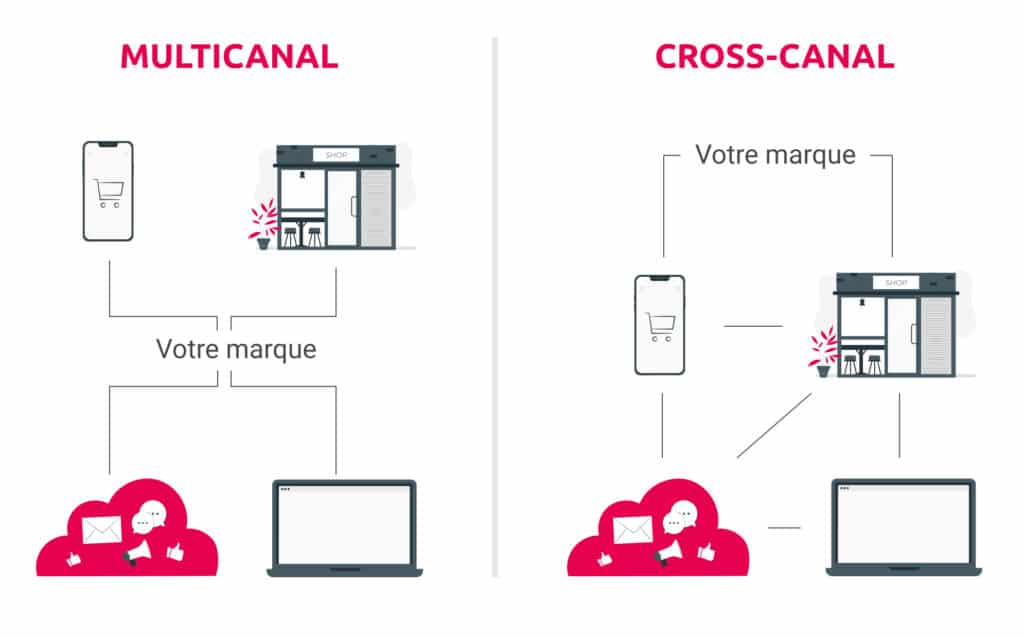
The advantages of cross-channel are numerous: a boost to your physical and digital presence, more purchase opportunities, and greater legitimacy in your field of expertise.
The objective behind cross-channel communication is to streamline the relationship with your prospects by allowing them to move across all communication channels. It is of course very likely that you already use them every day: email, social media, SMS, pop-ins, etc. In fact, the challenge lies in the ability to choose the right communication channels for your cross-channel strategy.
Defining your communication channels based on your customers’ needs
To define your communication channels, you need to understand your contact’s customer journey. To do this, you can rely on your marketing personas and their preferred communication channels. For example, if your persona regularly uses their phone during their purchase journey, it may be worthwhile to use SMS as a means of communication with them. Define several segmentation criteria that can help you better understand your customer;
Here are examples of segmentation you can use depending on the type of person you want to target
|
Prospect |
Customer |
Ambassadors |
|
|
|
Beyond defining your communication channels, this will also have an impact on the content of your communications. Depending on your segmentation, you will be able to adapt your communication channels and thus optimize your messages at each stage of your user journey.
Also read: Create and optimize your user journey
Let’s take a concrete example: you are targeting sales management teams; they are looking to increase their sales, and to convert they need reassurance about your solution’s features and guarantees. For this type of prospect, it may be wise to prepare an initial email campaign presenting the solution and offer a phone call or an in-person meeting to reassure them.
This is the full power of a cross-channel strategy: diversify your communication channels to significantly increase your sales.
Cross-channel communication channels & the purchase journey
Developing different communication channels depending on where the consumer is in the purchase journey is also an excellent way to optimize your communication strategy. Indeed, your prospect may use communication channels before and after the purchase. For example, before purchasing, your prospect uses your website to learn about your products and news. After the purchase, they subscribe to your newsletter to stay informed about your news and new product releases.
In fact, you need to ask the right questions throughout your entire purchase journey: who is your target, who are you speaking to? What means do they use to communicate, and what objectives do you want to achieve with your communication in relation to your purchase journey? So you really need to understand your prospects!
Each communication channel has its place in each phase of the purchase journey: discovery phase, comparison phase, selection phase.
|
Discovery |
Comparison |
Selection |
|
Use light-touch communication channels that will allow your contacts to get to know you and understand your positioning regarding your product. You can use, for example, your website, email marketing, or advertising. Do not be aggressive, because a prospect who does not know you could take it badly. |
Now that your prospect knows you, use more direct communication channels with your target. Use your social networks, for example, to highlight the strengths of your offering. |
If your lead is convinced, it is time to contact them! Choose the best communication channel or channels to contact your lead (email / phone / video call) and convert your lead. |
Understanding your prospects and your users
Understanding your prospects is the foundation of every successful strategy.
Indeed, segmenting, creating content, and distributing it across your communication channels is certainly very powerful, but your content still needs to be relevant and interest your audience. If you communicate about product A when it is product B that interests your audience, that is undoubtedly the best way to lose your contacts.
Use your prospects’ data
There is a great deal of data to take into account in order to get the most out of your cross-channel strategy. Does your prospect use the internet for their purchases, or your application? Are they more of an early bird or, on the contrary, someone who likes to work in the evening? Which products have they purchased? All of these insights can help you set up your different communication channels in your cross-channel strategy.
The satisfaction survey
This is the simplest method for asking your prospects for their opinion. Offering a satisfaction survey can prove very relevant, at any stage of your purchase journey, whether to your prospects in order to learn more about their issues in detail or to your ambassadors. However, you must be careful to offer it at the right time and, above all, to the right people. Would you like to fill out a satisfaction survey when you are unhappy with the product? That is an open invitation to criticism that could harm your image
The form
The form is another method for collecting valuable information about your prospect and it serves a dual purpose. First, we recommend integrating forms into all of your premium content (white paper, webinar, etc.) in order to collect information about your prospect. Then, you can include questions in your form about your prospect’s expectations.
Marketing automation strategy and scenarios
Marketing automation is the solution for addressing all of these issues and making the most of your omnichannel strategy. Implementing a marketing automation tool, and therefore a marketing automation strategy, makes it possible to automate certain tasks so you can focus on the ones that bring you the most value! It is one of the must-haves every marketer should have in their toolbox.
Also read: the best digital tools for a successful digital strategy
Indeed, earlier we talked about segmenting your database according to different criteria. Well, marketing automation can allow you to segment quickly and efficiently via automated campaigns. This will enable you to focus solely on creating content according to the segments you have created.
Marketing automation will therefore be the right support for connecting all of your actions across your different communication channels. It will allow you to specifically target certain very precise data, always with the aim of sending the right message, at the right time, to the right person. This is what will give coherence to your message and help you achieve your results much more effectively.
A practical example for implementing your cross-channel strategy
A practical example is better than theory, so we offer you a concrete example of a marketing automation campaign that will allow you to connect your cross-channel strategy and marketing automation.
You are a training center. Your segment includes all sales departments of companies with more than 20 employees that are looking to train their teams in new negotiation techniques.
First, you send an introductory email to all of these departments, reminding them who you are, which training courses related to new negotiation techniques you offer, along with a CTA leading to the download of your training catalog. This represents the first action in your campaign.
Then, two scenarios are available to you. On the one hand, if your prospect downloads your catalog, a new email will be sent to them after a short delay to offer them a phone appointment. Conversely, if your prospect does not download your catalog, add dynamic content to your site, on your pop-in for example, including a CTA about sales training.
After your phone appointment, offer your prospect an in-person meeting, and it is up to you to close the sale.
It is a fairly simple campaign, but it works. Of course, you can go further in personalizing your campaign; it is up to you to find the campaign best suited to your business.
You now have all the elements you need to implement an effective cross-channel communication strategy that will undoubtedly help you achieve your results! Now it is your turn to take action!