

Web Summit 2018 took place from November 5 to 8, 2018 in Lisbon. More than 70,000 visitors gathered to attend the trade show described as “the best technology conference on the planet” by the famous American magazine Forbes: Web Summit.
Sophie Panot, Sales Director at Webmecanik and Marie Chambon, CEO of Enjoy studio, had the chance to attend this great wave of inspiration. Aware of how lucky they were, they wanted to share the unique experience they had.
For this reason, Sophie and Marie met on Thursday, December 6 at Les Papeteries – Image Factory in Annecy, to host a conference on the 9 major Web Summit trends. The conference was a success, and we would like to thank everyone who attended. For those who unfortunately could not be with us, here is a recap of the topics discussed and a focus on what to remember.
What are the 9 Web Summit 2018 trends to remember? Discover them now
1. An extraordinary visitor experience
Since 2016, Lisbon has hosted the European edition of Web Summit, and for 10 years! Every year, the whole city switches into “Web Summit” mode, and everything is set up around this event to properly welcome professionals from all over the world: from the metro map, to the huge “Web Summit” structures in the city’s tourist spots for that little souvenir photo, to all the city’s shops offering deals for trade show visitors. An extraordinary organization costing the city more than 110 million euros, but bringing in more than 300 million… Lisbon therefore transforms itself into a first-rate host for 4 intense days mixing conferences, mindset, workshops, startup pitches and networking.
A very rich event in terms of learning as well as encounters: 170 different nationalities mingle, between startups and large groups (Facebook, Coca-cola, Google, IBM …), startups are ranked and identified by the maturity level of their business, in short, everyone is treated equally.
There is also diversity in learning, as there are more than 1,000 speakers, spread across 21 different themes, on 21 stages: robotics, IOT, sport trade, growth, fintech, autotech, clean tech, publicity, etc.
Marie and Sophie experienced a unique and surprisingly smooth experience despite the presence of more than 70,000 people. The smoothness of this event is partly based on the mandatory Web Summit mobile application, where visitors have access to their badges and their personalized schedules with all the conferences they want to see. An experience made so smooth because more than 200 employees work on it every year, constantly improving the customer journey.
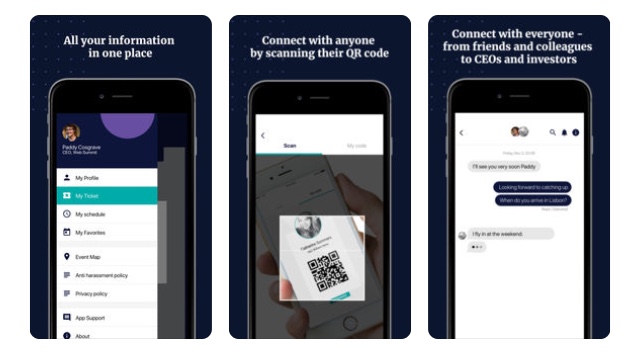
A completely omnichannel customer journey, a 360° brand experience!
2. Brand value in the digital jungle
Marie was able to attend 4 conferences on brand work and therefore wanted to share with us the points that stood out to her:
- It is essential to invest in your brand and identity; more than ever, this pays off in the long term,
- The key element is consistency across all channels,
- Formats are evolving, especially video, which has become today’s trending format, so there is real adaptation work depending on the channels. Posting the same content on different channels leads to a loss of credibility,
- Go where the audience is.
As you can see, the fundamentals for improving your brand value have not really changed. Nevertheless, today everything depends on innovation in the way this brand is made to shine and on the consistency of how the different channels are used.
To illustrate this, Marie wanted to use the example of “Puma,” a conference led by Adam Petrick (CMO of Puma). Indeed, the Puma brand experienced a significant decline and, to remedy this issue, they bet on rejuvenating their vision as well as their teams and agency partners. The goal was to change their mindset and work on the brand’s values with all the company’s stakeholders. This example highlights that you should not hesitate to question your model, and never stop testing new things.

Brand work has become more complex with the multitude of possibilities in channel selection. Everything now relies on consistency in the use of each channel, to acquire more prospects and then convert them into customers.
3. The challenge of commerce in 2019
The conversion funnel is not revolutionized in 2019, but it is evolving: some methods are gaining strength while others are emerging, and the human/automation pairing is at the heart of the new challenges!
The conversion funnel is made up of 8 stages, where several tools and methods intertwine to lead the prospect to the next stage. For each stage, here are the tools that stood out as effective:
1) Discovery phase
- Writing editorial content on your blog,
- Inbound Marketing: white papers, downloadable templates, webinars, etc.,
- Listing on a comparison site,
- Public Relations campaign,
- Buying keywords on Google Adwords,
- Targeting profiles on Facebook or Linkedin (we learned that Hubspot now targets only one persona per product).
2) Interest phase
- Product demonstration video; the requested format must be short, concise, 1 minute maximum;
- The traditional value proposition and customer benefits to highlight properly ;
- Comparison table of features and prices by edition;
- Instant messaging on the website to answer questions, chat and AI;
- Landing page to download a white paper or enter a prize draw for a gift;
3) Consideration phase
- x-day free trial offer with no commitment, be careful to create a sense of urgency,
- Customer references to reassure and convince,
- Appointment booking with customer service if needed,
- Detailed product presentation,
- Comparison with competing solutions.
4) Purchase intent phase
- Easy and secure payment,
- Fast registration.
5) Trial phase
- Perfect user experience,
- Available support,
- Call the prospect after X days of using the product, be present!
6) Purchase phase
- Dedicated follow-up,
- Verify the success of the project with the customer,
- Build loyalty with special offers, customer involvement in the product, or exceptional customer support.
7) Growth
- Several criteria must overlap to ensure the growth of the product or service: the team – the marketing budget – sales – the community – regular usage.
- Automation is an interesting growth lever if it is well designed and sufficiently personalized: human relationship first.
- Andrew Einaudi, CEO of Caavo (universal remote control system), explains that during the strong growth phase of his company, he spent half his time on the team and the other half nurturing his vision.
- Have the right balance between professional and personal life: take care of your mental and physical health to last over time!
8) Retention
- Regular customer follow-up to identify key moments of activity or inactivity.
- Reward through referral programs: not only the referred person but also the referrer!
- Ask them exploratory questions throughout the year to understand the problems they face.
4. Freeing access to data
“If you can’t measure it, you can’t improve it“ Lord Kelvin
Web Summit 2018 highlighted the importance of KPIs within organizations. Present in every department of every organization, 3 of them stood out as being easy to measure and of strong interest :
- HR: employee engagement, time needed to fill vacancies, staff turnover, etc.,
- Marketing: customer value, traffic / lead ratio, organic traffic, landing page conversion rate, etc.,
- Sales: sales target, product performance, revenue growth compared with the target, sales cost / revenue ratio, average customer follow-up time, average sales cycle.
To work on your data, it is recommended to:
1) Collect,
2) Analyze,
3) Keep a maximum of ⅔ KPIs for your objectives.
What stood out most to Sophie is the fact of breaking down objectives from a long-term vision → into 1-year tactical objectives —> into quarterly sub-objectives –> into monthly team objectives and then into individual objectives! With a maximum of 2 to 3 objectives per person.
The 2 KPIs to remember for companies operating with subscriptions:
Acquisition cost vs LTV (lifetime value)
Measures the relationship between “customer lifetime value” and “the cost of acquiring that customer.” This is a particularly crucial metric for subscription companies.
Churn rate – the number of people who cancel their subscription during a given month. If you have 1,000 customers and 20 of them cancel each month, the monthly churn rate is 2%. By simply inverting this value (1 / Monthly), you can calculate how many months on average your customers will stay. At a monthly churn rate of 2%, this amounts to 50 months.
Measurement implies tools, so let’s take a look at the tools selected to support a company’s growth—what are the 2019 trends?!
5. The special growth toolbox
To support the growth of your business, there are many tools with a wide variety of objectives:
- Project management: Monday, Trello, Basecamp,
- HR: Azuneed, Lucca, WorkConnect,
- Sales: Sellsy, Axonaut, Tiime, PipeDrive, Dolibarr,
- Marketing: Hubspot, Webmecanik (mentioned at every conference, laughter), Marketo, Buffer, Hootsuite, Limber.
These tools may have free versions to get started and test them. The goal is really to equip yourself with the best tools, the most important ones for organizing internally and getting quick feedback on growth.
6. Knowing how to tell your story: are there changes in your pitch?
Since the pitch is part of the basics, Marie wanted to attend the conferences on pitching in order to best support her clients on this topic.
The basic structure does not fundamentally change:
1 – Problem & solutions
2 – Product / market fit
3 – Business model
4 – Vision
5 – Time-bound action plan
6 – Team to execute this action plan
What to remember: the pitch is an exercise designed to make the audience want to know more.
Don’t forget to talk about the numbers; that is precisely what proves growth! Regarding the problem/solution topic, it is essential to ensure that the pitch is understandable to everyone.
A new element: proving that there is a real alignment between the project’s vision and the team that will carry it out; the right team to grow is often the key.
Finally, we must not forget that the pitch is an exercise in honesty, and any investor will appreciate lucidity regarding the challenges ahead for the project.
During these conferences, several pieces of advice were mentioned, for example, to properly anticipate a fundraising round, you need to start preparing it between 6 and 9 months before the moment when there will be no more cash left!
7. The recipe and ingredients for success
During this part of the conference, Marie undertook the exercise of summarizing all the advice she heard regarding the greatest startup successes.
The first is product/market fit: take the time to find this product/market fit while generating revenue, because generally the companies that succeed are not the greediest in terms of cash burn. A market need must be proven by revenue!
The next piece of advice is to focus on only one market segment at a time with a clear customer benefit. Once this benefit is defined, you must develop sales to this market segment before seeking to expand. It is by automating sales (as much as possible) that time is freed up to conquer other segments.
Each market segment requires identifying a clear value proposition for that segment. Growth can happen when value propositions complement each other across other market segments.
If there is one thing to remember from the various conferences, it is this: start small by testing markets in order to grow (= scale) later in a sustainable way. The best advice for scaling is to automate everything you can. The key idea is that all tasks without added value must be automated, which requires stepping back from your own business.
Be careful not to skip certain steps, because that can be risky if you are looking for sustainable growth.
Growth involves a path scattered with evolutions for founders:
1- Build and prove
2- Sell
3 – Automate
4 – Recruit
Investing in your growth may seem like trivial advice, but various speakers did not fail to remind us of it!
8. Focus on the SAAS model
Let’s remember that SaaS appeared in 2000, with the idea of accessing a fully online service. Today, 84% of new software is SaaS!

There were several experience reports from great software publisher startups (or others) that became major players, such as Slack, PipeDrive, SystemeX, Branch, SendGrid, Netflix…
Here is what had to be remembered from these conferences:
- Adapt prices to the size of your target (SalesForce sells at high prices → it targets large accounts)
- Personalize your offers!
- Offer a free trial, very interesting in B2C, much less so in B2B (70% never buy after a trial in B2B);
- Access complementary services and training available online;
- Quickly acquire more profitable new customers;
- Move customers upmarket to increase customer lifetime value over time;
- The importance of a positive user experience over the long term.
At Webmecanik, we made a real transition from the world of web marketing agencies to software publishing. This advice is and has been valuable for moving forward quickly, but it is valid only if there is real change management internally, a willingness to evolve, a vision for the company of tomorrow… All of this is a mindset in service of growth.
9. Finally, what if growth were a mindset?
The company of tomorrow is a broad and fascinating topic, and this is why Marie shared with us the different visions she discovered at Web Summit.
The first vision, explained by Michelle Peluso (IBM) and Alicia Tillman (SAP), consists of creating and bringing the brand’s values to life internally by creating working groups among employees. As an example, IBM spoke about the Millenials Core Program, a program that regularly brings together employees from all backgrounds to work together on their life within the company. Co-creation and collective intelligence are at the heart of the company of tomorrow.
The second, very complementary vision is: the culture of transparency. It is essential to be completely transparent with your teams in order to succeed collectively. It is by sharing all the stakes, constraints, means, obstacles, etc., that a collective objective is achieved.
However, to be transparent, it is obviously necessary to be capable of having a completely open mindset in order to accept disagreements that might emerge among employees.
“Honesty and transparency with a small dose of compassion allow you to give good feedback to your teams, and above all feedback that will help them grow”.
Once these foundations are firmly in place, the last of the visions is the one we particularly remember: the vision through experimentation. Taking action makes it possible to try and fail; it is often by failing that we progress.
The key takeaway would be the simple equation: problem + reflection = progress.
Marie wanted to talk about the famous “loop of success”: set goals, encounter problems, analyze where the problem comes from, test a solution and try again! It is precisely by working this way that we set ourselves increasingly bold goals, learn, and progress.
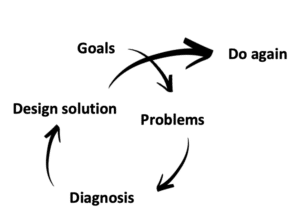
To conclude, growth is above all a mindset that relies on team agility, manager transparency, and encouragement to act! It is indeed by testing, learning, and progressing that we give ourselves the means to achieve even bolder objectives!
We hope we have made you want to join us next year, do not hesitate to let us know so that you can be among the lucky ones who will attend Web Summit 2019 with us!