In short: Artificial Intelligence won’t replace salespeople, but will redefine their role. Far from magic, AI and LLM models are based on statistical prediction using your CRM data. Used wisely, it eliminates time-consuming tasks to make room for emotional intelligence and B2B advice. Discover how Webmecanik Pipeline integrates AI to synthesize your customer histories, calculate your margins in real time, and boost your sales—everything guaranteed by a French publisher committed to data sovereignty.
The B2B sales world is in full swing. With longer decision cycles, an increasing number of stakeholders, and prospects that are more demanding and more heavily informed than ever, the pressure on sales teams has never been higher. In this tense context, a new technology is dominating every discussion: Artificial Intelligence (AI). For many, it raises a legitimate concern. Will AI replace salespeople? Will it dehumanize the customer relationship?
Let’s be clear and direct: the answer is no. However, ignoring its impact would be a major strategic mistake. Like any new technology or any new business process, change must happen intelligently. Many real-world examples today are proving the opposite: Artificial Intelligence is the future of a calmer, far more personalized, and infinitely more effective customer/salesperson relationship. As experts in CRM and marketing automation, we support SMBs, mid-sized companies (ETIs), and large accounts every day through this transition. Let’s unpack this reality together—far from Hollywood fantasies—to understand how AI is reshaping the rules of the sales game.
Demystifying AI: it’s not magic—it’s mathematics
The term “Artificial Intelligence” has become a buzzword you find on every brochure, but it’s often misused. To understand whether Artificial Intelligence represents a real danger for your sales team, you first need critical thinking and agreement on its true definition. Because misunderstanding is the mother of all fears.
Today, when we talk about generative AI and use the acronym LLM (Large Language Model: large language models), it’s important to understand the underlying mechanism. It’s essentially a gigantic matrix of word probabilities, placed one after another. Everything is governed by complex mathematical models—pure statistical predictions—powered by a monumental store of historical data. The machine doesn’t “think” in the human sense of the word; it calculates the most relevant result based on the context you provide.

The mathematician John McCarthy, often considered one of the fathers of the discipline, already mentioned it in the 1950s:
The idea is to describe learning so precisely that a machine can simulate it.
Today, computing power allows machines to solve complex problems, detect trends invisible to the naked eye, and optimize processes. But AI remains an algorithmic assistance tool. A supercharged calculator for words and behaviors, in short.
The illusion of the autonomous machine: AI doesn’t replace intuition
Given these extraordinary computing capabilities, you might wonder: can the machine outsmart our famous sixth sense—this intuition so dear to the best sellers?
The answer is categorical: no. An AI’s analysis of results helps refine a strategy, validate a lead to pursue, score leads generated by your marketing automation campaigns, and take into account past successes or failures. But at the beginning—and at the end—there is the human.
The genesis of any AI is built on data. To understand a customer’s buying journey, identify their frustrations, or anticipate their needs, you need quality data. In B2B, though, these data come from human interactions. They’re collected in the field by a salesperson who has subjectively felt the mood of a meeting, perceived the internal political stakes of a target company, and recorded this information in their CRM. Without this human sensitivity, the database is meaningless.
Artificial Intelligence is nothing without humans. It ruthlessly applies the rule of “Garbage In, Garbage Out”: if the data entered by your teams are bad or incomplete, the AI’s predictions will be disastrous. AI optimizes and prepares the ground, but the salesperson remains the only one in charge. They use their free will, their emotional intelligence, and their empathy to analyze the results and close the deal. It’s this authentic human contact—this handshake (even virtual)—that will build the long-term customer relationship and generate trust.
Increase customer value through predictive analytics
Customer Lifetime Value (CLV) is the key performance indicator for any sales and marketing leadership team. The goal is to optimize a company account’s profitability—from the first touchpoint (lead generation) through retention. This is where AI reveals its true potential: it’s a massive operational support to improve that value.
Thanks to predictive scoring algorithms (or predictive lead scoring), AI analyzes countless weak signals: sector conversion rates, web pages visited, quote-opening time, clicks in your email campaigns… The algorithm thus dynamically defines the profile of the ideal prospect and tells your teams who to call, and when to do it.
By targeting only ultra-qualified prospects (Sales Qualified Leads), your salespeople stop exhausting themselves on unproductive cold calls. They gain precious time, save on travel expenses, and focus on tasks with very high added value. As the well-known saying in the tech industry puts it perfectly: “AI won’t replace salespeople. But salespeople who use AI will replace those who don’t.”
The AI-augmented seller shows up to meetings knowing exactly which product to present, with which arguments, and at what price. Their enthusiasm is no longer disturbed by uncertainty; they can fully focus on active listening and negotiation.
Webmecanik Pipeline: your AI-boosted CRM, built for the daily work of salespeople
The theory is great, but practically speaking, how do you apply these concepts without getting lost in technological complexity? At Webmecanik, we firmly believe that software is only as valuable as its real usefulness for the end user. Your salespeople don’t want data entry—they want to sell. That’s why we integrated Artificial Intelligence at the heart of Webmecanik Pipeline, our CRM software.
An embedded LLM to synthesize your customer history
Imagine a salesperson reviewing a client portfolio or preparing for an annual renewal meeting. Traditionally, they had to read dozens of meeting notes, emails, and opportunity summaries spread across several months—sometimes even several years. A colossal waste of time.
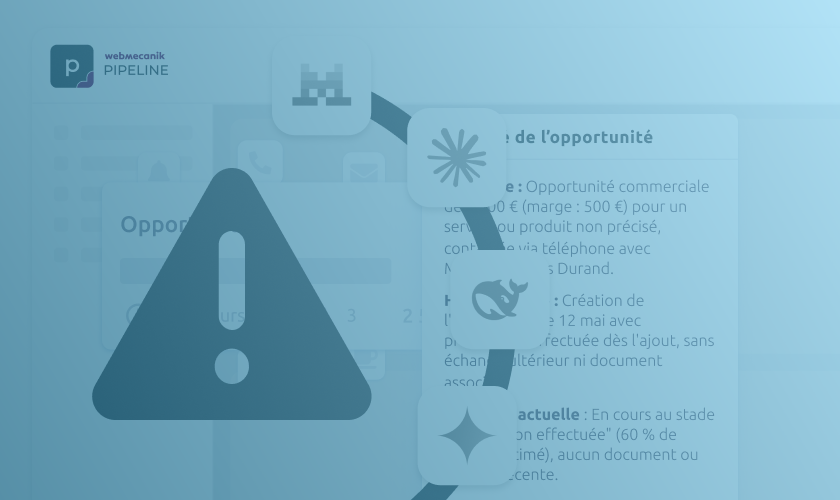
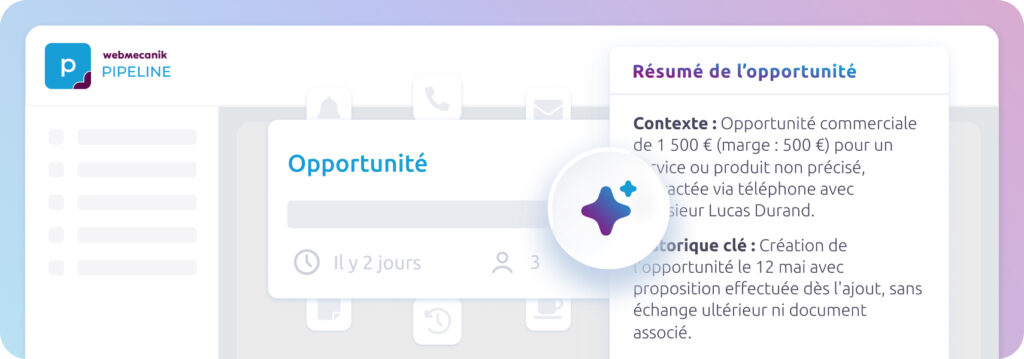
We solved this problem by integrating artificial intelligence into Webmecanik Pipeline. With a single click, it analyzes all the information from your opportunities, contacts, and company records to generate a clear, easy-to-read summary. This AI summary draws out the key information about your contacts, the crucial actions from the exchange history, past objections, and the next steps. The time savings are remarkable. Your salesperson approaches the meeting with a clear, synthesized view, strengthening their professionalism in the eyes of the client/prospect.
Sovereignty and security: the strategic choice of a French publisher
Deploying Artificial Intelligence within your sales process immediately raises a crucial question, especially for SMBs, mid-sized companies (ETIs), and large accounts: what happens to your sales data? Your customer histories, margins, and prospecting strategies are the treasure of your business.
Handing this data to American publishers creates the major issue of the Cloud Act, which allows U.S. authorities to access data hosted by these companies even if the servers are located in Europe. In terms of industrial espionage—or simply B2B confidentiality—the risk is unacceptable.
This is where Webmecanik asserts its uniqueness and strength. We are a French software publisher. Choosing Webmecanik Automation for your lead generation and Webmecanik Pipeline for your CRM means choosing uncompromising data sovereignty. Our solutions are strictly compliant with GDPR. Your data is hosted in France and Europe, protected against any extraterritorial interference.
Moreover, proximity is in our DNA. Our customer support and customer success teams are based in France. When you face a technical challenge or need strategic advice, you speak with local experts who understand the stakes of your market.
Conclusion: giving power back to emotional intelligence
Artificial Intelligence is definitely not a rival for your salespeople—it’s their best ally. By automating the synthesis of information, scoring prospects, and more, AI frees your teams from an overwhelming mental and administrative burden.
This saved time is also time reinvested into empathy, active listening, tailored advice, and negotiation. In the face of ultra-informed buyers, the technological tool alone isn’t enough; it’s the salesperson’s emotional intelligence—augmented by CRM capabilities—that makes the difference and secures the contracts.
With sovereign, complete, and accessible solutions like Webmecanik Pipeline, the future of B2B sales is already here. Are you ready to let your teams benefit from it?