

From Smart Data to Inbound Marketing: an overview of digital marketing trends
The last few years have been marked above all by the importance of “big data”. It was a real race for data among businesses. Data, being considered raw material, represented capital for the companies that possessed it. But this trend is over; companies now need to collect data and make intelligent use of this flood of information. This is what we call “smart data”. Companies must use the data they possess wisely in order to create a personalized journey for each customer. To do this, small businesses/SMEs as well as large groups must equip themselves with a CRM solution capable of analyzing and using data. To learn more, take a look in particular at this article about various CRM software solutions on the market.
Personalization remains one of the keys to marketing effectiveness
This brings us to our second point, personalization. For web marketing campaigns, personalization remains a determining factor in your success. The idea is therefore to analyze the data you have collected so that you can adapt your offer and your content to the behavior and profile of each of your leads. The more relevant and personalized the content sent to your prospect is, the greater your chances of establishing a relationship of trust with them will be.
Marketing automation is becoming an indispensable tool for businesses
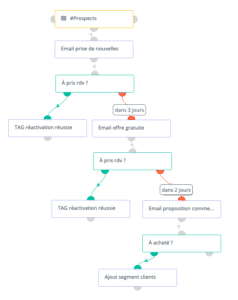
To personalize relationships with prospects as effectively as possible (thanks to very advanced segmentation), Marketing Automation has become essential for saving time in marketing campaigns. Webmecanic Automation therefore becomes a valuable ally for sending quality content at the right time. Automation scenarios can thus allow you to contact your prospects at a precise moment (for example 3 days after opening an email, or 1 week after clicking on a link, etc.)
Inbound marketing remains one of the major trends of the moment
Marketing strategies are increasingly focused on inbound marketing. As a reminder, inbound marketing consists of bringing the customer to you rather than trying to go after them (see the definition of inbound marketing).
By contrast, outbound marketing is a more traditional approach that consists of “buying” the interest of prospects by setting up promotional operations through the media, buying contact lists, etc. The major drawback of this method is that it generates significant traffic but generally of poor quality, so it can be difficult to turn these visitors into qualified leads.
We are therefore convinced that inbound marketing will remain at the forefront, as it allows you to more easily obtain qualified prospects by attracting them with relevant content (website, emails, white papers, infographics, etc.)
Nevertheless, it should be noted that a good inbound marketing strategy can quite be complemented by outbound because it can indeed allow you to multiply the effects of your inbound campaigns.
Interactive content is a key factor in converting leads
As we have seen, inbound approaches emphasize the importance of constantly providing quality content in order to attract and convert your leads. Producing relevant content is also a valuable asset for your natural search ranking and also helps strengthen your brand image.
Therefore, companies can no longer neglect the content they produce. According to the Content Marketing Institute, nearly 86% of companies have a B2B content marketing strategy. This concept is a real trend, as content is the cornerstone of any web strategy. Poor content will have no resonance on social media, for example.
Producing quality content is good, but producing quality content that stands out from what the competition offers is even better. To stand out, offering your leads interactive content can therefore be one of the decisive keys to your success. Think of games, interactive videos (where you determine different scenarios, for example), and so on.
Mobile is becoming a preferred platform for the majority of consumers
Mobile devices and tablets are gradually becoming a preferred medium for browsing the internet for many users. They are therefore perfectly likely to watch videos, use social networks, check their emails, search for information, and carry out many other tasks thanks to their smartphone.
It is therefore essential for businesses to have a responsive website or an app and of course to send responsive newsletters so that users have access to content optimized for reading on a touch device.
Email remains an indispensable tool in any web marketing strategy

Its death has been announced many times, but email marketing is still very much present in marketing strategies.
We tend to think that social networks will soon overtake and replace emails, but if we take a look at the figures, emails have, on average, conversion rates that are much higher than display advertising or advertising on social networks.
We have now reached the end of this non-exhaustive overview, but one that provides some insight. We hope this article has helped you see more clearly when it comes to the major trends in digital marketing!