

Customer journey mapping is simply a visual representation that shows all the stages a customer goes through when interacting with your company, from first contact to loyalty. It helps identify all touchpoints, whether online (website, social media) or offline (stores, customer service).
The idea is to better understand what your customer experiences at each stage, their needs, and even their emotions. This helps you spot where you can improve their experience, resolve friction points, or seize opportunities to strengthen the relationship.
In short, it’s a great tool for refining your marketing and sales strategies while making your customers more satisfied and loyal.
The stages of the customer journey
What is the goal of customer journey analysis
The steps to follow to analyze your customer journey
A few indicators to help you measure the effectiveness of the sales journey
Continue analyzing your sales funnel
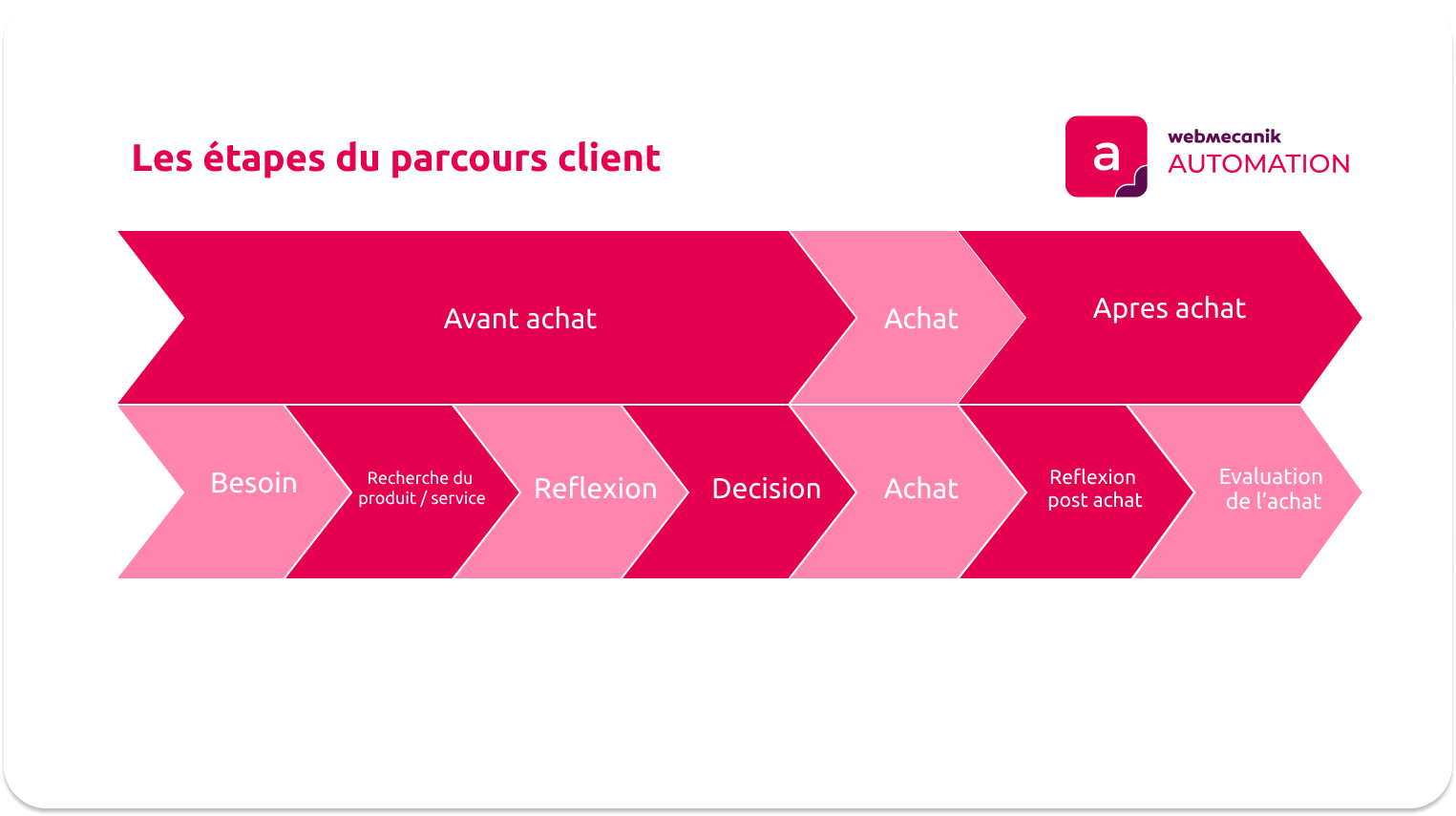
The stages of the customer journey
You have probably already thought about your customer journey in order to build the foundation for a good customer relationship
Before purchase
- The need
- Searching for a solution to the need
- Questioning phase (reflection)
- Decision
Purchase
- Making the purchase
After purchase
- Post-purchase reflection
- Opinion about the purchase / brand
What is the goal of customer journey analysis
Customer journey analysis aims to understand and improve every stage your customers go through when interacting with your brand, from initial discovery to purchase and beyond. The idea is to identify moments of friction that could slow down their progression and seize opportunities to make the experience smoother, more pleasant, and more personalized.
It is also essential to check whether the journey you have imagined for your personas actually matches what your customers experience. To do this, you need to analyze their behavior using data, collect feedback, and compare the planned stages with those actually followed. This approach allows you to adjust your strategies and ensure that your marketing plan is well aligned with your customers’ expectations and needs.
Also read: Sales funnel: definition and stages
The steps to follow to analyze your customer journey
Identify friction points in your current customer journey
To begin your analysis, identify your areas for improvement. By having a clear view of what you can improve, you will be able to best meet your customers’ needs.
Do you want your customers to be satisfied with their customer experience during their purchase journey? To do that, you need to identify the friction points, in other words where they abandon their cart, at what moment they leave the site? *
When you have identified where the problems are, try to understand why they exist. Is your website practical and easy to use? Is the information hard to find? By running tests and asking your teams for their opinion, you can improve these friction points.
Identify the different channels (omnichannel)
To deliver an optimal customer experience, it is essential to identify all brand touchpoints (website, social media, stores, etc.) and ensure that they provide a consistent and seamless experience. This means analyzing the customer journey on each channel, ensuring a consistent visual identity and messaging, and optimizing every touchpoint to facilitate purchases and personalize interactions.
Improve the customer / user experience
The UX experience within your sales channels is very important, because it allows you to understand the stages your contacts go through to make a purchase. You must be able to identify unnecessary steps that you can remove in order to streamline your sales journey.
Take into account the time and actions your customers carry out
To maximize your conversions, analyze the customer journey in detail. By identifying the pages where customers get stuck or spend little time, you can make targeted improvements to streamline their experience and encourage them to buy. If your customer spends little time on a page, this may indicate that they do not find what they are looking for at first glance. Make sure to improve these pages.?
Ask yourself at what moment your customers take action
Ask yourself at what moment your customers take action, meaning at what stage of the purchase journey they finally decide to buy or engage. It is important to identify the triggers that push them to act. This may be a reassurance element, such as customer reviews or guarantees, or simply a well-positioned CTA.
Identify the points where your customers are the most satisfied
When you identify positive points within your sales journey, maintain these actions/efforts in order to continue along positive lines.
Once you have identified your users’ satisfaction points, keep leveraging them and even improve these areas! For example, if a special offer is successful, do not hesitate to repeat it or modify it so that it remains attractive. The idea is to turn your successes into habits for ever more sales and satisfaction!
A few indicators to help you measure the effectiveness of the sales journey
The KPIs to track
Performance indicators allow you to track the actions you put in place. There are different ones depending on the stage you are at. Here are a few of them:
Attract?
- Conversion rate
Percentage of visitors who become prospects by carrying out a specific action (registration, download, etc.).
- SEO ranking
Ranking in search engine results for target keywords.
- Click-through rate
Percentage of people who click on your ads or organic links compared with the total number of impressions.
Qualify ✨
- Lead conversion rate
Percentage of qualified leads that move to the next stage of the funnel.
- Scoring
Scoring system used to assess prospects’ level of interest and purchase readiness.
Sell?
- Conversion rate
Percentage of sales opportunities that turn into customers.
- Sales cycle
Average time needed to close a sale from the moment an opportunity is created.
Retain?
- Churn rate
Percentage of customers lost over a given period. (Specific to companies that offer software subscriptions)
- Customer lifecycle
Average total financial value you expect from each customer over the course of their relationship with your company.
- Recommendation rate (NPS)
Measure of customer satisfaction and the likelihood that customers will recommend your company to others.
Continue analyzing your sales funnel
Do not stop at factual data alone. Try to dig deeper to understand your results so you can draw opportunities from them. Do you have too many prospects in one segment? It may be worth reviewing your segmentation and finding other determining elements in your database. Are you struggling to retain your customers? It may be time to think about a cross-selling campaign. In addition, this helps you detect market developments and changes in customer preferences, allowing you to adjust your strategies to remain competitive.
Data analysis is good, but interpretation is better! By going beyond the numbers, you will turn your data into concrete actions to improve your performance and grow your business.
Webmecanik Automation helps you analyze your sales funnel. The tool assigns scores to leads to identify the most engaged ones and prioritize them. The tool tracks conversions at each stage of the funnel, such as completed forms or downloads. It also generates detailed reports that show campaign performance and indicate what should be improved to optimize the sales funnel.