
People talk to you about inbound as well as outbound marketing? Are you wondering what inbound really is? And what outbound is? But above all, you do not know what the differences are between the two? You are in the right place! I will simplify the definition of these strategies for you and also help you choose which one is best suited to you. It is important to understand how they work and how to benefit from them.
Comparison between inbound marketing and outbound marketing
What is inbound marketing
Inbound marketing, also called attraction marketing, is a marketing strategy aimed at attracting qualified contacts. You draw leads to you. To do this, you need to implement different levers. The inbound marketing strategy got a boost thanks to the rise of social media and content creation. In principle, it is a strategy that costs less to implement. Some levers used in inbound marketing require high-quality work, which means spending time on them, and for many companies, time is money.
The idea behind implementing marketing resources within an inbound marketing strategy is to offer added value to potential customers, answer their questions, and solve their problems. By doing this, we hope these contacts will naturally turn to our company when they need our products or services. The saying goes: give before you receive!
This strategy is generally perceived as less intrusive than outbound. Because you do not disrupt users with unsolicited ads or content.
What levers are used for inbound marketing
Your website is seen as a showcase for your brand. You therefore need to highlight your products, services, and values. You must therefore carefully think about the user experience you want to offer. Optimizing your SEO (organic search) is crucial for organically attracting visitors to your website. Be sure to develop your landing pages with forms to download your high-quality content. Also create clusters of blog articles to position yourself on specific queries. In addition to your website, social media is also part of the marketing levers you need to take care of. They play a role in extending the reach of your messages. But also in building relationships with your community.
The advantages of inbound marketing
Inbound marketing has many advantages, here are a few:
- Attract prospects ?: by giving your visitors the opportunity to find answers to their questions, you are more likely to attract new leads.
- Direct interactions ? : you can interact directly with your customers / prospects, which creates a sense of closeness and belonging. You need to make sure you are responsive.
- Generates qualified prospects ✨ : thanks to the visibility you gain, you attract qualified leads, that is, people who come directly to you because they are interested in your brand, products, etc.
- Improves loyalty ? : by providing your prospects with high-quality marketing content throughout their buying journey. You will create a close relationship and a sense of belonging. This relationship encourages customer loyalty.
- Reach your target audience ? : thanks to your inbound strategy, you can reach your target more directly. You maximize the chances of reaching people who are truly interested in your solutions. By using automation tools, you define the appropriate communication channels to continue the relationship with your target audience in a segmented way.
Why use inbound marketing
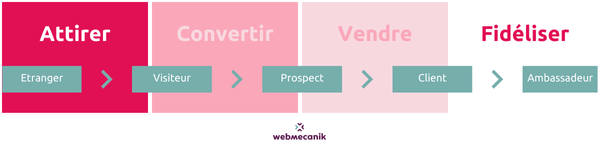
The diagram above represents the customer journey in an inbound marketing strategy.
Inbound marketing will allow you to attract unknown visitors to your channels (websites, blog, social media, etc.). You can then convert these visitors into prospects. You can therefore seize the opportunity to convert them into customers. Once they become customers, it is essential to retain them so that they become ambassadors for your brand.
Automation serving inbound marketing
Marketing automation helps simplify certain inbound marketing processes. Thanks to automation software such as Webmecanik Automation, it is possible to optimize your lead nurturing stages, qualify with lead scoring, and send your marketing resources. Your communication becomes more personalized and targeted. Thanks to all the analytical feedback your tool will provide, this will allow you to continuously adjust your inbound strategy. That is the full power of inbound marketing!
What is outbound marketing
Inbound marketing, got it! But what is outbound marketing? Outbound marketing means going out in search of the consumer, which is the opposite of inbound. This approach has always existed and is even considered a “traditional” strategy. These are mainly offline levers used to interact directly with your target audience. Just think of door-to-door prospecting. Thanks to the digitalization of marketing, levers such as SEA (online advertising) and social ads have become part of the outbound marketing strategy.
This strategy is generally perceived as too intrusive, compared with inbound, which is seen as more natural. It allows you to get a message or an offer across to as many potential customers as possible.
What levers are used for outbound marketing
Online levers?
Levers such as online advertising on Google, on social media, everything that includes SEA, display, social ads, as well as cold prospecting emails that are often automated. They are part of outbound marketing’s media strategy. These tools are a more modern way of doing outbound marketing; they often require managing large volumes of data in the hope of achieving meaningful conversions.
Offline levers?
Offline communication relies on levers such as radio, phone prospecting, trade shows, newspapers, television, and billboards. They offer the opportunity to reach a mass audience without any notion of personalization. Only phone calls ensure immediate contact. Otherwise, you need to make sure you have included many calls to action in each initiative to maximize all chances of conversion. The ball is in the audience’s court.
The advantages of outbound marketing
Here are some advantages of outbound marketing:
- Fast lead generation⏳ : with outbound marketing, if you decide to allocate a (often substantial) budget, you can generate leads more quickly than with inbound marketing (be careful, this is not a long-term solution).
- High visibility ? : thanks to certain levers, you can reach a wider audience.
- Direct approach? : outbound marketing allows you to create one-to-one business relationships by opting for phone prospecting or one-to-one email outreach.
Why use outbound marketing
Outbound marketing allows you to generate leads and quickly grow your business in the short term. You can choose the messages to convey while defining your target audience and the channel you want to use for your campaigns.
Comparison between inbound marketing and outbound marketing
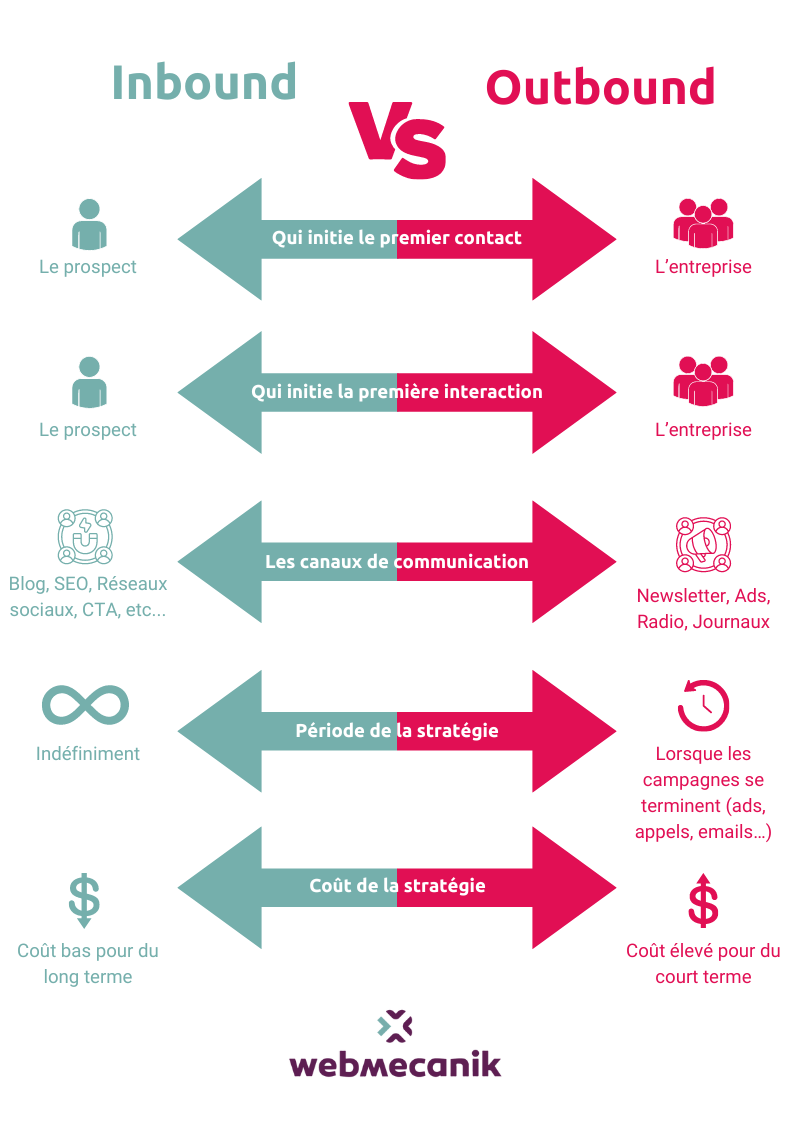
As illustrated in the diagram above, although inbound and outbound marketing have differences, you can choose to use them complementarily. Integrating both approaches is essential if you want a 360° marketing strategy. You benefit from the strengths of each strategy, and you also have a better chance of reaching your prospects. By combining the two approaches, your chances of engaging your prospects even more increase, because you personalize and guide your leads through their conversion funnel.