

Nothing is more frustrating than a marketing strategy that does not work and for which many resources are deployed. Many bloggers have fallen into the trap: they contribute several times on another blog or in another publication, and become disillusioned when they do not achieve the expected results.
To establish yourself as an expert and have positive repercussions for your brand, you must implement a comprehensive guest posting strategy.
The state of “Guest Posting”
According to the “blogging data from Orbit”, 56.2% of bloggers occasionally publish guest posts, while 34.5% never do, and only 9.3% do so regularly.
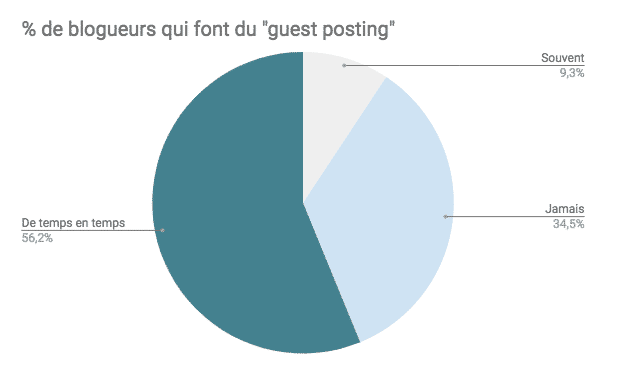
Although it is nice to see that more and more people recognize the potential of “guest posting,” this lack of consistency prevents many bloggers from achieving a real return on investment.
In 2017, according to “The State of Digital Media”, 61% of publishers planned to increase the number of guest posts to publish, while only 4% planned to reduce it.
Publishers want to share new ideas with their readers. They want to publish content from people who are experts in their field, or from people who bring added value in a specific sector and for which readers have a real interest. They need to do this regularly in order to keep their readers engaged.
To do this, they must find reliable external experts who can contribute regularly and provide high-quality content, which cannot be done properly without a guest posting strategy.
Achieving a successful strategy
It is certain that a post here and there will not generate more traffic to a blogger’s site, just as one contact with a prospect will not lead to an immediate deal.
A guest posting strategy does more than help contributors improve their writing skills and build their network, even if these are significant benefits. It can be very effective to use “guest posting” as the cornerstone of your strategy, by contributing to a variety of publications: some on blogs that have large audiences, others much smaller but with very specific topics, for example.
This very broad approach can make a strong contribution to building an online reputation and thus generate a large number of visits and increasingly qualified leads.
Implementing a “guest posting” strategy
To get the most out of your guest posts, you must include these publications within your overall content strategy.
Guest posts will enable you both to reach new readers and to offer enriching and diverse content to the audience that usually reads you. The mere fact that your name appears in a publication represents a mark of quality for your readers, but you cannot be satisfied with that alone.
You must give your audience the opportunity to learn more about the topic developed, by offering them links to other relevant and complementary content, for example on your own blog or on a site to which you have contributed. In this way, you will create a path for your readers, allowing them to learn more about a subject while collecting new tools, such as white papers or guides.
This approach is not necessarily perceived as a promotional approach. According to the survey, fewer than ¼ of publishers consider that links to “educational” content can be “too promotional.” It goes without saying that linking to other content means building a set of quality content. It is strongly discouraged, for example, to link to your website’s home page, because in that case it would be perceived as commercial promotion. The objective is always to seek your readers’ interest and engagement.
However, if you offer valuable, relevant content that helps your reader, you can add links to content on your site or on a partner site where you have published on the subject. This will generate traffic, leads and boost SEO. Everyone wins because you generate more traffic, publishers attract readers’ interest, and readers gain access to good-quality content. The higher the quality of your content, the more positive the impact on your “guest posting” strategy will be.
7 steps to create posts that generate value
A better overall strategy makes each post more impactful, but what makes a single post better? Here are some tips and tricks for producing a good guest post. You can then reproduce this until you have created a network of content across the web that accomplishes the objectives you have set for yourself.
1. Identify your audience and their online journey
What does your ideal client/partner do online? Which sites do they visit? What type of content do they appreciate and share with their peers? Try to gather as much precise data as possible, then build a list of publications with content relevant to the audience you want to address.
2. Research the preferred types of content
After determining the publication that will allow you to attract your audience, analyze the types of content your target audience appreciates across the different sites identified: What topics does the site like to cover? Which formats are favored, short or long? With lots of text? Infographics? Lists? Data-driven analyses?
Then take the time to check the main publication guidelines and style. Some prefer to use the comma, while others are more particular about headlines and the use of “I”. The more you know about the style your audience appreciates, the easier it will be to reach them.
3. Create the content
Write with your target in mind, and write only about a subject you master. Share something of value, such as advice or tips you wish you had known. Avoid directly promoting your business, but do not shy away from using the writing/publication of content on your site to support your objectives.
4. Edit and proofread
This should not take you too long, but you might be surprised by the number of publishers who cite poor quality and lack of professionalism as the main reason for rejecting your content.
In short, do not send content with spelling and grammar mistakes to a publisher. Check your sources carefully for every figure you include and, if necessary, ask someone to proofread it for you. You can also run your content through a plagiarism detector and, in this way, avoid accidentally copying someone else’s work. The more polished and flawless your content is, the more likely publishers will be to publish it.
5. Master your approach
Be careful about how the site’s publisher wants to be contacted and to receive your article. Some may want a complete article, while others will prefer first to have a summary and an author biography. Do not try to bypass these processes by sending an email directly to a publisher if it is specified on the site that there is a defined route for getting in touch.
6. Share as widely as possible
Once your content has been approved and published, share it on all the channels where you are present. Facebook, Twitter, LinkedIn, emails, etc., share your content as much as possible while it is on the site’s front page. The more traffic your publication generates, the better your chances of publishing again.
7. Refine and repeat
Take editor feedback into account to improve your style and your approach next time. Your “guest posting” strategy depends on the consistency of your publications.
By following these tips, you will certainly be able to improve your ROI.