

In your marketing strategy, you have probably included marketing lead generation goals. This is a very good thing if you want to benefit from the many advantages. Generating leads is an excellent way for B2B companies to ensure sustainable revenue. That is why it is useful to filter and analyze incoming leads in your buying journey in order to distinguish hot leads from cold leads and convert them into customers. This is what is called lead management.

How to set up a lead management process
The role of marketing automation in lead management
Definition of lead management
Lead management, also called contact management, involves implementing a set of marketing techniques and tools to categorize and differentiate your leads in order to deliver the right message, at the right time and to the right person. According to Webmecanik, there are three ways to differentiate your leads:
MQLs → Marketing Qualified Leads
HMQLs → High Marketing Qualified Leads
SQLs → Sales Qualified Leads
In other words, lead management is all the means at your disposal to track the behavior of your leads and qualify them. Lead management involves implementing many tools and methods at your disposal: inbound marketing strategy, lead scoring, lead nurturing, SEO, emailing, etc.
To optimize your lead management, it is important to have a CRM synchronized with your marketing automation tool. This will allow you to act confidently at every stage of your prospect and customer lifecycle between your sales and marketing teams. When choosing your CRM, remember to use the checklist.
Why is lead management essential?
Lead management is essential because it allows you to maximize your sales and marketing efficiency. By managing your prospects throughout their buying journey, you can better understand the needs and behaviors of your target audience. It also allows you to personalize your interactions and improve your conversion rate. Lead management is the key to turning prospects into loyal customers.
Benefits of lead management
Implementing a lead management system will bring benefits to your marketing strategy. There are many similarities between the benefits of inbound marketing and those of lead management:
- Time and productivity gains in your strategies. You will be able to identify which leads will be interesting and which leads need to be monitored and nurtured.
- Lead management will also allow you to automate certain actions. It will therefore be easier for you to generate leads.
- Better knowledge of your prospects thanks to more precise targeting.
How to set up a lead management process
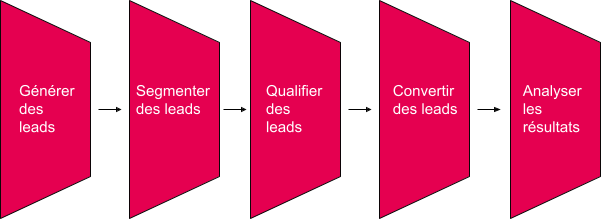
Implementing a lead management process is a project that can pay off big if it is used and optimized properly. It will save you valuable time, whether in terms of working time or organization. The process can be divided into several steps:
- Generate leads
- Segment leads
- Qualify leads
- Convert your leads
- Analyze results & optimize
Step 1: generate leads
The first step in lead management is to generate qualified leads. Indeed, to be able to manage your leads, you first need to generate them regularly. There is no secret or magic potion, you need to focus on the methods that work best for you. Of course, content creation is part of the plan.
The persona
Knowing your persona is essential, because it represents your ideal customer. When you define it, you need to describe it as much as possible: behavior, habits, means of communication, family life, etc. All the elements that are essential to your marketing strategy must be mentioned and highlighted. The goal here is to understand your ideal customer’s needs.
SEO
Once your persona has been created, you can start the biggest part of the work: SEO (Search Engine Optimization). This method is the most widely used to generate large amounts of traffic. It consists of writing web content based on the favorite topics of your leads, with the aim of attracting them to the themes your company offers.
Combine your SEO strategy with an SEA (Search Engine Advertising) strategy. Thanks to SEA, you will be able to target specific keywords in exchange for money. It works through a bidding system: whoever wins the bid for the keyword is positioned in first place. The advantage of this method is that it allows you to rank for keywords that are not or are barely accessible with SEO. This allows you to be visible to your hardest-to-reach prospects.
Marketing resources
To support your SEO content, offer your prospects richer and more detailed content. White papers and webinars make excellent B2B content. Most of your leads expect this type of content, although this obviously depends on your business sector. In exchange for your content, your leads will provide you with information about themselves through forms.
The goal here: collect your prospect’s email address. It is a very practical and easy way to grow your database and be able to contact them again.
It is also relevant to offer your premium content via SEA, using landing pages.
The landing page
It is a landing page, indexed or not, attached to your site for a visitor and accessible from an external action to your website. The purpose of a landing page is to address a single objective, with a single message and a single call to action. All of this is aimed at optimizing your conversions and your lead generation. Its advantage is that it delivers a clear message and makes it easier to track your leads and their actions.
As a reminder, the golden rule for an effective landing page is: one message, one objective, one CTA.
Social media
Beyond building a community, use social media to generate leads. It allows you to find prospects in a targeted way around your company. This enables you to acquire qualified and engaged leads. Basically, the methodology and the benefits brought by social media are the same as SEO/SEA: awareness and traffic acquisition.
A bidding-based and therefore paid system is also available depending this time on the target audience you want to reach. That is why using these tools remains a very good way to generate leads provided that you diversify your acquisition channels.
Step 2: segment your database to optimize your communication
After completing the first step, you have collected many leads. You now move on to the second step, which is the most important. This step will allow you to segment your leads according to their interests and behavior on your site.
A segment corresponds to a group of individuals with similar characteristics. These can be behavioral and/or demographic characteristics. For example, if you are a company that sells services, you will create a segment of all the prospects interested in your service A, then another segment of your prospects interested in your service B.
How to segment your database
Thanks to the first step, you have seen the ways to attract leads to your channels. Each method has its preferred target and its own communication style.
Each method seen in the first step will allow you to segment your contact database. For example, your landing pages can help you create unique and relevant segments. Your premium resources can also be sources of segmentation. They will specifically target your prospects’ needs. For example, all the people who download a premium resource on the topic of “business software” can be grouped in the segment “business software prospects”.
What is the point of segmenting your database?
Segmenting your database is essential for the proper functioning of your strategy. Indeed, a better-segmented database will allow you to communicate better about your products, your services, your offers, but also about your company’s news. Thanks to segmentation, you personalize your communications. Segmenting your database will allow you, on the one hand, to communicate the right message to the right person at the right time. On the other hand, it allows you to communicate through targeted email campaigns. The purpose of segmentation is to help you improve your conversion rate. Thanks to segmentation, qualifying your leads becomes easier.
Step 3: qualify your lead
This step consists of qualifying your leads with the aim of converting them into customers. To convert effectively, you need to distinguish your cold prospects from your hot prospects. That is why you need to set up a scoring system to differentiate your leads. To do this, we will use lead nurturing as well as lead scoring.
Lead nurturing: nurture your prospects
The practice of lead nurturing is very widespread in the B2B sector. This strategy involves nurturing your prospect with data through marketing campaigns according to their needs.
For example, you are a company that sells software to companies. They have the segment “software A prospects”. Some of the leads present in this segment lack information on the subject. This is probably why they do not buy. Offer them a comparative PDF of business software according to their features, for example. Provide as many marketing resources as possible to your leads to maximize your chances of making sales. To do this, you will send this information little by little at the best time, ideally according to their behavior and reactions to the latest interactions.
Lead scoring: assign a score to your prospects
Lead scoring consists of assigning a score to your prospects according to their behavior toward your brand. If we go back to our software example, if your prospect is interested in your comparison, there is a greater chance that they are interested in buying it.
Downloading this resource will therefore add points to your lead. These are the points that will allow you to judge whether a lead is relevant or not.
To help you understand, here is an example of lead scoring that you can implement in your strategy.
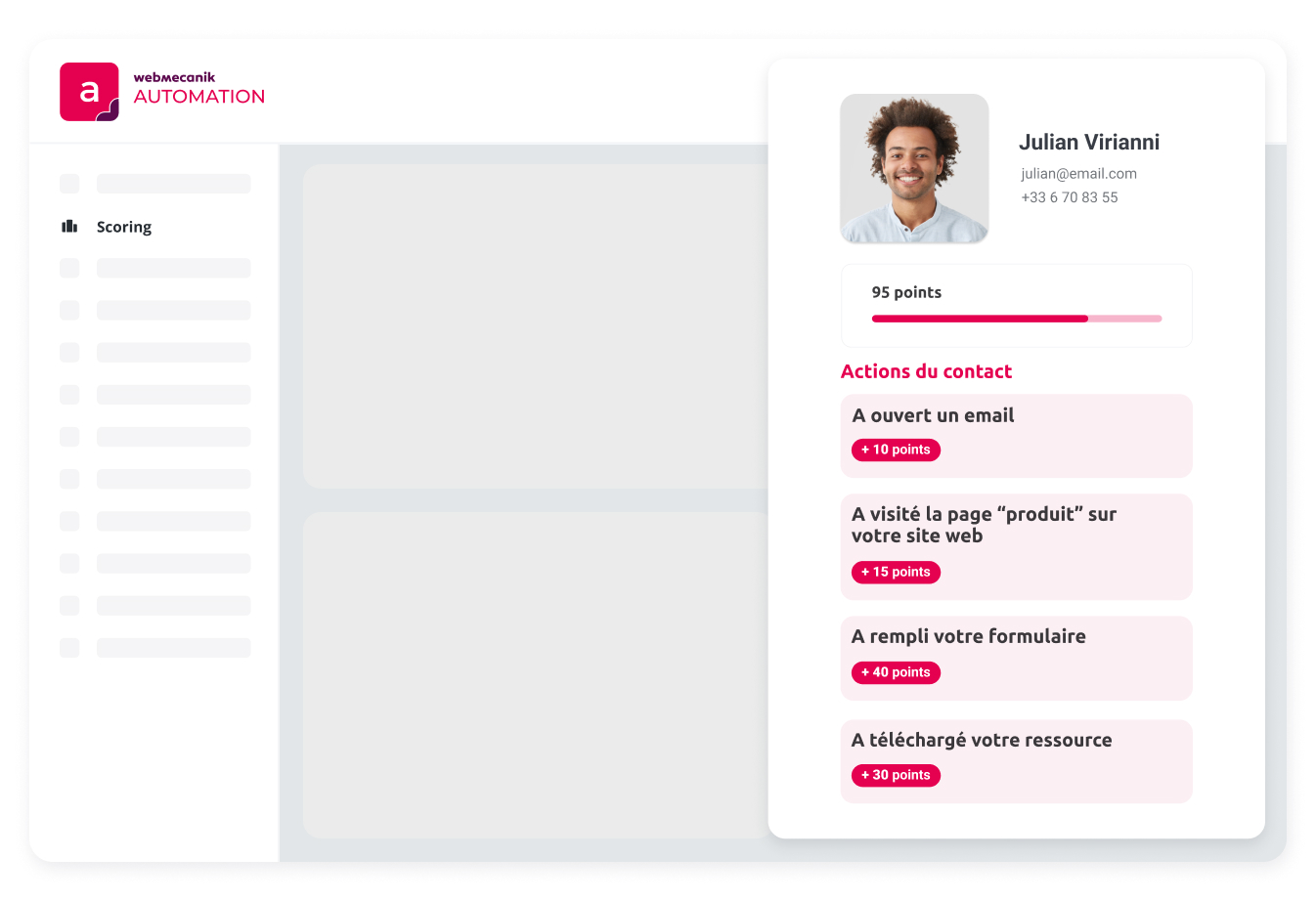
Thanks to certain marketing automation software solutions, such as Webmecanik Automation for example, you can set up the sending of a notification to one of your sales representatives so that they can contact prospects who reach a certain number of points.
Step 4: convert your lead
The ultimate step in lead management is the ability to convert your leads. The great advantage here is that you have managed your relationship with your leads well enough for them to engage with your brand. During this step, you must pay attention to many points. First, make sure that your lead has indeed matured sufficiently in the lead scoring step. What is the conversion goal for you? A sale, an appointment, a free trial? . It will also be useful to continue your lead management after the conversion to reassure them about their decision.
Also, keep regular contact with your most qualified leads and, of course, your customers.
There you have it, you have gone through the most important steps up to the conversion of your lead. Remember that lead management focuses on lead qualification. You may have an interest in extending your strategy by integrating your conversion funnel, which encompasses the entire conversion process, from initial contact to loyalty.
Step 5: analyze the results
In general, for all your marketing actions, you need to analyze your results. These analyses are also crucial in the context of lead management. They help optimize your strategies and maximize your chances of conversion.
Even after handing a lead over to the sales team, it remains important to continue evaluating lead quality and pursuing the scoring strategy. It is essential to ensure that leads progress properly through the sales cycle without getting lost or being sent back to the marketing team for additional nurturing.
Several KPIs can be used to evaluate lead management results:
- Visits to your site: this allows you to assess the relevance of the content offered. To go further, remember to analyze your UTMs to assess the origin of your leads precisely.
- Cost per lead: measures the financial investment in marketing acquisition strategies.
These first two KPIs are extremely interesting in your lead generation strategy.
Next, the KPIs that are useful for properly monitoring your lead nurturing campaigns and therefore your lead management:
- The conversion rate of your visitors into leads: a key indicator of the effectiveness of your engagement strategies on your site.
- Marketing and sales return on investment (ROI): evaluates the overall effectiveness of campaigns. Take the amount invested in your marketing and sales operations and compare it with the revenue generated by those same operations.
- The number of sales closed: the ultimate measure of the success of the lead management process, this is the objective associated with converting your leads.
Ultimately, it is vital to continue the evaluation throughout the process to identify what works and what does not work for the company. Solving the detected issues may take time, but it will make it possible to optimize the lead management process, thereby generating better business results.
The role of marketing automation in lead management
All the actions mentioned above should be integrated into your marketing strategy. These strategies aim to improve and optimize your lead management.
To implement all these actions effectively and easily, adopting a marketing automation solution is more than recommended. You automate, thus saving valuable time and avoiding overlooking some of your leads that may not be mature enough today but could be interesting tomorrow. You make marketing and sales management easier, ensuring the optimization of your sales cycle for better results. It means +100% qualified leads on average from the first year.
Finding a marketing automation solution can be a challenge for your marketing strategy.
To put it simply, lead management not only makes it possible to filter and analyze leads to distinguish hot leads from cold leads, but also to convert them into customers. By using different techniques such as segmentation, nurturing, and scoring, you personalize your communication methods and maximize your chances of conversion. By integrating marketing automation, you optimize your processes. Lead management has many benefits, and this definition article helps you turn prospects into loyal customers while maximizing your sales and marketing efficiency.