
Once again this year, Webmecanik’s marketing team attended Web Summit, 3 days of rich and inspiring conferences on the major trends of tomorrow.
An online edition, focused on the major challenges facing our world—environment, mobility, diversity—and on the evolution of new technologies and their impact on our society.
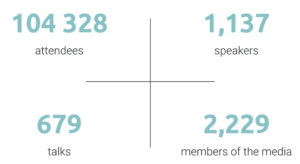
Over 104,000 participants and 1,137 speakers such as Eric Yuan, founder of Zoom, Ursula Von Der Leyen, President of the European Commission, and Serena Williams gathered on the event’s web platform. A fine mix of world personalities, institutional figures, and leaders in new technologies.
Major marketing trends for 2021

Lucile Cons, our marketing manager, attended numerous conferences to uncover the best trends for the coming year.
Impact of the pandemic on marketing
2020 was a special year that will shape consumer habits for years to come. The main takeaway is that adaptability was put to the test, and while this is true for each of us personally, companies also had to adapt in order to sell differently.
Customer experience and trust are more central than ever.
It was necessary to stand out and act quickly. It was creativity that made it possible to rise above the crowd. For example, fashion week managed to reinvent itself very quickly by creating online events, each crazier than the last. Some of these usually ultra-private events opened up to the general public and, since the desire to belong to a group is very strong during this somewhat bewildering period, brand image was positively impacted.
Overall mindset of the event
This desire to belong shows that consumers’ needs and drivers have changed, or at least that the changes already underway have been accelerated and amplified.
From now on, people are interested in the company beyond the brand: the quality of the product, yes, but also the way employees are treated and the company’s day-to-day commitment. In fact, 85% of consumers say they no longer buy a product from a brand—or rather a company—they do not believe in.
What stands out most to me here is Mark Morris, who leads digital marketing at Burberry. For him, every marketing action must be told with passion. Company policy must shine through in marketing and in the DNA of every product. That is what customers expect from a brand today: to know a brand’s values, vision, and story before buying its products.
Sustainability is the winning word of this Web Summit: I didn’t attend a single conference where it wasn’t mentioned. My takeaway is that this notion has become an essential foundation that is no longer, or at least no longer merely, a marketing lever. However, strong long-term actions are indeed being implemented and praised: Levi’s, for example, announced during a conference that it was putting in place a second-hand collection and resale system.
Trust also goes beyond the values shared between the company and the consumer. There is also the interaction enabled by the use of social networks in particular: privileged, personalized, two-way communication. Consumers want to be able to interact during the purchasing process and feel valued. The result: stronger loyalty.
What’s new for your strategy
The following new developments emerge from all these lessons and should not be missed for successful marketing in 2021:
- Ephemeral content is highly favored for engagement. The feeling of living in the moment is important
- Technological advancement also makes it possible to innovate: like fashion week, it is possible to do new things to engage consumers. Stores with connected mirrors, / Lamborghini (Katia Bassi) uses virtual reality to bring cars into consumers’ living rooms
- Marketing automation to make it possible to engage in more dialogue, by personalizing and freeing up time for essential and highly appreciated exchanges. Be careful to avoid emails with “no-reply”
Management and Customer Success

Sophie Panot, our marketing and sales director, took an interest in conferences on work organization and management in the time of Covid. She also shares concrete advice on customer success and the best way to sell despite the crisis.
Management and remote work
As the whole world has had a taste of remote work, we now know the advantages and disadvantages of working from a distance. Reduced commuting time, longer periods of concentration, and reduced office space have their advantages, but can your teams remain just as strong? That was the issue raised by Jason Fried, CEO of Basecamp, and Jessi Hempel of Linkedin. His answer is yes, under certain conditions (let’s remember that Basecamp is 100% remote).
The first is understanding.
For many people, the first lockdown was the first time they had worked from home, sometimes after 30 years of office work… It is therefore normal to need days, weeks, and for some even months to get used to it, to find the benefits in this situation, and to find a rhythm for working from home. You don’t have the time? You need to make it.
We must not underestimate how difficult it can be to find yourself at home working, sometimes with children as well. Not everyone can be a full-time worker or a part-time parent. It is sometimes complicated for them to work normal hours, so be flexible.
The second condition is to equip yourself with tools.
Relax, forget all kinds of tracking, set SMART goals, and hold regular check-ins: project kickoffs and follow-ups, but also social check-ins to know how people are doing, what everyone is doing, how they are experiencing it…
Jason Fried tells us: “stay close to your team, in terms of team management, like a life coach who listens to them and digs a little when necessary to really know how they are doing.” He also tells us to “take advantage of this moment to reinvent the way we work”, “encourage your desire to do, to learn, to start something new”. A new skill is always good for personal development and that of the team!
Customer success tips
I’m sharing 5 concrete and actionable techniques, proposed by Sandi Lin, CEO of Skilljar, to ensure that customer focus is at the heart of the entire organization—a priority that translates into a 97% customer retention rate and an NPS of 79.
Also, let’s remember one statistic: you have a 20% chance of selling to a prospect versus an 80% chance of selling to a customer.
- Define and track the major priorities for your clients: market news, a new direction within the company, product feedback, account development. For this, a weekly check-in with account managers, executive committees specifically aimed at optimizing your clients’ experience, or even a client matrix.
- Listen to your clients. Ask them questions every quarter and listen to their feedback.
- Conduct a quarterly client retrospective : focus on themes, not just metrics, develop bottom-up insights each quarter, identify cross-functional recommendations, and identify highly actionable trends
- Make rolling six-month forecasts: document action plans against churn risk, plan to bring the Account Managers and Customer Success teams together each time.
- Calculate your annual NPS (Net Promoter Score). It is preferable to collect open comments and specific responses with verbatim analysis rather than a precise and fixed scoring system.
Selling in times of crisis
How do you maintain sales momentum during Covid-19? Bryan O’Connell, CEO of huckleberry, the 100% online insurance service, gave us a few ideas that Sophie is also sharing.
- Boost your software stack that will help your team sell well and better (CRM, marketing automation, support, billing…).
- Don’t create urgency, Covid is already doing that!
- Address the Covid objection head-on, if you can do it, do it! Continue your investments if you can because those who can will do so.
- Adjust your sales flow. Expect longer sales cycles. Try to maintain a consistent volume and reduce the frequency of slow periods you may experience by making courtesy calls, communicating more broadly…
- Hyper-localize your strategy. Create content based on specific data, all the way down to the regional and city level, by looking at how buyers research and buy. In the retail world, hyper-localization can mean that stores adapt their offers to local demands and trends. Become a seller/advisor. Online, retailers and websites can offer discount codes or unique promotions for specific regions such as individual cities.
A good example of hyper-localization is when your local pizzeria offers half-price pizzas if your local football team wins. They take into account the interests of a local area and leverage them for a unique promotion.
One phrase also stands out: Don’t forget, customer experience first! Personalize your relationship with kindness.
Social media trends 2021

Laurine Augiron, communications officer, took a close interest in the evolution of social networks in 2020 and offers you an overview of the social media trends not to miss in 2021!
Social networks during the crisis
Social networks were a way to keep in touch and express oneself during this unprecedented year. Practically all social networks saw their usage explode with the arrival of Covid and lockdown.
53% of the world’s population uses social networks, an increase of 12.5% in 2020, Hootsuite / We Are Social
They were an escape from a heavy reality, but also an amplifier of committed messages (police violence, #BlackLiveMatter, climate crisis…) as well as an accelerator for the spread of information, whether true …or false.
This increased presence enabled brands to get closer to their consumers by implementing more advanced conversational marketing than usual. The goal is no longer to sell at all costs, but rather to build a relationship with your audience by being present, interacting regularly, and focusing on engaging your community.
We also observed certain companies taking positions on current events. This approach can indeed bring consumers closer to brands, but it is not without risk.
33% of consumers believe they would buy more from a brand that takes a stand on social issues they care about, Falcon.io
Highlighting your company’s activism can be a catalyst, provided your words are consistent with your actions and your values.
The keyword for your strategy: creativity
“Social networks are a space for sharing and exchange. A way for some people to escape their daily routine and feel like they belong to something greater.” reminds us Jeff D’Onofrio, CEO Tumbl.
Content creation has never been stronger, especially with the rise of platforms such as TikTok and Twitch. Dino Kuckovic, community director at Falcon.io, advises us to bet on these niche platforms (provided they are suited to your target audience) given the low competitive presence and low advertising costs.
TikTok has more than 800 million active accounts in 2020, Datareportal
Video formats are still an essential online medium, and the new formats allow greater interactivity and engagement.
An average online video consumption of 100 minutes per person per day is forecast for 2021, MarketingCharts
As we mentioned in the introduction, ephemeral content is a growing trend. Social networks are now seeing the popularity of these new raw formats explode and gradually replace the overly polished content of Instagram feeds. All platforms now have their story feature: Snapchat the pioneer, Instagram and WhatsApp the leaders of this category, Facebook, LinkedIn, and even Twitter for some time now.
500 million accounts view Instagram stories every day, Facebook
The key components for successful ephemeral content:
- Less polished content.
- A vertical ready-to-film format.
- Spontaneity and authenticity, which help users identify more easily with your world.
- Interactivity to nurture the relationship with your fans. Example on Instagram stories: poll module, questions, use of augmented reality filters created by your brand, which are very popular (it is actually rare to see a story without a filter…)
- FOMO (Fear Of Missing Out), or the fear of missing something. A bias that helps capture your audience’s attention. It is widely used in Story Ads with ultra-limited offers, but it can raise ethical questions.
Social commerce: evolution of the social commerce landscape
The pandemic has not only impacted the way we create social ties but above all, it has accelerated the transition of business toward e-commerce by 5 years and, with it, the emergence of social commerce (Techcrunch).
The most influential social networks quickly implemented solutions to facilitate purchasing through their interfaces:
- Instagram, the leader of the social commerce landscape with product tagging on posts and soon an extension to IGTV and Reels.
- Facebook Shop, launched in 2020, could become a real alternative to Amazon.
- TikTok’s ‘Shop Now’ button in collaboration with certain brands, as well as integration with the merchandising platform.
Hyper-personalization is a key element for success in social commerce. Analyzing your data to produce personalized and relevant content will enable an enhanced shopping experience. Be careful, however, not to go too far with this personalization, as it can have the opposite effect.
Social media are the new public relations
Social networks should no longer simply be seen by brands as an advertising channel, but must be taken into account in their press relations and content-sharing strategy (nothing too new so far).
However, the emphasis was placed on the usefulness of influencers, brand ambassadors, and even brand communities that have the power to propel your brand’s actions and messages.
They should no longer simply be seen as relays for your communication, but rather as co-creators who will bring additional value to your messages. This will not only allow you to reach a more qualified audience (because your brand will have been recommended by these opinion leaders), but also to learn more about that audience’s preferences and improve your future actions.
Finally, measurement is essential when implementing any action. It is necessary to put in place social media listening tools that will reveal:
- what is being said about your brand
- insights into current events
- a better understanding of your clients
Privacy and personal data

Carol Correia our international manager shares her feedback on data management and privacy topics. A subject that is becoming increasingly important and on which everyone must remain vigilant!
Ethics and society
Once again this year, topics around data privacy were very present. With Covid and following the development of tracing applications by various governments, data, globally speaking, were seen as the answer to everything.
The more data, the better.
In this context, the question of data confidentiality and protection is even more relevant.
We have seen that these contact-tracing applications were met with a great deal of distrust. They were seen as toxic techno-solutions where the blend of public-private partnership raised questions about accountability around this personal data.
These technologies linked to personal data are not intuitive and many people think it is total surveillance. It is therefore necessary to educate them. However, we cannot explain implementation details, collection methods, and technical specifics in full; trusted intermediaries must convey these notions and this trust. It is also important to involve all stakeholders and get them participating from the earliest stages.
Personalization, marketing, and respect for privacy
There are entire business models based on data collection and ad targeting. This is what is called surveillance capitalism, or the attention economy: the idea is to keep us captive for as long as possible, both to collect as much data about us as possible and to better sell their advertising space to advertisers.
Some ask themselves: in the jungle of the internet, who owns your data? But the real question is who controls your data.
Regarding this notion of ownership: you own your own data, but you do not control it. It has to go beyond simply accepting ads through a pop-in.
Can privacy protection and personalization coexist?
Personalized marketing is evolving with an emphasis on trust and transparency. These are two key values that are absolutely necessary for any type of business or activity. Give people control over their personal data! People are ready to give their data in exchange for a pleasant and personalized experience, but they have to trust you.
That is why data protection plays a central role in digital strategy, especially for Europe. The speakers addressing this topic call for transparency, user control, data protection by design, and vigilance and accountability.
All these questions and challenges are becoming urgent with the rapid spread of IoT (Internet Of Things), these ecosystems of connected objects.
Takeaway
This entire discussion around data privacy is very broad and should not be carried out only among data protection officers or lawyers specialized in this field, but rather with technologists, scientists, product teams, and risk teams. This conversation should be reframed; it is no longer limited to simple legislative compliance, but concerns an essential issue: the ethical use of data.
It is necessary to change laws and the way certain technologies are built, and to regulate them.
Think carefully about where your company stores its data. And be vigilant not to host it where human rights violations occur. Create an obligation for yourself to be accountable.
Open source, a winning choice!
Open source tools represent the winning choice for scaling your strategy while respecting users’ privacy.
A new horde of software has conquered the world and is now a reality. World-class for-profit companies such as Amazon, Google, Microsoft, Facebook, and Twitter are now major users and contributors to the revolutionary OSS wave, even though a few years earlier this idea was simply unthinkable.
Open source is a real hope for privacy. Today, people do not know what code is running in their operating system; the more open source we have, the better our understanding will be of what the software does, what type of data we receive and send…
To conclude, it can never be said enough: the year 2020 truly disrupted our consumption habits but also our way of thinking. People, trust, and values must more than ever be at the heart of every strategy, whether in marketing, communication, or management.
Sustainability is also the winning word for our future. However, this argument should not be used as a differentiator. This notion must now be present in the DNA of every company.
Finally, data and privacy protection are subjects on which companies must be transparent in order to create real trust between you and your clients.
We hope these tips will be useful to you in building your 2021 strategy, and we will see you next year!