

Over the past few years, we’ve seen a profound transformation in the way marketing is approached. Indeed, technological progress disrupts consumer behavior; therefore, it is essential for companies to evolve their marketing approaches. Content marketing is the illustration of this phenomenon. Content marketing has become one of the strongest webmarketing trends. In fact, for the majority of companies today, content marketing is a method of acquisition in its own right.
Implementing a content strategy is not as simple as people think. Producing quality content is, of course, the heart of a content marketing strategy; however, it’s no longer enough. This is partly explained by the competition on the web, which is becoming increasingly tough. According to an estimate, 92% of SMEs and small businesses will have an Internet site by the end of 2019. That’s why you need to go further in your strategy; determining which marketing channels you will place your content on is all the more crucial. Indeed, if your content is high-quality but nobody sees it, then your goals will not be met.
To help you determine which marketing channels you should distribute your content through, we compiled a list of the marketing channels you should focus on in 2019.
Discover the marketing channels that can amplify your reach, resonance, and revenue.
1 – Word of mouth
Data collection
According to the report Marketing & Ethics conducted in 2017, only 4% of consumers believe in the integrity of marketing & advertising.
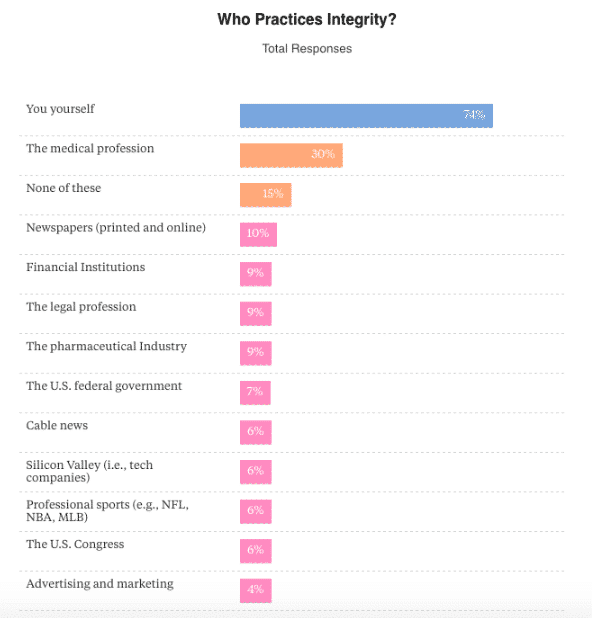
So how should you go about convincing your target consumer, knowing that most of them don’t trust you? Rely on word of mouth!
Word of mouth is a tool that each of us uses in our everyday life. Whether it’s for vacations, a restaurant, or a professional app, asking the opinion of a trusted third party determines the purchase. According to a study conducted by International Data Corporation, the concept of word of mouth is the main decision factor for B2B companies.
What’s more, word of mouth has taken on another dimension with the web. Today, more than two-thirds of internet users leave a positive or negative review online. These reviews are now advice that you can think of as word of mouth. If you have good ratings, you’ll also get opinion amplifiers. The very same opinion amplifiers that can help you convert leads.
For your word-of-mouth strategy to work, you of course need to focus on developing the best product/service and provide impeccable customer service. In other words, you must meet your customers’ needs before your own. Only then will your customers recommend your brand to their friends, families, or other consumers through various reviews.
2 – Podcasts
Coming from the United States, podcast consumption is constantly increasing in France. If we refer to a study carried out by Opinionway:
- 39% of people in France listen to podcasts daily
- 74% of listeners remember an advertisement heard while listening to a podcast
- 51% of listeners say they bought a product after listening to a podcast.
So, the podcast is a real asset in a context of visual information overload. However, that doesn’t mean that once you publish a podcast, it will be listened to by many people. Like any type of content, your podcast will only be listened to if it holds consumers’ attention, if it’s relevant to your audience’s needs, and if it entertains its listeners.
You just need to come up with an original and unique podcast concept.
To know: According to a study by researchers in the field of neuroscience, storytelling is the best way to capture consumers’ attention.
3 – Emails
Wasn’t email supposed to be dead this year? And last year? And the year before that? On the contrary, the figures prove that email marketing is not ready to say goodbye.
- 67% of internet users have at least 2 email addresses and are subscribed to more than 6 newsletters (2017 study Aberdeen Campaign Monitor)
- 75% of people go to a store to buy a product or service promoted in a newsletter
- 76% of newsletter subscribers have purchased a product or service online by clicking the link included in the email
Building a loyal, engaged subscriber base says a lot about the quality of your content and its emotional resonance. Even though many pieces of content saturate the internet and most people’s inboxes, they continue to engage actively with your content, which is a clear sign that they truly value it.
To learn more about building an email, what to do and what not to do to improve your open rate, feel free to discover our latest blog post: The best tips to improve the deliverability of your emails!
4 – Social media
Most people use social media to escape everyday life, have fun, and connect with others. Sometimes, however, brands forget why people use social media in the first place by blindly distributing their content to the widest possible audience.
With more than 2.7 billion social media users worldwide, millions of brands have been promoting their content on these platforms for years. But the popularity of social networks has flooded every platform with a multitude of articles, photos, and videos, drowning consumers in content.
So how do you make people notice your presence on social media? The first thing to do is to observe your audience’s behavior on social networks: Which social networks are they on, what they like, comment on, share, and at what time of week or day are they most active.
This analysis phase is crucial, because it’s thanks to this phase that you’ll be able to adapt your social media strategy to your audience’s needs and desires, and thus succeed in generating leads from your publications.
5 – SEO
Search engines are probably the best marketing channel for getting attention. Most people discover new brands and publications via Google. In fact, according to Google, 89% of B2B buyers and 81% of online buyers use search engines to look for new products and services.
Search engines are also one of the most effective marketing channels. Since people actively search for answers to their questions and solutions to their problems on Google, they are likely to download your offering or request a product demonstration if you can provide what they’re looking for.
Here are the steps not to miss when setting up your SEO strategy :
- Create a list of topics for your natural referencing (SEO) strategy
- Create a list of long-tail SEO keywords based on these topics
- Build one page per topic
- Create a blog to develop your strategy
- Create content every week to strengthen your authority and expertise in Google’s eyes
- Create a Backlinks strategy
- Stay informed about the latest SEO practices
- Optimize your site’s page load speed
- Track and analyze the strategy