

Traffic to your website is an important factor in your inbound marketing and it depends on your SEO. To achieve this, you need to create quality content that meets the expectations of algorithms. These algorithms aim to rank articles published on the web in order to provide internet users with results that are relevant to their searches. Conversely, you need to work on your content to prove its relevance in response to quality searches. We discussed this topic in depth with the Semji experts during our event on February 2, 2023, in Lyon.
Definition of SEO
The SEO, or Search Engine Optimization, includes the actions aimed at improving your position in the SERP (Search Engine Results Page) of search engines (Google but also Yahoo, Bing, Ecosia etc.). Natural referencing, as it is also called, therefore brings more visitors to your site.
SEO and SEA, what are the differences?
SEA is the abbreviation for Search Engine Advertising. Unlike SEO, it refers to ads that allow you to be displayed at the top of the first page. Here again, algorithms determine which ad will be displayed at the top, or will not be displayed. SEA results occupy the top of the page and the mention “ad” appears next to the site link. SEA differs from SEO in terms of costs.
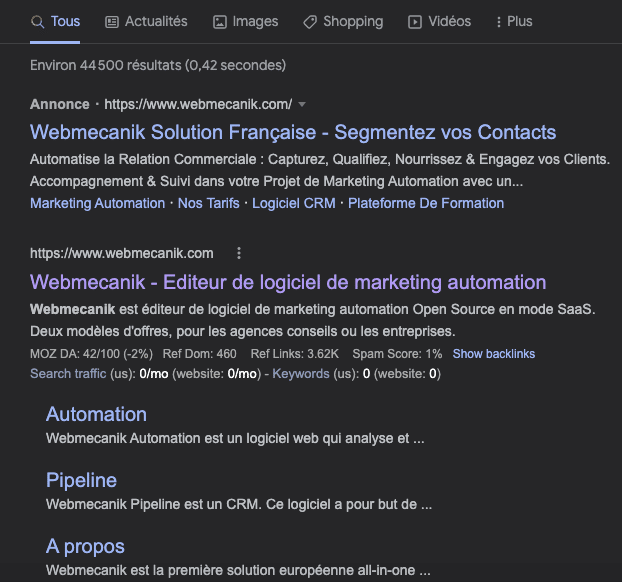
Google: how to get into the SERP
Google is the most widely used search engine. It accounts for 65% of searches carried out worldwide. Reaching the first page of results for a desired keyword is a real success. 91% of clicks happen on the first results page and potential traffic decreases sharply depending on the position you hold in the SERP.
Also read: Google Search Console: the guide to understanding the tool
|
Position |
Percentage of clicks |
|
1 |
34% |
|
2 |
17% |
|
3 |
11% |
|
4 |
8% |
|
5 |
6% |
|
6 |
5% |
|
7 |
4% |
|
8 |
3% |
|
9 |
2% |
|
10 |
2% |
So how do you get into the top results? Google relies on guidelines that provide the rules to follow and the limits not to cross. The algorithm then pays attention to several criteria:
- popularity
- content
- performance and optimization
To work on popularity, focus on external links and those pointing to your site. Content appreciated by Google is regularly enriched with new content, organized with titles and keywords linked to one another. Your site must also be optimized: quick to load, with a well-thought-out structure and internal linking.
II. Getting started with SEO: best practices
Let’s look in practice at how to get started properly in SEO, especially for articles that really perform!
Targeting topics
Start by defining a keyword. This can be a single word or a full expression, known as a long-tail keyword. To choose it, you need to study the market and competitor positioning. Several criteria must be taken into account: the number of searches for this keyword and the level of competition. Indeed, some low-search-volume keywords can be interesting to work on in order to avoid competition and gain authority.

Understanding intent
When you search for a keyword on Google, the results will include wording around the keyword that indicates the search intent.
Let’s take an example: when people search for “iPhone 15,” the overwhelming majority of titles talk about the release date and price. These are therefore the intentions of internet users when they type “iPhone 15”: to know the price and the release date. These intentions are essential to take into account when deciding the direction of your article. This is the information Google will look for to place you in the top position. Be careful, however, not to limit yourself to this. An article that offers added value will be favored more.
Adding images
Images have several advantages. First, an image says much more than words (thanks, Confucius!). Google builds its algorithm on user preferences and therefore highlights articles that contain one or two images. However, remember to fill in the tags and the image title. Also pay attention to its file size. The faster the image loads, the better its ranking will be.
Working on links
In an article, internal and external links are of crucial importance. First, links to other sites will allow you to show the relevance of your article and your sources. However, you should be careful not to cite competitor websites! A little tip: .gouv sites are highly appreciated.
Next, linking articles together is very important. However, this internal linking must be thought through and follow a logic. It is up to you to put your SEO technique in place and stick to it. You can vary between “Read more” links followed by the clickable title and contextualized links, which take up the idea of the title in a sentence.
Structuring the article
H1, H2, H3, table, drop-down list, image, paragraph: these are some of the many possibilities to mix for an article that is pleasant to read, both for your readers and for the Google algorithm! So vary the structure of your articles.
SEO: 2023 trends
EEAT: Experience, Expertise, Authority, Trustworthiness
Expertise, authority and reliability: this is what Google expects from articles in 2023 more than ever. To do this, create complete content on topics you are skilled in. By working on related topics, you will gain authority and reliability (“trustworthiness” in English). To meet the EEAT criterion, each piece of content must be unique and created from the writer’s Experience, while being relevant and written by experts, all on a trustworthy site. It goes without saying, but your links must also direct readers to reliable sites. This must be carefully considered during the internal and external linking phase of your article, known as netlinking.
Always bring more expertise
Your expertise is your added value. Your content must be 90% unique for Google to notice you. Gone are the days of texts designed to please Google, with keywords thrown in everywhere that add nothing, and certainly not the pleasure of reading!
Today, the algorithm only highlights content that answers internet users’ questions. And if your text is long (for good reasons!), that is a good thing. The longer the content, the more likely it is to contain more information. However, this implies structured and organized content!
Content is evergreen
There is not only text in life. This is especially true for users who mainly use Google on their mobile, which is a large majority of us. For the user, it is easier to listen to a podcast or scroll on social media while on the move rather than concentrate on a long text. The consequence? You need to think about the user on social media and create videos. But they also need to be well optimized to reach the top of Google! One article + one video + one reel on the same topic and coming from the same source will have much more impact than a single article.
Work on your titles
Work on your titles but stay vigilant. Google now changes titles that are too long or contain too many keywords to another title from your article. To avoid this and ensure good SEO, only include the targeted keyword and do not exceed the recommended length.
Artificial intelligence, the future of SEO?
ChatGPT artificial intelligence has existed since 2015, but it is its latest version released at the end of January 2023 that is making headlines. This dialogue-specialized robot answers all your questions and will no doubt revolutionize the way we use the internet and, in particular, content creation. But is it good for SEO? Not really!
Yes, it avoids writer’s block and makes it possible to design text outlines, but in no way will copying and pasting texts from ChatGPT be viewed favorably by Google in terms of SEO. Sorry! Indeed, these automatically generated texts may contain (serious) errors and will never replace a human being who has the ability to properly source their information.

To learn even more about SEO and discover other trends that will be everywhere in 2023, download our free e-book created with Semji on the topic of content recycling.

In conclusion, SEO is a complex topic that is nevertheless necessary in 2023. Step by step, you can improve and see your pages progress in rankings.
And to further increase your sales performance, you absolutely must combine the strengths of SEO and Marketing Automation.