The 6 reasons to integrate your CRM and Marketing Automation software
Developing and maintaining a relationship of trust with your customers is essential to your company’s success. The multiplicity of customer journeys and platforms greatly complicates this customer relationship management. As personal data is now the fuel of all growth, you lose a huge competitive advantage if you do not master CRMs and other Martech solutions (a contraction of Marketing and Technologies).
To help you see things more clearly, I suggest distinguishing the differences between Marketing Automation and CRM, the advantages of each, and finally why and how they complement one another. And to finish, the six reasons why you must synchronize them perfectly.
More than 100 CRMs are synchronized with Webmecanik Automation. Salesforce, Microsoft Dynamics, Hubspot, Pipedrive, Sellsy and many more.
The differences between marketing automation and CRM
What Marketing Automation is
Marketing Automation software allows you to send the right message, to the right person, at the right time. How? By segmenting contacts according to their behavior, scoring their maturity level regarding your topics, and automating actions for sending personalized messages.
Marketing Automation manages your customers’ behavioral data.
Not only does it become difficult to carry out all of your marketing actions manually without getting lost and devoting costly resources to them, but as with anything done manually, the margin for error is significant. For example, launching a promotional campaign on products your contacts have just bought at full price is a common mistake, notably due to the impossibility of updating dynamic segments.
What differentiates Marketing Automation from CRM is that you can track in real time the behavior of prospects engaged with your brand and analyze their data. You thus automate highly personalized campaigns and give your customer service team information that enables them to engage the relationship at the right time with the right message.
Marketing Automation will execute your campaigns and your repetitive tasks such as scheduling and sending marketing emails, and managing your many contact lists.
Marketing Automation is also very often used for prospecting, autoresponders and lead qualification in order to move prospects forward through a predefined customer journey. But it is important to know that many scenarios are possible, involving different touchpoints such as organizing events, trade shows, webinars, your FAQ page, developing your ambassadors, or re-engaging inactive contacts.
23 scenarios and KPIs that will boost your customer and partner relationships with the first book on marketing automation to boost your business.
What Customer Relationship Management (or CRM) is
CRM is first and foremost a management tool. It is software used for managing contacts, sales, information about distributors and influencers. CRMs are increasingly becoming ERPs that also offer quote, billing and cash flow management modules. CRM is a knowledge base for your historical customer data.
With a CRM solution, you will be able to work analytically based on this history. Target your most profitable customers, adjust pricing according to your contact segments or sales seasonality, manage your customer service, forecast your sales by geography, etc.
Customer relationship management software keeps track of your customers and partners. It records factual information such as email addresses or phone numbers, but also meetings as well as all the actions carried out by your marketing, sales, customer success or support teams. Ideally, the most advanced ones save you from manual data entry by integrating call capture and other automatic data updates via the forms your contacts fill out
What is the difference between Marketing Automation and CRM?
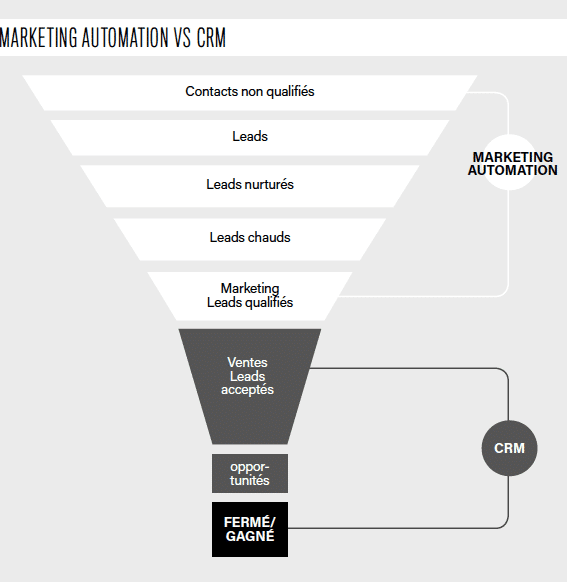
To sum up, Marketing Automation allows you to automate your marketing campaigns using predefined conditions and triggers. It will detect weak signals, compile them to make them understandable and actionable by salespeople via the CRM.
CRM helps you manage your sales processes and keeps your sales team organized using a database. It automatically assigns tasks to salespeople as leads move through the sales funnel.
More generally, Marketing Automation is mainly used at the top of the funnel, while CRM is dedicated to the bottom of your funnel.
The 6 reasons to integrate your CRM and Marketing Automation software
1 – Automated list and segmentation management
Your segments allow you to organize your contacts according to their interest identified by content (Marketing Automation) or proven through purchases (CRM).
Marketing Automation allows you to manage your contacts according to their behavior, thus enabling you to immediately adapt the content of your campaigns. CRM, for its part, will use this behavioral data to confirm consistency (or not) thanks to information from sales and the contact’s history with your company.
If behavioral information (MA) goes against historical information (CRM), this constitutes a weak signal that must be qualified quickly: a call, an invitation to lunch, or contacting partners and influencers in a complex B2B sale, a requalification email using suitable rich content such as a video in B2C.
Not only does CRM allow you to keep your lists automatically up to date, but it also helps you avoid inconsistencies in messaging or actions that may be perceived negatively by your customers and prospects.
2 – Autoresponders and triggers
When you want to scale your sales activity (Scalability is used to define the ability of an IT product to adapt to fluctuations in demand while maintaining its various functionalities) without increasing your human resources, automating your marketing is essential for very simple tasks such as:
- Website visitor filling out a contact form
- Online order confirmation
- Newsletter subscription
- Booking an appointment
- Watching a product demo
- Registering for a webinar or a trade show
Autoresponders will help you automate your confirmation emails and respond to customer actions instantly.
The 5 emails to automate right away to make your life easier and satisfy your customers
Triggers (scenarios that are triggered under prior conditions of actions and/or scoring) will engage your prospects when they are most interested in you, quickly (automation) and effectively (personalization).
3 – Continuously qualify the data in your CRM
Having 100% of the data in your CRM up to date, a Holy Grail? Perhaps a reality with Marketing Automation.
With all the actions automated based on your content, you will have a wealth of information about interests (topics, products, communication channels, best times for interaction) that you will use to automatically update the segmentation of your customers, but also how close they are to taking action.
Moreover, if you place forms inside your videos and on downloads of your main marketing resources such as white papers or use cases, then you will also update contact details. By using progressive profiling, you auto-complete the data you already have on your contact, they complete the rest, or even correct what is no longer up to date. And your salesperson no longer has any data entry to do!
Tutorial – How and why to do auto-completion of your contact forms.
4 – Your customer data speaks to you
Marketing means making decisions solely on the basis of quantified and objective data.
At last, you will have factual data related not only to your customers’ history such as their purchases and order lead times, and even their financial scoring provided by organizations such as Euler or CreditSafe. But in addition, you will be able to cross-reference them dynamically with their behavioral actions on your websites, your webinars, and even at trade shows.
For example, when a customer registers for one of your events, you will nurture them with dedicated actions. A proposal for a qualified meeting if they attended, and a video replay of the conference in the second case.
The cross-referencing and analysis of data from your CRM and Marketing Automation keeps you focused on the most important key performance indicators by making them easily accessible.
5 – Get a reliable picture of your customer journeys
Finally, marketing and sales teams will be able to optimize their actions with a very precise idea of where a customer is in the sales funnel.
Customer journey mapping is a process of visualizing how each interaction and touchpoint is established between your company and your customers (existing or prospective.)
“Get closer than ever to your customers. So close that you tell them what they need before they realize it themselves” – Steve Jobs, co-founder and CEO of Apple.
CRM will inform you about transactions carried out by the customer such as purchases, calls or appointments made. Marketing Automation will inform you of all the actions they have taken without your knowledge and in what order. This way you know the performance of your assets. You will even be able to score an asset differently depending on when in the sales cycle it is engaged. For example, a prospect who accesses a demo video (Marketing Automation information) will earn 5 points, whereas if it is after a quote has been issued (CRM information) it will earn 50. Indeed, in the first case it is just a signal of interest that is added to the others; in the second it is proof that they have almost chosen you and that they are re-assuring themselves about their choice. So this is the right time to call them and close the deal!
6 – Make GDPR easier for yourself
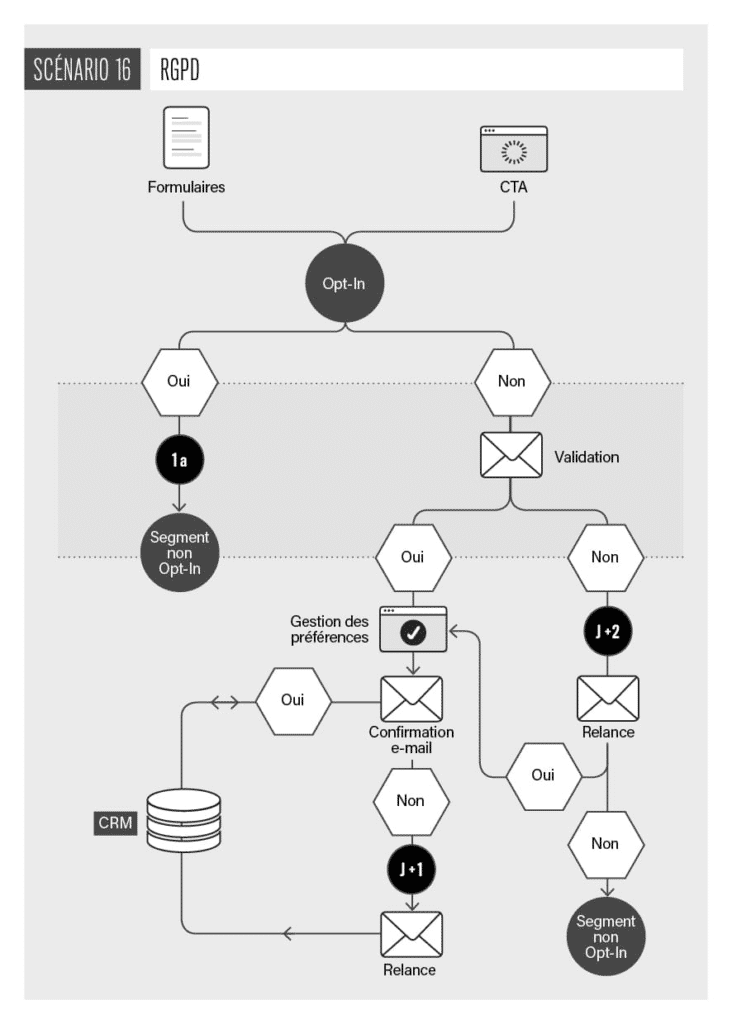
The GDPR requires companies to collect only the necessary data, securely, while being responsive to contacts’ requests. The person’s consent is the basis for data processing. Each company must therefore collect explicit (B2C) or tacit (B2B) agreement to use the data. In any case, this practice fits with the spirit of inbound marketing, which seeks to attract rather than force the lead.
Finally, since you have all the data (historical thanks to CRM and behavioral thanks to Marketing Automation) in one place, it will be very easy for you to give consumers and contacts who request it access to it. The same goes for deleting it.
Moreover, a double opt-in presents a major advantage: automatically revalidating the validity and accuracy of your contacts’ email address. According to LinkedIn, professional email addresses change on average every 18 months … during a change of company of course. Yet another great opportunity to congratulate your contact and qualify their new needs, but also to check that a new person has indeed arrived at the company they just left and may need to be trained. A double opportunity to sell!
The comparison / benchmark to choose your Marketing Automation solution wisely.
What now?
Now that you are convinced of the usefulness of synchronizing your CRM and Marketing Automation solutions, you will need to implement a marketing and content strategy. Before taking action, I suggest this self-assessment which will allow you to evaluate your Inbound & Marketing Automation performance. The personalized report will help you identify your areas for improvement and better define your action plan:
- You evaluate the performance of your Inbound & Marketing Automation practices in just a few minutes
- You receive personalized advice to go further as your answers progress
- You get your score and receive the Inbound & Marketing Automation barometer in France