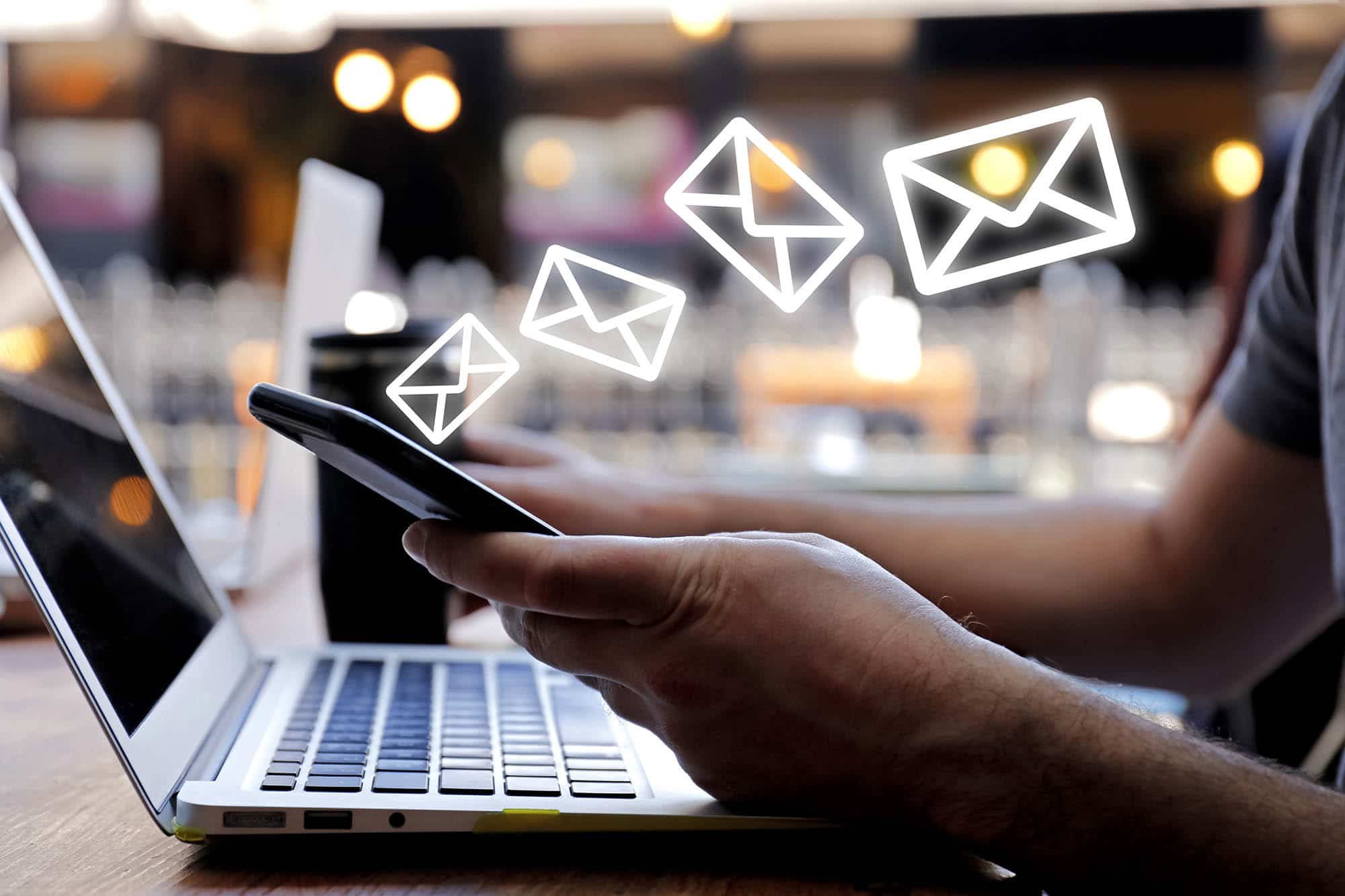
2 billion emails are sent per month, and when the GDPR came into effect, records were broken with more than 100 million emails sent per day. Emailing remains a preferred communication channel, whether for institutional, transactional, or marketing communication, and marketing email statistics should be monitored.
It is therefore important to take the utmost care with your emails to optimize deliverability.
You should know that more than 14% of emails do not arrive in the inbox.
First of all, let’s define the concept of deliverability: it refers to the number of messages that reach the recipient’s primary inbox, without being deleted, filtered, or placed in a spam folder.
Deliverability can be impacted (positively or negatively) by different criteria:
- the quality of the contact list,
- the targeting of this list,
- the content of the message,
- the sender’s reputation,
- sending frequency,
- open, unsubscribe, and bounce rates.
MAINTAIN GOOD CONTACT LIST HYGIENE
Data collection
One thing you should not do is import a contact list without checking it.
The collected data must, first of all, be correct:
- not contain typos,
- not contain inactive addresses,
- not contain nonexistent addresses.
There are services like “neverbounces” or others with which most sending providers have partnerships, allowing you to verify your email addresses.
Blasting emails to a database containing many “bad” email addresses will generate a much higher bounce rate, which will negatively affect your e-reputation and therefore your deliverability.
Opt-in
In addition, with the GDPR, it has become mandatory to obtain consent from people in B2C.
Your online forms must include an opt-in field. This allows you to send emails to people who want to receive them, so your open rate will necessarily be higher. Likewise, the unsubscribe rate may potentially be lower because your contacts will be interested.
The open rate as well as the unsubscribe rate are important elements that affect deliverability. The higher your open rates, the more your deliverability improves. Conversely, the higher the unsubscribe rate, the more negatively your deliverability is impacted.
Double opt-in
The double opt-in is a very good way to improve the quality of your contact list.
The principle is to send an email to a person who has signed up (by giving their consent), in which a link is included inviting them to click on it to ensure that the email is legitimate and really exists. This helps avoid typos such as “@gmil.com instead of @gmail.com”.
Inactive contacts
Inactive contacts are much less likely to open your emails and therefore lower your email open rate.
If a contact is inactive, it may be because they are no longer interested in your products/services. You should therefore remove them from your mailing lists.
You can consider an inactive contact to be someone who has not opened your emails for 6 months.
Captcha
Set up captcha/reCaptcha to prevent bots from submitting your forms and polluting your database with “fake” contacts.
Segmentation
Once your contact database is “clean,” it is imperative to segment it. Indeed, it is not relevant to send emails on this or that topic to people who would not be interested, because that would lower the open rate.
Segmentation can be done according to different criteria:
- demographic,
- behavioral: site browsing, interests, etc.
MESSAGE CONTENT
Taking care of the message content can greatly improve deliverability.
Subject line
The subject line is the first thing the person will see in their inbox. It is what will make them want to open the email.
The subject line must not contain:
- keywords related to finance, taxes, money, huge discounts, etc.: unless you are legitimate in these fields,
- words in capital letters and special characters: example HUGE PROMOTIONS!!
It can contain:
- emojis,
- personalization: such as the person’s first name in the subject line.
Text/image ratio and length
It is recommended to have a text/image ratio of 60%/40%.
In addition, the email should not be too long, otherwise it may be truncated by some email clients such as Gmail.
Email weight
The size of the email can have a major impact, since an email that is too heavy is much more likely to end up in the spam folder.
It is recommended not to exceed 500KB. You therefore need to pay attention to the size of the images inserted in the email.
Unsubscribe link and online viewing
Contacts must be able to unsubscribe easily.
At a minimum, the unsubscribe link must be included in the email footer. It is even better to include 2, one in the header and the other in the footer.
The same goes for the online viewing link; with some email clients, the rendering may not be optimal. The person must therefore be able to view the email in their browser.
Offer a text version
Some email clients (such as Outlook, for example) may have trouble reading your email; one solution is to offer a plain text version.
Optimize the HTML
Do not hesitate to test your email’s HTML on sites such as the W3C website. It is common, for example, to forget to close a tag.
Responsive design
Knowing that emails are increasingly viewed on smartphones, your email absolutely must have a responsive design (display correctly depending on the different devices).
Personalization
Personalizing emails consists of adding different contact fields (such as first name, last name, etc.)
Personalizing the email (especially in the subject line) greatly improves the open rate.
A/B test
Use A/B testing to test your different email versions and see which one works best. A/B testing can also be done on different sending times.
Test your emails
Don’t forget, before launching your email campaign (or blasting your newsletter), remember to send the emails to yourself to see whether the rendering is good.
SENDER REPUTATION
Your sending server necessarily uses one or more IP addresses. There are 2 types:
- dedicated IP addresses,
- shared IP addresses.
It is important to monitor the reputation of the IP address because with a blacklisted IP address, you have much less chance of reaching the inbox and therefore the spam rate will be higher.
Dedicated IPs
You are the only one sending emails on this IP. You directly manage your reputation.Use a dedicated IP if you send a huge number of emails at a recurring frequency, without spikes from one send to another.
To get started with a dedicated IP, you generally need to go through a warm-up phase. This consists of making different email sends while gradually increasing the number of sends.
Shared IPs
You share this IP with other companies and therefore share the reputation.
The advantage of being on a shared IP is that if you do not send emails regularly and you have sending spikes, this spike will be absorbed by the pool of shared addresses.
AUTHENTICATION
Authentication standards make it possible to give legitimacy to the sender (the domain name). This does not prevent you from ending up in SPAM, but webmail services (Gmail, Yahoo, etc.) and ISPs (Orange, SFR, Bouygues, etc.) will be more inclined to let emails through to the primary inbox. In addition, this secures your domain name so that it is not used by spammers.
It is strongly recommended to implement these 2 protocols:
- SPF (Sender Policy Framework),
- DKIM (DomainKeys Identified Mail).
SPF
Via a TXT record in the DNS zone of the sender’s domain name, this consists of authorizing the IP addresses that can send emails using this domain name.
DKIM
This also works through a TXT record in the DNS zone of the sender’s domain name. DKIM contains a public key and a private key and, in addition to authenticating the domain name, guarantees the integrity of the message.
SENDING FREQUENCY
Sending frequency is an important criterion to take into account.
If you regularly send 10,000 emails but suddenly need to send 200,000, you will need to go through a warm-up phase.
Also, ISPs (Orange, SFR, etc.), unlike webmail services such as Gmail, are not used to receiving a huge quantity of emails all at once. They can therefore throttle the emails (letting only 1 through every 30 seconds, for example) or, worse, put them in spam.
Read also: How to read marketing email statistics with robot (bot) behavior?
Read also: Email spam?
Read also: Emailing solution or marketing automation: why and how to choose?
In conclusion, email deliverability is impacted by different criteria. It is therefore important to keep all of them in mind because it is the sum of all these criteria that will improve your deliverability and therefore your open rates.