
You don’t know which workflow to start with in your marketing automation strategy? Discover the three most important marketing campaigns to get started.
The steps for creating a marketing automation campaign
The highest-performing workflows
The steps for creating a marketing automation campaign
Define your target audience
The first step in designing your marketing automation campaigns is to define your target audience. Who do you want to address your message to? It is important to communicate differently depending on the person receiving the message: a marketer, a manager or a director. Marketing automation software allows you to segment your database according to demographic and behavioral criteria, for example, marketing directors of very small businesses/SMEs who have visited your pricing page. The key word: adapt.
Define your objective
One marketing campaign = one SMART objective! In other words, an objective that is clearly defined, measurable and achievable! Your objectives can be:
- Generate 50 new leads over the next 3 months
- Convert 20 leads over the next 3 months
- Generate 5% revenue from my existing customer base.
The more precise your objectives are, the more likely you are to achieve good results.
Define the stages of the journey
Now that your objective is set, it is time to define the stages of your marketing campaign: how will your target audience be able to help you reach your objective? How many emails will be needed to get there? Do your prospects need to fill out forms? Visualizing your sales funnel before building your campaign is an excellent way to optimize the user journey and avoid future mistakes (for example, sending a promotional offer to a customer who has just bought a product).
Create content
It is now time to create your content! If you followed the previous three steps correctly, this one should be a piece of cake! Use the most appropriate format (video, email, article, pop-in) and address your target audience’s challenges.
The highest-performing workflows
In marketing automation, there are many campaigns that you can use in your strategies. We suggest starting with classic campaigns that are inseparable from a good marketing automation strategy:
- A lead generation campaign
- A lead conversion campaign
- A customer loyalty campaign.
Generate leads effectively with marketing automation
Why set up lead generation campaigns
Generating leads regularly is essential for a marketing strategy. That is why one of the first campaigns to set up is a lead generation campaign. Shall we explain?
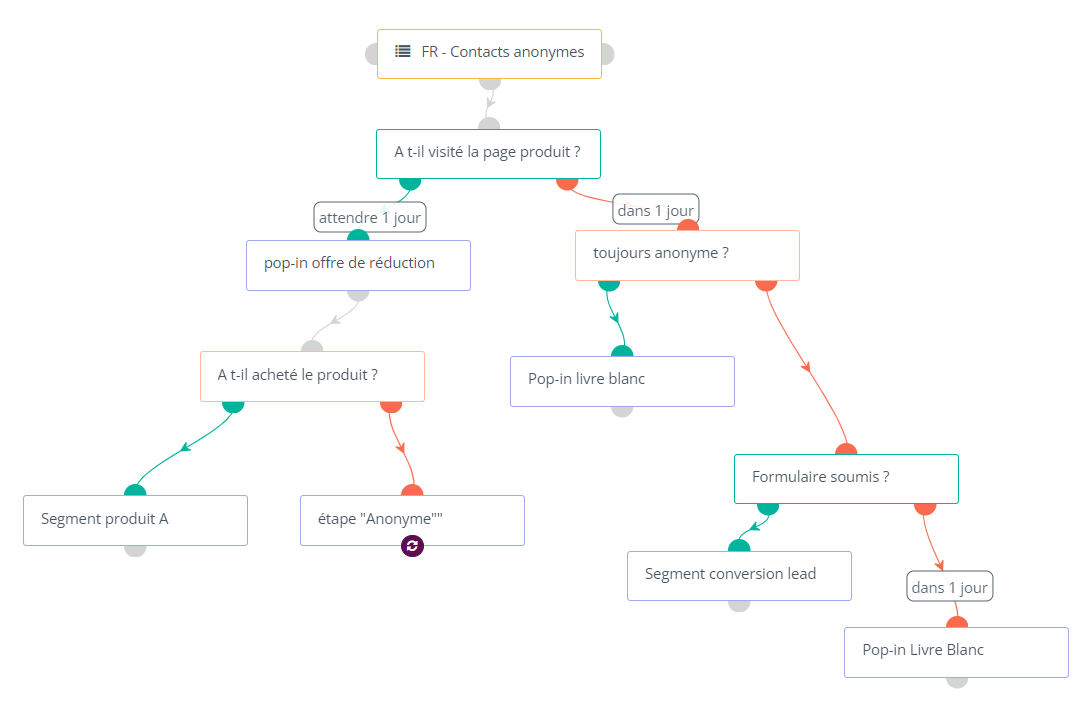
The objective of this campaign is to obtain the contact details of your website visitors in order to feed your database.
If we go back to our campaign creation steps, our target will be your website visitors and our objective will be to collect their data. Here, we are going to use a marketing automation feature: the pop-in.
The campaign starts when the person goes to your website, especially one of your product pages.
Left branch
Once the contact has visited a product page on your site (thanks to behavioral tracking), a pop-in with a personalized offer will appear on the site during their next visit (this can be a newsletter subscription, a discount on a product, a quote request, etc.). If the person responds favorably to your offer, they enter the segment “Product A purchase,” which groups together everyone who bought product A. On the other hand, if the action is not completed, they join the “Still anonymous” stage in the right branch to maximize the chances of collecting their contact details.
Right branch
Your visitor has not visited your site or you do not have their contact details? You have the opportunity to set up a pop-in during their next visit to offer them a resource to download. The objective: collect data. If a form has been submitted, your visitor becomes a prospect and enters the campaign dedicated to conversion. As long as the visitor has not submitted a form, the pop-in will continue to appear.
Convert your leads with marketing automation
Why set up conversion campaigns
The goal of conversion campaigns is to turn leads into customers. You will set up a workflow to encourage them to carry out actions such as making a purchase or signing up for a service.
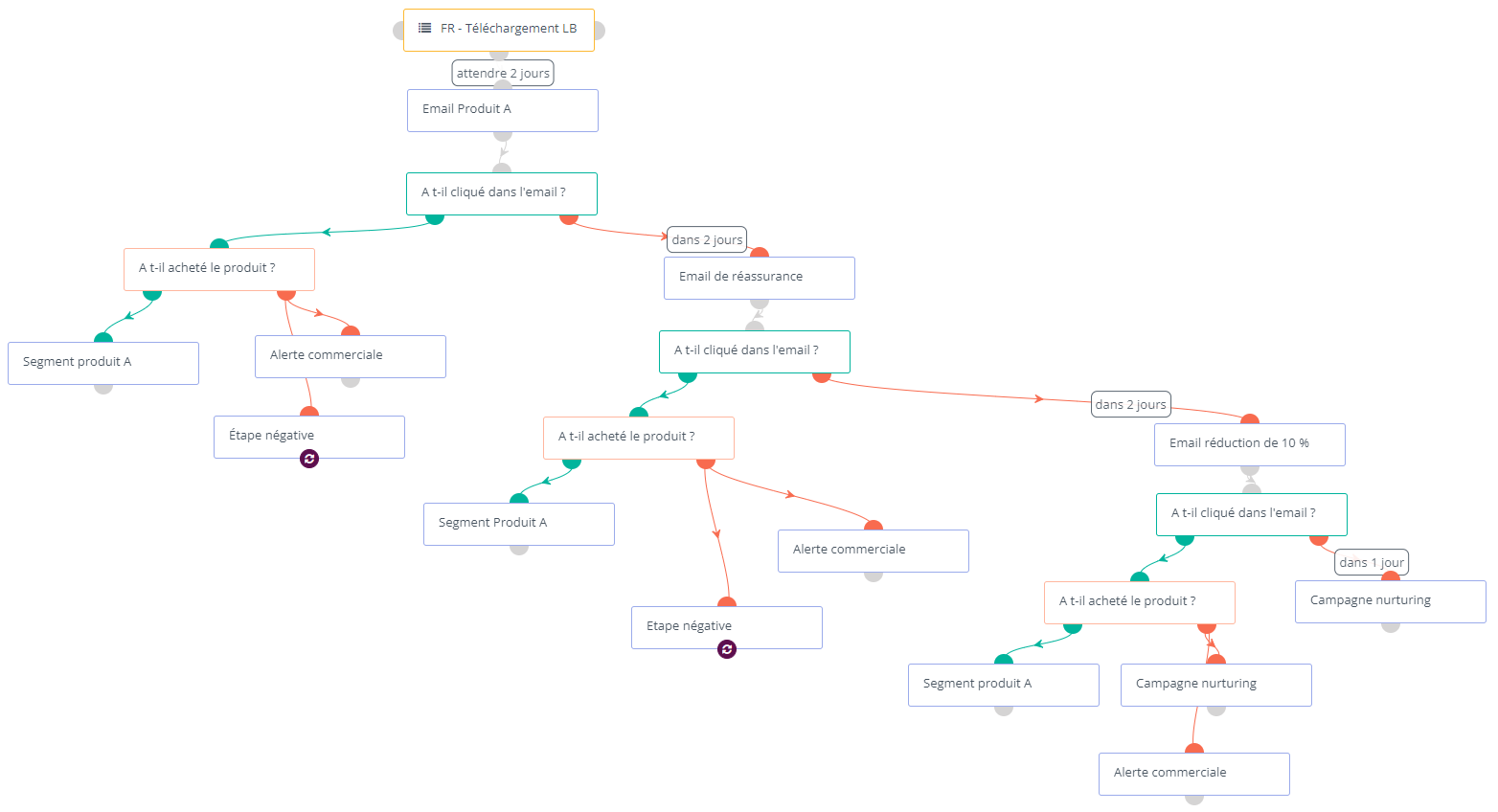
The objective of this campaign is to convert all the prospects who have downloaded a resource from your website into customers. You will therefore guide them step by step through your buying journey.
The initial target audience is prospects who have downloaded a white paper. You begin by sending them an email dedicated to promoting one of your products. The scenario develops according to your prospect’s behavior
Left branch:
The branch starts when your prospect opens and clicks on the email. Two possibilities: your prospect buys the product and moves into the buyers segment. The objective is achieved. Or the person has not bought the product. In that case, they move to the “reassurance email” event and your sales team receives a notification with all the information about the prospect’s behavior.
Right branch:
The branch starts when your prospect does not open the first email sent. The objective here is to stay in contact with your prospect for as long as possible. To do this, you will send a reassurance email about your product on day 2.
If the prospect bought your product thanks to the follow-up email, then they enter a specific segment; otherwise, they continue on to the third part of the campaign
The last part of the campaign follows the same principle: if the person did not open the previous email, they receive a much more aggressive sales email to encourage them to buy (in this campaign, it is a discount, but it could be a gift from your company, or consumables if you sell items that require consumables).
If no purchase has been made, a nurturing campaign will need to be set up.
Our tip: have you thought about A/B testing for your marketing automation campaigns? It is an excellent way to improve their results.
Build customer loyalty with marketing automation
Why set up loyalty campaigns
Why stop at the initial purchase when you can offer your customers upsell or cross-sell opportunities? Let us explain the campaign.
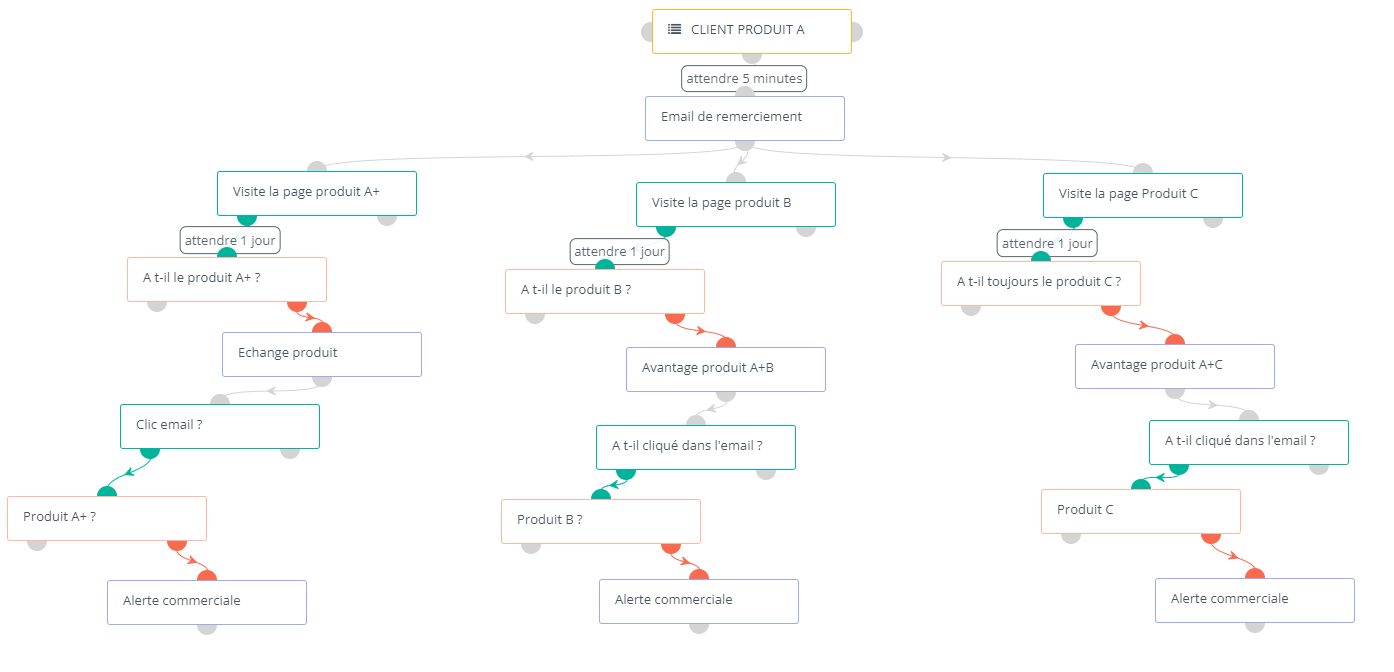
Your goal here is to build loyalty among customers who bought your product A. You will send a thank-you email. Your objective is to guide them toward buying another product.
Left branch
Your customer owns product A and visits a page for the same product with more features or from the higher range. The upsell campaign begins. Depending on the information you have about your prospect (Have they already bought this product in the example above), you can send them an email and offer them an exchange for the new product.
Center / right branches
The following branches follow the same reasoning; you can duplicate them according to the number of products you offer. Your customer owns product A, for example, a computer, and visits the page for product B, for example, a mouse. Depending on the information you have about your prospect (Have they already bought this product in the example above), you send them an email presenting the advantages of the two products together.
Our tip: remember to integrate a sales notification if the person clicks in the email, to bring your sales team into the process.
Webmecanik’s tips
- Be GDPR compliant
When you want to collect, use or share data from your contacts, you must first have obtained their consent!
- Make your marketing campaigns your own
The campaigns presented are generic. They must be different depending on your products and services. It is up to you to adapt them to your marketing needs and your conversion funnel. You can also have fun adding scoring to measure the maturity of your leads in your marketing campaigns
- Also think about SMS campaigns
SMS messages are read in most cases within 3 minutes of being sent. This article on best practices for a successful SMS marketing campaign should help you implement them in your strategy.
- Get support with your marketing strategy
Webmecanik helps its clients implement their marketing campaigns. A Customer Success Manager is assigned to each client in order to establish their strategy according to their needs for better workflow implementation.