
Purpose and how a CRM solution works
Advantages and benefits of CRM
Connection with marketing automation
What is a CRM?
CRM, or Customer Relationship Management, is a term used in the field of marketing and customer relationship management. This “Sales Relationship Management” software in its French version refers to a set of practices, strategies, and technologies aimed at improving the management of interactions with customers and prospects. It is an essential tool for any sales representative who wants to accurately track their activity and achieve their goals.
Among other things, it allows the sales representative to record and therefore centralize all customer-related information, such as contact details, purchase history, and past interactions, in a single database. Thanks to this data, companies can better understand their customers’ needs and preferences, enabling them to personalize their interactions and provide more efficient service. CRM also facilitates coordination between the different departments of a company by allowing information sharing among sales, marketing, and customer service teams. CRM is an essential tool for managing and improving customer relationships, by providing a complete overview and helping deliver more personalized, higher-quality service.
Did you know? A survey conducted by the website Stradenet in 2022 reveals that 91% of companies with ten employees or more use a CRM to manage customer conversations.
Purpose and operation of CRM:
The main objective of a CRM system is to help companies better understand, manage, and maintain their customer relationships. The idea is to centralize all customer information and make it accessible to all relevant departments, such as customer service, marketing, and of course sales. Webmecanik Pipeline, for example, makes it possible to collect, transform, and track all your sales opportunities. Here is what a good CRM solution looks like:
CRM works by collecting and recording customer data provided by the sales representative, such as contact details, purchase histories, preferences, past interactions with the company, etc. This information is then used to personalize interactions with prospects, provide better service, target specific offers and promotions, and improve customer loyalty. A great advantage for your company’s marketing department too! Speaking of advantages… Here is why you absolutely need a CRM.
Advantages and benefits of CRM
CRM offers many advantages for businesses and enables highly organized operations, making it easier to achieve sales goals… because we love making life easier! ?
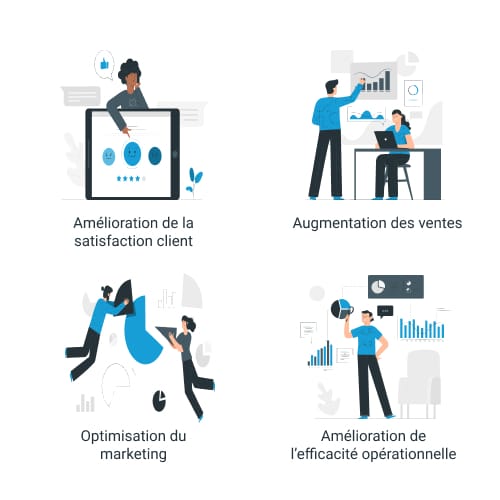
Benefit no. 1: improved customer satisfaction:
By having access to all relevant customer information, a company can offer more personalized service and respond more effectively to their needs. The responsiveness of after-sales service is always what customers appreciate most and it strengthens loyalty between a customer and the company. Even in pre-sales, if the sales representative is responsive and thorough in their answers, they are much more likely to convert a prospect into a customer.
Good to know: Webmecanik places customer satisfaction at the heart of its business, and 98% of customers say they are satisfied with the support they receive… Give it a try!
Benefit no. 2: increased sales:
CRM makes it possible to better target potential customers and track sales opportunities. Better understanding customer needs is indeed invaluable for sales and marketing teams. Good use of a CRM (your CRM must be completed and updated regularly) makes it possible to manage sales pipelines effectively, which can ultimately result in increased sales. Better organization = better achievement of goals?
Benefit no. 3: marketing optimization:
Thanks to CRM, companies can segment their customer base, analyze data, and create targeted marketing campaigns with marketing automation, which leads to better marketing performance.
Benefit no. 4: improved operational efficiency:
By centralizing customer information and automating certain tasks, CRM saves time and improves the efficiency of internal processes.
Connection with marketing automation
Good to know: when a company implements a CRM, it is used by sales teams (80%), marketing (46%), and customer service departments (45%).* In fact, a CRM can be used by at least three departments in your company to go even further in performance, customer satisfaction and achieving sales objectives. To do this, you need to connect your CRM to your marketing automation software and take advantage of the many benefits this synchronization has to offer. ?
Synchronization between Webmecanik Automation and Webmecanik Pipeline, for example, enables smooth integration of customer data between the two systems. You can synchronize key information such as customer or prospect contacts, the segments of your choice, purchase histories, and interactions with your prospects, providing a more complete and accurate view of your customers.
This is important for your marketing colleagues too! This integration makes it easier to create targeted and personalized marketing campaigns. They can then use CRM data to segment the customer base and send specific messages based on customer preferences and behavior.
This synchronization indeed improves campaign efficiency and increases the chances of conversion.
Finally, by connecting CRM and marketing automation software, you can automate certain tasks, such as sending follow-up emails, managing responses, and qualifying prospects. Save time and resources at last, while offering a consistent and personalized customer experience.
Linking your CRM with your marketing automation software therefore improves the personalization, efficiency, and management of your marketing campaigns, while offering a smoother and more satisfying customer experience.
So if you want to improve customer satisfaction, increase sales, optimize marketing actions, and improve operational efficiency, all while centralizing customer information, a CRM solution is for you! The key benefit? A better understanding of customer needs, which will ultimately strengthen customer loyalty and the growth of your company over the long term.