

According to a study carried out at the end of 2015 by the agency Noir sur blanc, no fewer than 80% of business schools have evolved their brand over the last 15 years. In just a few years, branding has become a strategic discipline for all higher education institutions. Yet 20 years ago, likening a grande école or a university faculty to a brand would almost have caused a scandal. And, with the notable exception of Sciences Po, which had already embarked on such thinking under its then director, Richard Descoings, few institutions had yet taken an interest in their brand(s) and how they evolve. They now define their cultural uniqueness and strengths; it is a matter of trust for all stakeholders: domestic and international students, alumni, distinguished guest speakers, teacher-researchers, institutional partners and companies.
It is a revealing symptom of an interesting paradigm shift. But beyond the brand, there is a new requirement for consistency in content and the adaptation of interfaces. What we know from brand / consumer relationships also applies to the relationships between schools and their customers. Education has fully entered the commercial sector, and differentiation in the face of competition depends on reassuring the various stakeholders. Redesigning processes, content and relationship chains is becoming mandatory, at the risk of immediate disruption.
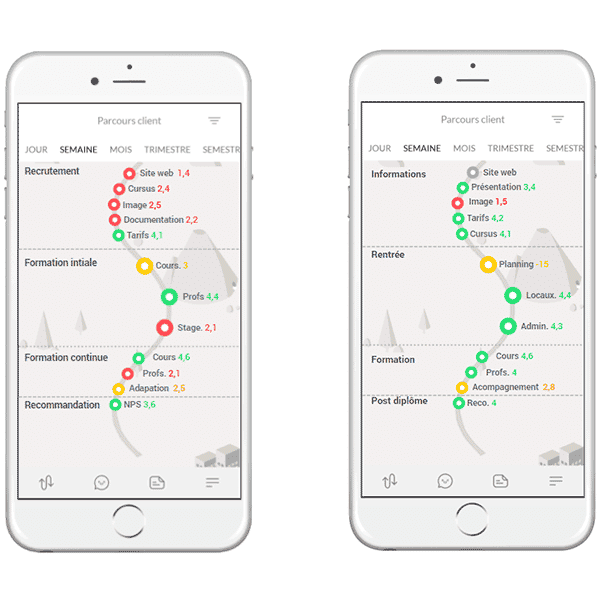
We recommend working on three points:
- study in advance the expectations and needs of the different audiences (especially international students, guest speakers, etc.) and test their perception of content and processes throughout their user journeys,
- do not hesitate to seek external advice in order to move beyond preconceptions and allow yourselves to ask new questions,
- rely on the influence of schools’ natural allies and ambassadors: starting with students, of course, who are the least resistant to change, but also alumni, who have spread out and can also bring the experience from their own companies in this field. Those working in banking and insurance, for example, know exactly what this involves, and those in fintech and other foodtech sectors are thoroughly familiar with UX methodologies and customer journeys.
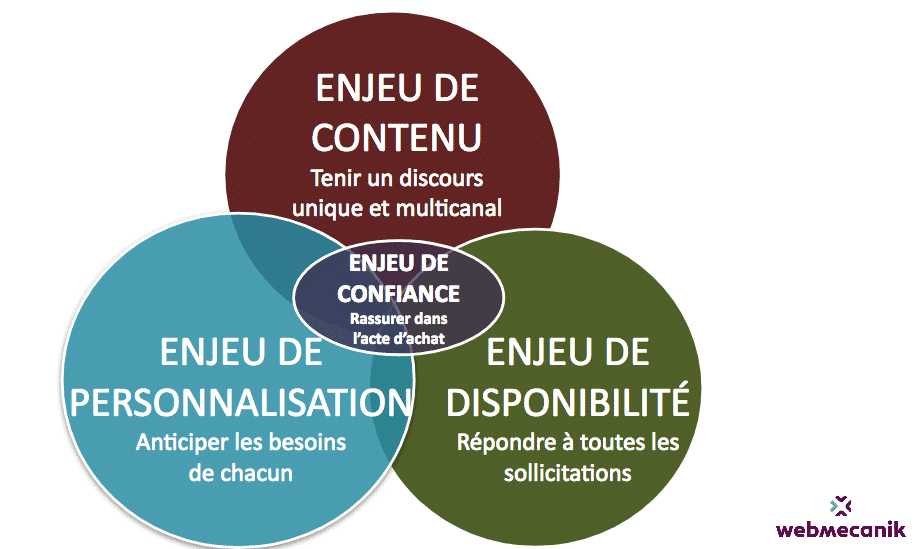
This will enable you to address the threefold trust challenge of your domestic and international students, alumni, distinguished guest speakers, teacher-researchers, institutional partners and companies:
- A content challenge, with consistent messages and values throughout your journeys and communications,
- a personalization challenge: moving beyond standardized messages toward mass personalization, delivering the right content at the right time to the right person,
- an availability challenge: your contacts must be able, 24/7, to find the right information and initiate a process with you, deciding when and how they engage with you.
Did you know? Marketing spending in the Education sector accounted for 11% of revenue in 2015, compared with 24% for consumer goods or 15% in B2C services. Industry stood at 8%. Source: Deloitte CMO Survey 2015 |
Scenario example – Engage your alumni
Marketing automation expertise
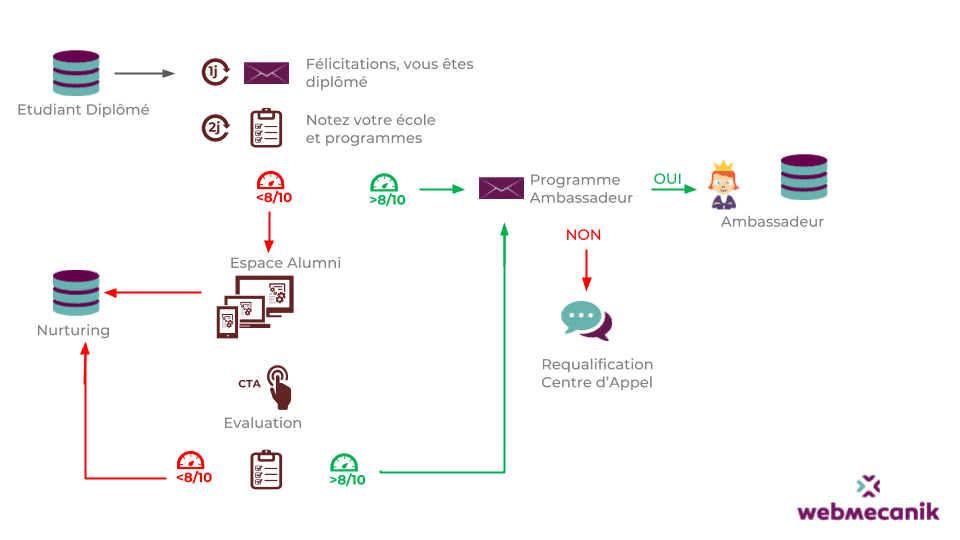
Congratulations, your students have graduated and are about to join the cohort of executives in companies. Nevertheless, alumni associations constitute networks whose reach is generally underestimated. They help amplify schools’ reputation, provide advice and lobbying to support their strategic projects, help guide their programs in order to prepare students for the jobs of tomorrow, develop access to major international groups, and can even participate in funding through fundraising efforts supported by alumni.
The Alumni relationship appears to be a key resource for your school, a strategic “asset” in business terms. Managing this network is fundamental to your future. To do this, you must maintain a direct connection with your Alumni, know them and cultivate the relationship with them. Engage them as ambassadors as soon as they leave the school.
The scenario
Main objective:
- Increase the effectiveness of your recruitment campaigns
- A simple and user-friendly journey for the candidate
- A self-assessment test
- Ongoing support
Score
- The level of satisfaction
- Alumni engagement
Segment
- Ambassadors
- The right referral program
|
The benefits
|
|
Expected results
|
To meet these trust challenges and capture data through the automation of your tasks, your institutions must switch to 24/7 mode. Discover, in 5 key points, how to trigger the transformation of your institutions.