

At Webmecanik, we are proud to take part in the Email Expiration Date initiative, led by Zero Carbon Email. This collective project aims to reduce the carbon footprint of the email industry by limiting how long outdated emails remain stored in inboxes.
In line with our CSR commitments and our journey toward Responsible Digital certification, we have integrated this new eco-friendly standard that allows you to set an expiration date for your emails.
Why add an expiration date to your emails?
Every day, billions of emails are sent, yet very few are ever deleted. Most remain stored for years on mail servers, even though more than 99% of opens and clicks occur within 48 to 72 hours after sending.
Expired promotions, ended flash sales, outdated information – many emails (transactional or marketing) become irrelevant after just a few days but continue to consume energy and storage space unnecessarily.
By adding an expiration date to your emails, you allow email services to automatically delete them once they are no longer useful. A simple action with a direct environmental impact. 🌱
How does it work in Webmecanik Automation?
You can now define a lifetime for each email directly within Webmecanik Automation. By default, this is set to 365 days, but you can adjust it based on your needs—whether for a one-time campaign or an automated email.
Once the defined duration is reached, the message may be automatically deleted from the recipient’s inbox, if their email client supports it.
(👉🏻 See the list of participating email providers – the more organizations adopt it, the more it will encourage others to join the movement).
Available format: relative duration (e.g., 3 days after sending).
A global setting, configurable at the instance level, defines a default delay of 365 days for both transactional and marketing emails.
ℹ️ As part of our CSR initiatives, we have also deployed this feature across all our internal technical emails (password resets, notifications, etc.) so that we can actively contribute to this initiative.
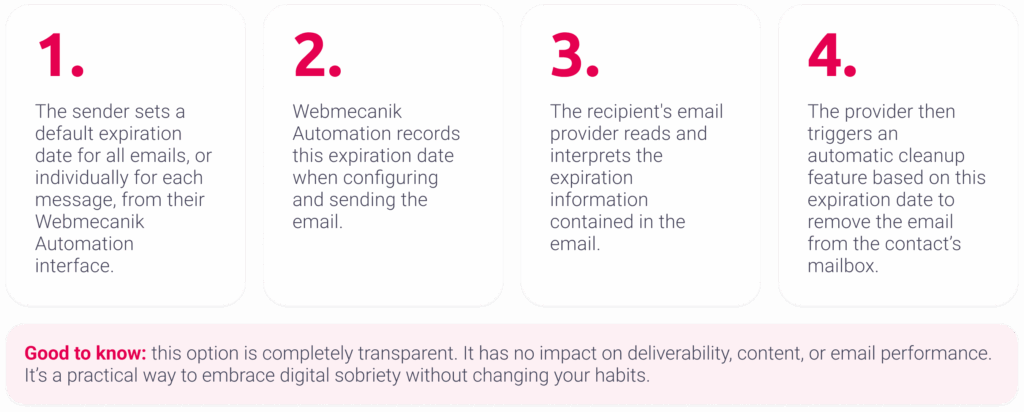
It’s a simple gesture with a significant impact: once the expiration date is reached, expired messages will no longer remain unnecessarily stored in data centers, helping reduce the carbon footprint of your campaigns.

For those curious about what actually happens behind this feature, the mechanism is quite simple. The expiration date of an email is defined directly in its header.
In practice, you simply need to add this line when sending the email:

Once this is set, email providers that host emails in the cloud (Gmail, Outlook, LaPoste, etc.) recognize this instruction and automatically schedule the deletion of the message on the specified date.
📄 Learn more about how it works in the official specification: IETF – Email Expires
Our recommended expiration times by email type
Each type of email has its own lifespan, depending on its nature and relevance to the recipient. It is therefore important to adjust the expiration period based on the content and purpose of each message. For example, a promotional offer quickly becomes obsolete after its end date, while a transactional email – such as a password notification – should remain accessible for a longer period.
The goal is simple: keep emails only for as long as they remain relevant, maximizing their impact while minimizing their environmental footprint.

Why support and adopt this initiative today?
At Webmecanik, we believe innovation in marketing must go hand in hand with environmental responsibility. That’s why we integrated the email expiration feature into our solution – to help you make your email campaigns more sustainable.
In a context where environmental awareness has never been stronger and regulations are tightening, adopting responsible digital practices is no longer optional – it’s a strategic necessity. By enabling this option, you benefit from several key advantages:
- Demonstrate your CSR leadership: Show your customers and partners that you are actively committed to environmentally responsible practices. A strong asset for your brand image.
- Concretely reduce the carbon footprint of your emails: By limiting unnecessary email storage in inboxes and data centers, you actively contribute to reducing energy consumption. This simple action, applied across your campaigns, can represent a significant reduction in carbon emissions.
- Benefit from a seamless and frictionless solution: Far from being an additional burden, this feature integrates easily and intuitively into your existing workflows. It has no impact on deliverability, content, or campaign analytics.
With Webmecanik Automation, align your marketing with your environmental values – and those of your customers. Commit to a more responsible, efficient, and sustainable marketing approach.
To learn more about this initiative, visit Zero Carbon Email.