
There are different kinds of marketing emails that are sent to your contacts thanks to email builders in marketing automation.
Depending on the needs and goals of your strategy and your company, you can send newsletters, targeted emails, emails centered on your visitors’ behavior, content emails to nurture your prospects, etc. Each choice is made according to a specific goal, and yet many marketers neglect one type of email that is actually very attractive: the transactional email. Yes, transactional emails represent one of the most effective means of communication for engaging your prospects.
What is a transactional email?
Transactional emails are the emails you receive from e-commerce sites (such as Decathlon, for example) that confirm your order, provide shipping information, etc. These messages are triggered by a specific action initiated by your contacts and can also be used to inform them of the next steps, or direct them to complete an action already started. For example, if you register for a webinar, you fill out a form and then receive a transactional email, which will provide you with the information you need to join the webinar space.
So, what is the marketer’s equivalent of the transactional email?
Thank-you emails, or automatic messages sent to visitors when they fill out one of your landing pages.
3 ways to use thank-you emails
Recipients expect to receive these thank-you emails because they help them complete their action, and that is, of course, why recipients open and click on these emails. As a marketer, you can benefit from this dynamic by adding ultra-personalized calls to action in order to make the most of the fact that your lead is already actively engaged with your brand.
Thank-you emails are effective because:
- Your content is placed directly in your contact’s main inbox. This means that even if the lead has not fully completed their action, has left the page without confirming their choice, etc., thanks to this email you give them the information they need to finalize their action.
- Contacts will often share your content by forwarding it by email, so a thank-you email allows you to extend the reach of your content to a new audience.
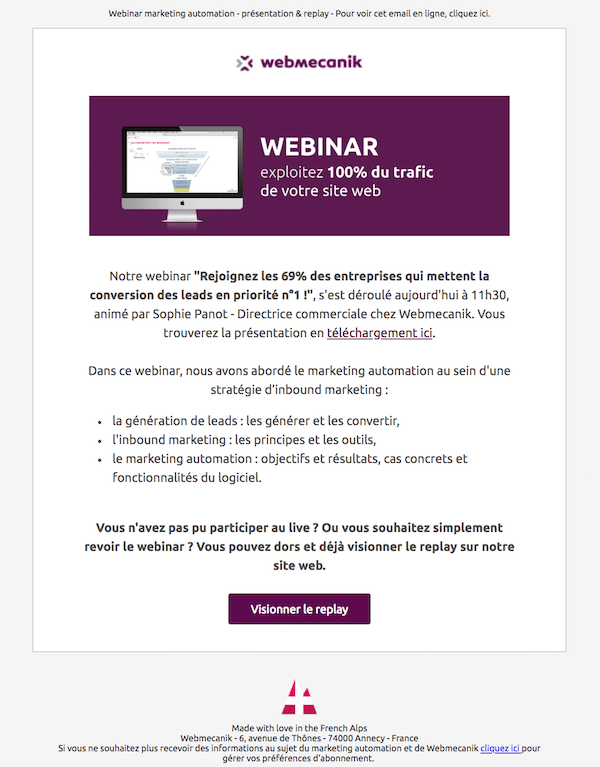
As in the example below, you can see that there is a first link to the resource to download and the second link offers a 2nd conversion opportunity with more value since it allows the webinar replay to be viewed. This double conversion helps move the lead a little further along in the buying cycle.
Also read: The new responsive email builder is out!
Also read: Webmecanik Automation shows you the best times to open your emails
Also read: 3 tips for designing effective email campaigns
Key takeaways:
1- Use simple thank-you emails
First of all, if you are not yet using a thank-you email system after your prospects have filled out a form on your landing page, start implementing them as soon as possible. To take it a step further, you can make these emails the first step of a lead nurturing strategy on a larger scale. In this way, you will be able to control the other communications received by this contact, continue sending them relevant information, and move them along in your marketing and sales conversion funnel.
2- Optimize your thank-you emails
This step is essential, because you encourage secondary conversions through these personalized emails. In other words, you can include calls to action (CTAs) to highlight high-value marketing offers, which will allow you to move your lead forward in the conversion funnel. You can, for example, offer an appointment with your sales expert, a free trial, registration for a webinar on a topic related to their journey on your website, etc.
If you are already applying this strategy, take it one step further by including dynamic content that adapts to each recipient. The goal is to automatically change the content according to the prospect’s path, which creates marketing emails that are much more targeted, segmented, and effective.
3- Make your thank-you emails compatible with social media
One of the main benefits of these emails is that they are forwarded and shared, in order to reach a new audience and gain new visitors and prospects.
You can encourage this initiative by making sharing even easier, thanks to social media sharing buttons that invite your contacts to pass the message on to others.