
Improve the profitability of your trade shows with marketing automation!
Planning trade shows and events in advance, as well as following up afterward, is very time-consuming for both the Marketing team and the Sales teams. However, many low-value-added tasks can be automated.
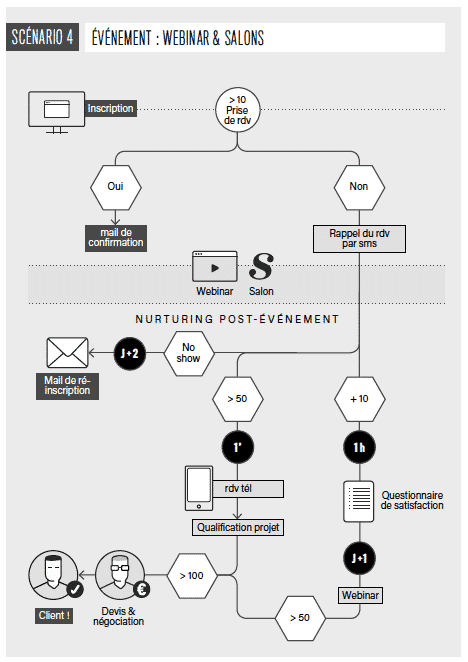
Registration is the first mandatory step to properly prepare a trade show. It is the first sign of interest from a company in your event. It allows the contact to be entered into the automated system by confirming that their registration has been properly received. A few hours before the event, a reminder is sent by email or SMS.
First scenario: the prospect does not show up at the trade show. Did their schedule change or priorities shift? You need to learn more—follow up by offering them the chance to register for your next event.
Second scenario: the prospect attended, but you don’t have any additional information about them. This is the right time to propose a post-event satisfaction questionnaire to assess their maturity in the project and any potential blockers. Based on these results, a nurturing phase with content tailored to their specific interests begins.
Third scenario: the prospect attended, requested a meeting quickly, and attends that meeting. This lead becomes a Sales Qualified Lead (SQL) and can move into the negotiation phase with your sales team up to closing. Mission accomplished! In this kind of case, your salespeople only retrieve qualified, hot leads, which automatically improves your conversion rate.
During your trade show, you’ll collect both declarative data (contact details) and behavioral data (show vs. no-show, whether they attended a given conference, whether they came to the sales meeting). Marketing automation will allow you to immediately track the leads, raise the temperature to spark follow-up.
One key to success is post-event responsiveness. However, your sales team returns from a trade show exhausted, with urgent matters to handle. By adding the contacts from a trade show right away into a marketing automation scenario, you gain speed while remaining GDPR-compliant by requesting an opt-in confirmation from these new contacts.
My advice: right the day after the trade show, thank the attendees and provide information regarding personal data. You’ll score points compared with competitors whose salespeople take over each business card themselves!
At Webmecanik, we’ve seen across all our events—trade shows, webinars, conferences—a number of registrants multiplied by 4 and participation in events rising from 50% to 80% thanks to automation. What’s more, if you film your presentations during your events, you’ll benefit from premium content that you can then make available in replay mode, giving you a new opportunity for nurturing and qualification. In replay, the audience is generally multiplied by 2 over a longer period.
In conclusion, marketing automation saves time and increases the productivity of the marketing team. They can focus on inviting targeted clients, analyzing event results and optimizing them, strategy, etc. Marketing automation also frees up the sales team from the early steps of the sales process so they can focus on closing the most mature and hottest deals.
Generally speaking, by implementing this kind of scenario, we see a rate of SQLs converted into customers multiplied by 3.
So when will you automate the organization of your events?
This scenario is part of the first book on Marketing Automation, with more than 20 ultra-detailed, practical, illustrated, and quickly actionable scenarios to start or improve your automation.