
It is regularly during consultations that we hear that marketing automation and CRM tools are essentially identical, even though they serve two very distinct purposes. Webmecanik tells you everything about the differences between marketing automation and CRM.
Their intended use
One of the main differences between these two types of software is their intended use. First, CRM software is focused on sales, whereas a marketing automation tool is focused on marketing outreach (but not only that…).
Salesforce, one of the leading American publishers in the CRM industry, defines CRM as “a strategy for managing all of a company’s interactions with customers or prospective customers.”. A CRM stores information such as addresses, names, phone numbers, and interactions with the company (email, appointments, etc.).
In France, Webmecanik Pipeline offers sales teams a solid and secure alternative to optimize their organization.
On the other hand, leaders in marketing automation describe their software as a system “that allows companies to automate and measure marketing tasks and mechanisms”.
While marketing automation records information similar to a CRM, such as a contact’s details (email, address, phone number, company name, job title, etc.), it also records all of the contact’s activities.
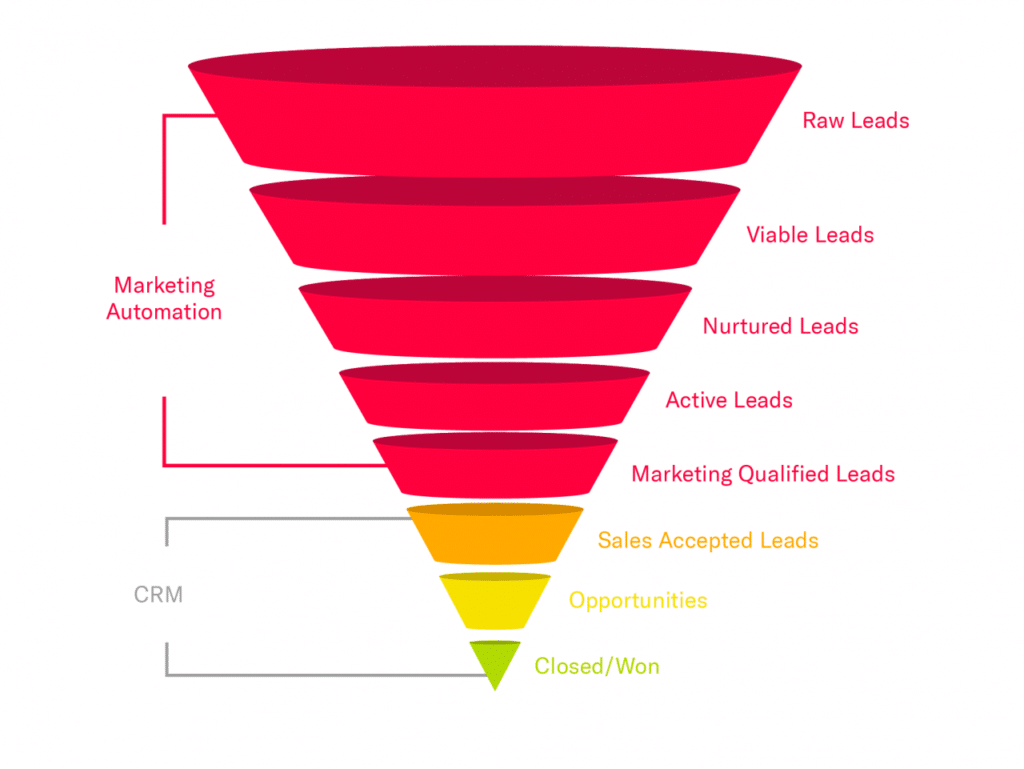
Indeed, marketing automation allows you to track a prospect’s activities from the moment they enter the conversion funnel. This includes the pages visited on your website, emails read, blog articles viewed, or forms submitted. Generally, marketers use marketing automation software to plan and measure marketing campaigns, specifically email campaigns and mass communications. Other benefits can be listed as follows:
- The ability to easily segment prospects into suitable email lists based on their past interactions with your company or according to their interests and preferences.
- The lead nurturing features allow you to automate the sending of emails based on certain triggers at the moment when the person will be most interested in your message about your product or service. You can also schedule a series of emails (referred to as a drip) in a campaign, so your company and your brand remain top of mind for your prospects.
- Once a campaign is finished, the system automatically generates reporting and analytics data.
In other words, marketing automation helps you nurture your leads and turn them into quality prospects for your sales teams. Once the lead has progressed to the bottom of the conversion funnel and is now a sales-qualified lead for the sales team (SQL), this is generally the moment when companies begin tracking information in the CRM. CRMs record information such as the length of the contractual relationship with the customer, products purchased in the past, dates and notes associated with a phone conversation, etc.
Sales and customer service teams use the CRM to optimize human interactions between the company and the customer in order to improve customer satisfaction. The benefits of a CRM can be listed as follows:
- A salesperson can see where the contact stands in the sales process in order to ensure the opportunity is closed under the best conditions.
- When you need to speak with the customer, you have an overall view of who they are and their history with the contacts in your company, making the conversation as personalized as possible and leading to the best results.
- The system allows internal alerts to be sent when a call is scheduled, when a customer’s contract needs to be renewed, or when it is your customer’s birthday, for example.
To sum up, a CRM helps you secure sales by building a more personalized sales cycle for your customer.
As a result, while a CRM and a marketing automation tool may seem to address the same need at first glance, they actually meet different needs within your company, and these differences make them all the more useful for the teams that use them.
Why two different tools?
But then, what is the point of recording half of a prospect’s interactions in one piece of software (marketing automation) and the other half in another (CRM)?
Good question!
Most marketing automation solutions allow you to synchronize your CRM data so that all prospect and customer activities are accessible from a single solution.
Webmecanik also offers the possibility to synchronize its Webmecanik Pipeline CRM software with Webmecanik Automation to strengthen efforts and bring marketing and sales teams together.
Also read: 4 reasons to combine your marketing automation software and your CRM
Many other companies offer the same possibility and synchronize information both ways (this is called bi-directional synchronization) so that marketing teams know what is happening from a sales perspective (and can segment based on this data). And so salespeople can know the history associated with the customer or prospect.
In addition, more CRM systems have developed or acquired a marketing automation solution, so they have integrated everything (or give that impression).
Also read: The 6 reasons to integrate your CRM and Marketing Automation software
If you are still stuck trying to find out whether your company needs a CRM and/or marketing automation software, you now know the differences!
And if you want to learn (even) more about the similarities and differences between your Marketing Automation software and your CRM, you can watch the replay of our webinar
So, which tool do you need?