
Section 1: Understanding marketing automation
Definition of marketing automation
Marketing automation refers to the use of specialized software and technologies to automate marketing tasks, generally repetitive ones, in order to optimize processes, increase efficiency, and improve results. Although it is more commonly used for 100% digital campaigns and events, it is also well suited to physical events or any other marketing initiatives, as long as you can collect data from your prospects.
Objectives of marketing automation
The objectives of marketing automation are many, ranging from simplifying workflows to improving customer engagement. These objectives include automating marketing campaigns, personalizing communications, managing leads, scoring prospects, and improving the productivity of marketing teams.
How marketing automation works
Marketing automation works thanks to software that allows you to create high-performing campaigns and content for better lead conversion. You can nurture and automate the relationship with your prospects while also ensuring better ROI across many communication channels (email, SMS, notifications, social, etc.).
You then gain a better view of user or prospect behavior, and can automatically deliver messages, offers, or specific actions to each individual.
Section 2: The challenges of physical events
Overview of the challenges related to promoting physical events
Promotion, registration management, communication with participants, tracking feedback after the event… Organizing a physical event presents many challenges. These tasks can be tedious and resource-intensive. In fact, event organizers are sometimes faced with manually managing registrations, personalizing communications, and optimizing ROI without any technological assistance other than Excel files and an email marketing tool. These challenges can lead to a loss of time and efficiency, as well as lower participant satisfaction.
Kiosk mode to stop tracking
To enrich participant data on site at your event or trade show, Webmecanik Automation also offers a kiosk mode. This mode prevents cookie tracking when one or more active forms are submitted during online completion. In other words, the many contacts (we hope so for you) entered on site by a sales team or through an available tablet will be added to your database. They will be newly created and will not be linked to the same cookie and IP address as your computer or tablet and the event location. It’s a bit technical, but trust us, it will allow you to have a clean and up-to-date database for your post-event campaigns!
> Learn more about GDPR compliance
Section 3: How marketing automation can help
Using marketing automation to manage registrations
Marketing automation simplifies registration management by automating the participant registration process, generating confirmations, and sending reminders, which helps maximize participation rates, optimize the participant experience, and reduce human error.
Personalizing communications with participants
Thanks to marketing automation, organizers can personalize communications based on participants’ preferences and behavior, thus ensuring more relevant and engaging interactions throughout the event.
Post-event follow-up to maximize return on investment (ROI)
After the event, marketing automation can be used to gather feedback and assess the event’s success. This in-depth analysis makes it possible to adjust future strategies and optimize return on investment, thereby ensuring more effective planning for upcoming events.
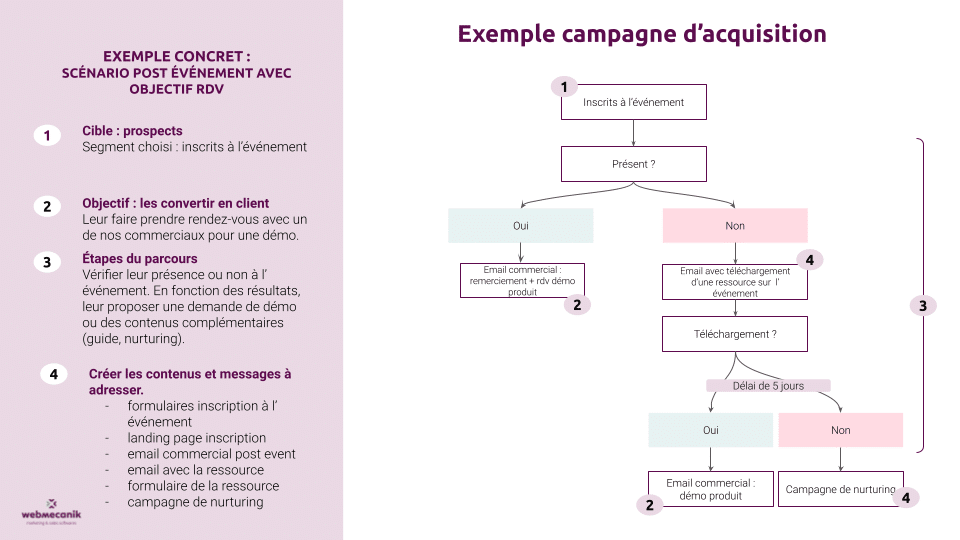
Example of a post-event campaign
> Download the template for this campaign!
Section 4: Case studies
The French group BIC has successfully used marketing automation for its physical events.
With the aim of selling the brand’s pens and colored pencils, the team takes part in trade shows dedicated to the education sector. BIC chose to recruit ambassadors in the form of primary school teachers. Thanks to these trade shows, they organize games, offer kits for teachers to use during classes, and provide them with pen samples. To receive these samples, teachers must leave their contact details in a form on a tablet, after which they are automatically entered into a marketing automation campaign.
Indeed, through indirect sales via these advocates, BIC ensures it can indirectly convince students’ parents as well. During back-to-school shopping, parents will respond to requests from primary school teachers recommending BIC pens.
In conclusion, marketing automation is a powerful tool for overcoming the challenges inherent in promoting and managing physical events. By intelligently integrating this technology into the event planning process, organizers can provide an optimal experience for participants and maximize the results of their investments.