
You invest in SEO, social media, email marketing, ads, or content creation. But do you really know which channel brought a prospect to you, what prompted them to convert, and what made them come back afterward?
With the new contact source analysis feature in Webmecanik Automation, you can now track the main entry points in each contact’s journey and more easily identify which channels contribute to your acquisition.
For each contact, Webmecanik Automation identifies, in particular, the original source, the conversion source, and the most recent source.
Why is it essential to know the source of your contacts?
Identifying where your contacts come from is not only about measuring your marketing performance. It’s also a way to better understand how your prospects move forward in their sales journey.
By knowing which channels attract them, which ones get them to convert, and which ones re-engage them, you can:
- better evaluate the contribution of your various marketing levers;
- adjust your investments based on the most effective channels;
- adapt your campaigns according to your contacts’ journey;
- share more context with your sales teams;
- better align Marketing and Sales around the same prospect journey.
Knowing the sources helps you to manage your sales cycle more precisely, from the first interaction through to commercial conversion.
Three sources to better understand your contacts’ journey
The original source: how did the contact discover you?
The original source corresponds to the first known entry point for the contact.
It lets you, for example, see whether a prospect found you through:
- organic search;
- a paid campaign;
- a social network;
- an email;
- a website;
- an AI assistant;
- or another offline source such as an import or a manual creation.
The conversion source: what turned the visitor into a contact?
La source de conversion correspond au point de contact associé au moment où le visiteur devient un contact identifié. Un prospect peut ainsi vous découvrir grâce à Google, revenir quelques jours plus tard via une campagne LinkedIn Ads et finalement remplir un formulaire.
In this case:
- Original source: organic search
- Conversion source: paid campaign
The most recent source: what keeps engaging your contact?
The most recent source corresponds to the last known channel through which the contact came back to your site. Now imagine that our prospect comes back a few weeks later from your newsletter.
Their journey then becomes:
- Original source: organic search
- Conversion source: LinkedIn Ads
- Most recent source: email marketing
You get a much more complete view of the journey than if you only kept the first or the last interaction.
How to use contact sources in Webmecanik Automation?
Sources aren’t just visible on a contact’s profile. They can also be analyzed, filtered, and used in your marketing actions directly from Webmecanik Automation.
From your dashboards
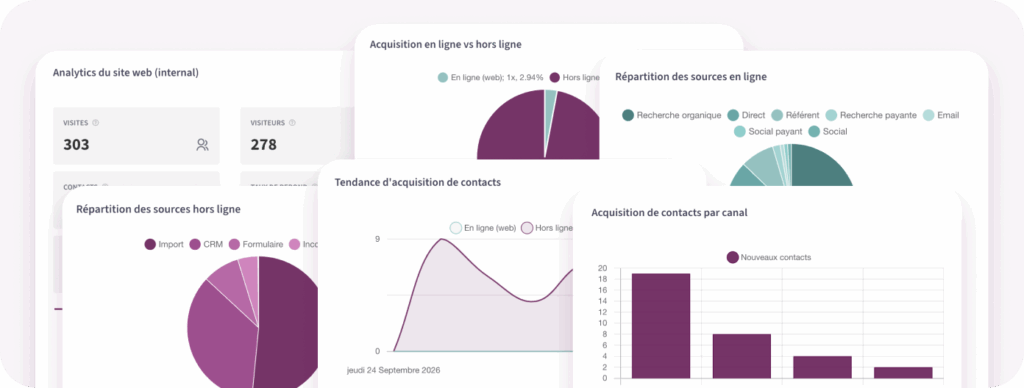
New widgets allow you to track your acquisition at a glance:
- Contact acquisition by channel: to see which channels generate your new contacts.
- Contact acquisition trend: to track acquisition over time.
- Online / offline acquisition breakdown: to compare the share of contacts coming from the web versus those coming from offline sources.
- Online source breakdown: organic search, social, email, referrals, AI assistants, paid…
- Offline source breakdown: CRM, imports, forms, plugins, etc.
You can thus quickly see which channels generate the most contacts and how their contribution evolves over time.
From the contact profile
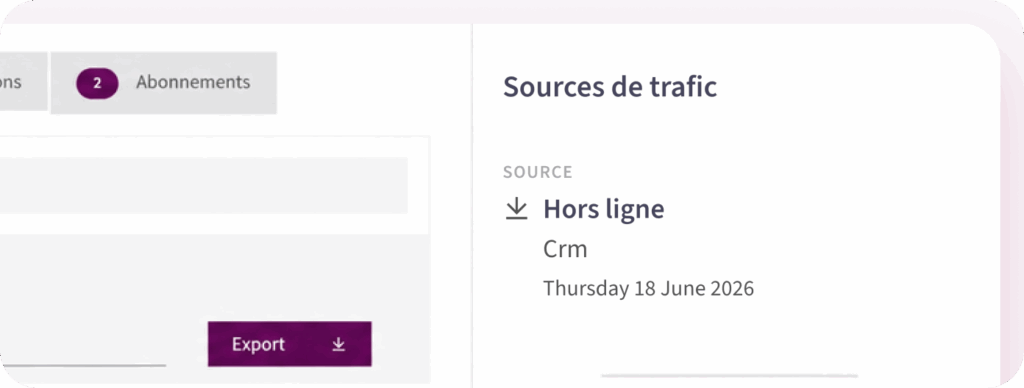
On each profile, you can directly find the original source, the conversion source, and the most recent source. This gives you the context you need to understand an individual prospect’s journey, from their first interaction to their most recent visits.
From your reports
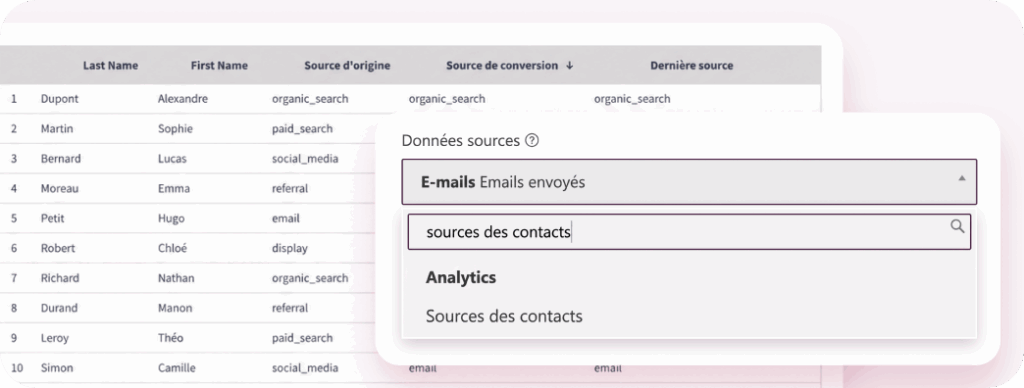
A dedicated contact sources report lets you go further in your analysis. For each contact, you can find their various sources and analyze how they’re distributed using several dedicated views, including on acquisition trends and the split between online and offline sources.
From your segments
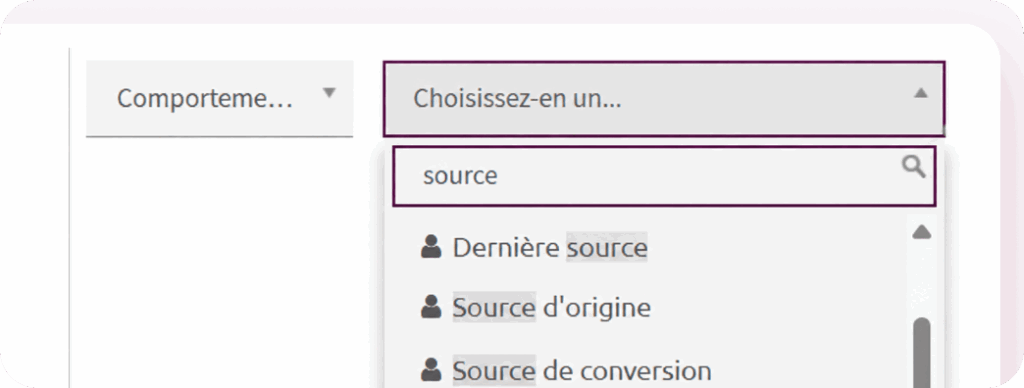
Sources can also become true segmentation criteria. You can create segments from the original source, conversion source, or most recent source, then include or exclude certain types of sources.
For example, you can create a segment of:
- contacts from organic search;
- contacts converted through a paid campaign;
- contacts who recently came back via email;
- contacts from offline sources.
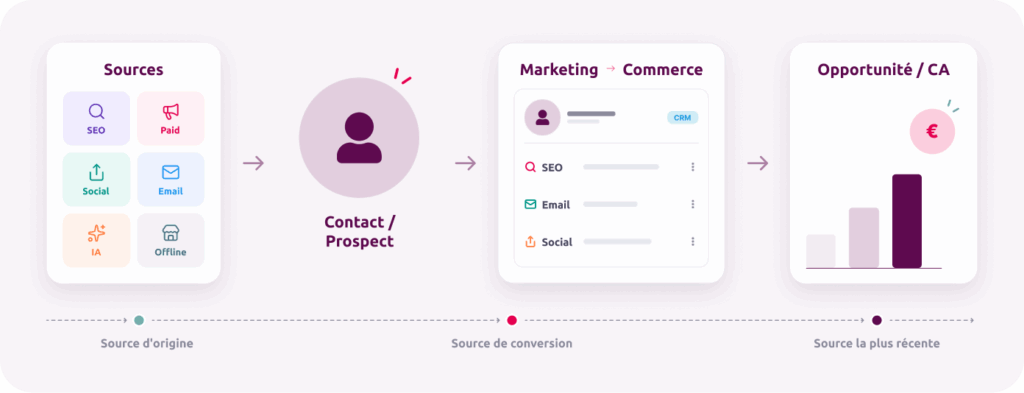
A complete view of the journey, from Marketing to Sales
Not all your contacts follow the same path. Some come from organic search, a paid campaign, a social network, or an email; others come from an import, a manual creation, or an offline source. And as usage evolves, new entry points such as ChatGPT, Claude, or Perplexity are also taking an increasing place in acquisition journeys.
This diversity of sources lets you reconstruct a prospect’s journey more precisely, from their first interaction through to when Sales takes over. Marketing can therefore better understand the acquisition context, while Sales can pick up a contact with more information about the interactions that took place before conversion.
This continuity of information helps you to better align marketing and sales and limit breaks in the prospect journey between acquisition, nurturing, and selling.
From source to revenue: measure what truly generates value
Sharing this information with sales teams isn’t only about giving them more context for their conversations. It’s also essential to measure Marketing’s contribution to the company’s revenue.
Since revenue is generally tracked in the CRM, it’s important that information related to contact sources can also be stored there and used. By finding, in particular, the first touch, last touch, and sales data in the same place, you can cross-reference acquisition sources with opportunities and the revenue generated.
You can therefore go beyond the simple number of acquired contacts and identify which channels truly contribute to your revenue: which levers generate prospects that become customers, which sources are associated with the most important opportunities, and which channels contribute the most to creating revenue.
These data can also be sent to your CRM and, more broadly, to your information system so you can cross-reference acquisition sources with your sales data and measure their contribution to revenue—from the first marketing interaction to the sale.
From analysis to action
Contact sources aren’t just useful for understanding where your prospects come from: they can also become an action criterion in your marketing campaigns.
For example, you can create segments based on the original source, conversion source, or most recent source, then tailor your scenarios according to these journeys. A contact who came via SEO, converted through a paid campaign, or recently came back from an email can therefore receive a message or content that’s more relevant to their context.
These data also help you to compare the effectiveness of your different channels more precisely and focus your efforts on the ones that contribute the most to acquisition and conversion.
Are you already using Webmecanik Automation, or do you simply want to discover how this feature works?