
Sales objectives play a role in business success. They serve as a benchmark to guide actions and decisions toward concrete results. Without these sales objectives, it becomes difficult to assess your performance or direct your strategic efforts.
I’ll explain why defining clear sales objectives is essential to achieving your results. We will also see how to set objectives and stay aligned with your strategy.
What are the different types of sales objectives?
How should you prioritize your objectives?
Quantitative VS qualitative objectives
Team and individual objectives
SMART method: an approach for well-defined objectives
What are the different types of sales objectives?
Sales objectives vary depending on your priorities and your company’s strategies. They are generally grouped into several categories:
- Business-related objectives, such as revenue, market share, or conversion rate.
- Customer-related objectives, to strengthen the satisfaction and loyalty of your existing customers.
- Prospecting objectives, focused on acquiring new customers or breaking into new markets.
- Brand awareness objectives, to increase your company’s visibility and recognition.
- Operational objectives, focused on improving internal processes, such as the productivity of sales teams.
Each of these categories plays an essential role in building a balanced and effective sales strategy. In the following sections, we will explain how to choose and prioritize these objectives according to your company’s specific needs.
Short-, medium-, and long-term objectives
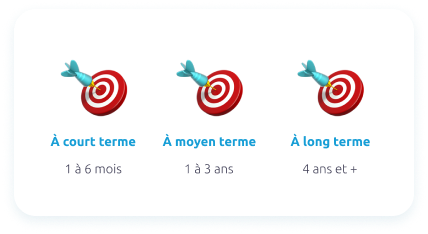
Your sales objectives must be defined over time. This gives you and your teams a deadline to achieve the objectives that have been set.
Short-term objectives
These are results to be achieved quickly, in the coming weeks or months. For example, increasing my sales by 10% this month or signing two new contracts during this quarter. These objectives are generally more motivating because the results are quickly measurable and achievable.
Medium-term objectives
These objectives concern more important strategies. They are achievable over a longer period, generally between 1 and 2 years. For example, generating 300 leads over the year. As you will have understood, this requires more thoughtful planning and sustained efforts throughout the duration of the objective.
Long-term objectives
Long-term objectives are intended for a broader strategy. They are defined over a period of 4 years or more. For example, doubling our revenue within 4 years. These objectives provide a clear direction and guide your short- and medium-term strategies.
How should you prioritize your objectives?
Start by assessing your resources: your budget, your team, etc.
Your long-term objective will help you put in place medium-term objectives, which in turn will define the short-term objectives. For example, if your long-term objective is to double your revenue in 4 years, your medium-term objective will be to increase your customer base by 30% in the next 2 years. To get there, your short-term objective is to implement new marketing strategies aimed at generating 50 leads per month.
Why define sales objectives?
Defining sales objectives is a step that allows you to succeed and drive your marketing and sales strategies. It goes far beyond simple organization; it directly influences efficiency, motivation, and your efforts.
Align your teams?
Clear objectives allow all teams to work in the same direction. They ensure that every department, from marketing to sales, acts consistently with the company’s strategy, which avoids scattered or contradictory efforts.
Measure and track your progress?
To adjust your actions and assess your performance, you need to measure and track your objectives, which must be clearly defined. ?
To stay motivated individually and collectively?
By setting ambitious but realistic objectives, you motivate your employees and yourself. They give meaning to daily work and help everyone stay focused on a collective goal. This strengthens commitment and productivity within teams.
Refine your actions?
Without clear objectives, it is easier to get distracted or even waste time on actions that are not very relevant or not a priority. By setting objectives, you focus your efforts on what really matters. ?
Quantitative VS qualitative objectives
It is essential to distinguish between quantitative and qualitative objectives, while understanding how complementary they are.
Quantitative objectives
Quantitative objectives are measurable thanks to numerical indicators. They allow you to concretely assess the performance of your actions. For example, increasing revenue by 15%, generating 200 qualified leads per month, or improving the conversion rate by 5%. These objectives help you track your progress.
Qualitative objectives
Qualitative objectives, on the other hand, focus on less tangible but equally important aspects. This may involve improving customer satisfaction, strengthening your retention rate, or achieving a better brand image. These objectives directly influence customers’ perception of and relationship with your company, which impacts your long-term performance.
Why combine both?
Quantitative and qualitative objectives complement each other. Integrating them into your strategy allows you to combine efficiency and satisfaction. ?
Defining team and individual sales objectives
To achieve your sales objectives, you need to break them down into team and individual objectives. With this approach, you translate general objectives into achievable actions at every level.
Break down overall objectives into team sub-objectives?
Overall objectives, such as doubling revenue for example, must be broken down into sub-objectives for each team. For example, the marketing team can focus on lead generation, while the sales team aims to convert those leads into customers. Each team plays a role in achieving the overall objective and helps ensure coordination.
Importance of individual objectives?
Defining individual objectives is just as essential as defining team objectives.
This allows each member to have a specific role. For example, a salesperson may have the objective of signing a certain number of monthly contracts, while a colleague may have the objective of contacting a certain number of prospects by phone.. These individual objectives, aligned with the team’s objectives, help maintain motivation and create a high-performing team.
This combination of team and individual objectives allows you to create a structured work environment where every action and every team member contributes directly to overall results. ?
SMART method: an approach to defining sales objectives
This method hardly needs an introduction anymore, but I’ll still give you a quick reminder. ? The SMART method is based on five criteria: Specific, Measurable, Achievable, Realistic, and Time-bound. This framework allows you to set structured and clearly defined objectives.
- Specific : the objective is precise and clearly defined. For example, rather than saying “increase sales,” you could aim to “increase sales of our bestseller in region X.”
- Measurable : define indicators to track your progress. In this example, you could target a 15% increase in sales over three months.
- Achievable : as explained a little earlier, your objectives must be ambitious but realistic, taking into account your available resources. Setting a 50% increase in sales in one month could be unrealistic, but 15% is an achievable objective. (It all depends on your business, of course ?)
- Realistic : Make sure the objective matches your current context. If your product is already well established in the region, aiming for 15% growth is consistent.
- Time-bound : Give yourself a time limit to stay focused. For example, “achieve 15% growth by the end of the next quarter.”
Example of a SMART objective
Suppose you lead a sales team and your overall objective is to increase sales. By applying the SMART method, you can define an objective such as: “Increase sales of the bestseller by 15% in region Y within three months, mainly targeting existing customers.”.
Track and measure results
We are now reaching the most important step for your sales strategies: ✨ tracking and analyzing results ✨. It is not enough to define objectives; you must also analyze your progress to adjust your strategy according to performance.
Regular monitoring
Regular monitoring makes it possible to quickly identify gaps between expected results and actual performance. Thanks to this, you can react and adjust your actions. This may involve improving a marketing campaign, reassigning a team’s roles, or reviewing your forecasts.
Adopt a CRM
To make it easier to monitor your performance, I recommend using a suitable CRM. Thanks to the tool, your sales reps can track their results in real time. Managers, meanwhile, have an overall view of what has or has not been done. A CRM centralizes your data such as the number of leads generated, conversion rates, or completed sales. You can track everything with personalized dashboards.
Have the right features
Some tools have features specifically designed for your objectives. For example, Webmecanik Pipeline allows you to track your objectives at every stage of your sales funnel. It provides a view of performance, from lead generation all the way to sales. Each salesperson is responsible for their performance. They learn to continuously track and analyze their results, which makes them more autonomous and proactive. ?

You now have all the keys to define your sales objectives. Whether they are quantitative or qualitative, short- or long-term, these objectives must be aligned with your company strategy to guarantee achievable results. ?