
Have you ever received an email and thought it wasn’t interesting, or even that the sender had made a mistake in sending it? Well, you’re not alone.
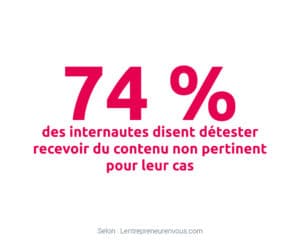
74% of internet users say they hate receiving content that is not relevant to them. (According to Lentrepreureurenvous.com)
It is therefore imperative to have relevant emails that stand out from your competitors. One solution is to personalize your emails with dynamic content. Integrating dynamic content allows you to increase your chances of converting your leads into loyal customers.
But what does that really mean? Well, quite simply, you personalize your communication thanks to your content becoming dynamic, making it possible to adapt specific content to the contacts or segments to whom you will send your emails. The goal is thus to strengthen your chances of achieving a better open and click-through rate.
What types of dynamic content are there
The benefits of email personalization
What data should be used to create dynamic content?
Segmentation and personalization
Creating dynamic content: tools and techniques
Testing and optimizing your dynamic emails
Best practices for dynamic content
What types of dynamic content are there
Here are the different types of dynamic content that you can add to your emails to personalize them:
- ?️ Personalized images can vary depending on the contacts.
- ? Text blocks can adapt and vary depending on each segment. For example, it is possible to personalize the way you address your loyal customers compared with your prospects.
- ? Product recommendations can vary depending on your contacts’ preferences. These recommendations can also be updated based on stock levels.
- ⏳ A countdown can be integrated if you are organizing an event or planning an important release/announcement. The countdown is dynamic content because it changes over time.
The benefits of email personalization
Personalization starts above all with segmentation and the creation of a user experience. By putting this in place, you will be able to see an increase in your engagement rate. Your target audience feels more concerned by your emails. Segmentation allows your dynamic content to be adapted according to contacts. The other positive effect is also that your bounce rates will drop drastically.
Another notable benefit is time savings! Imagine that you want to personalize your emails very precisely without marketing automation software allowing you to do so… You would have to create several emails. With Webmecanik Automation, you can use dynamic content blocks and thus create variables according to the recipient. You will only have a few variations to plan for rather than creating a large number of similar emails?
What data should be used to create dynamic content?
Email personalization begins with the creation of dynamic content. It is adapted according to the data you have in your database. Respect for your customers’ data must comply with GDPR standards. This is essential to establishing a relationship of trust with your recipients. It is possible to adapt your dynamic content according to different criteria. Here are a few:
- Demographic data, such as last name, first name, age, gender, etc.
- Behavioral data, including all data relating to the contact’s actions with regard to the brand, such as time spent on the website, engagement rate, score (thanks to scoring ?)
- Purchase history, that is to say buying habits, frequency, etc.
- Geographic data, linked to the location of your audience. You can choose to communicate with your database in different languages. For example, if you are a Swiss company with customers spread across the whole territory, you can send messages in German, French and Italian, depending on your contacts’ profiles.
Segmentation and personalization
Thanks to your marketing automation software, you can segment your database according to different criteria. You can decide to send a certain type of email to particular segments. This makes it possible to personalize the communication that you want to establish with your database. You thus increase your chances of conversion.
Read also: Dynamic content: features and best practices
Creating dynamic content: tools and techniques
There are different types of dynamic content, such as images, suggestions, text blocks, etc. You can use tools to make their creation easier, such as builders or editors, to use the proper term. For example, here is the Webmecanik Automation software, which simplifies the creation and sending of emails.
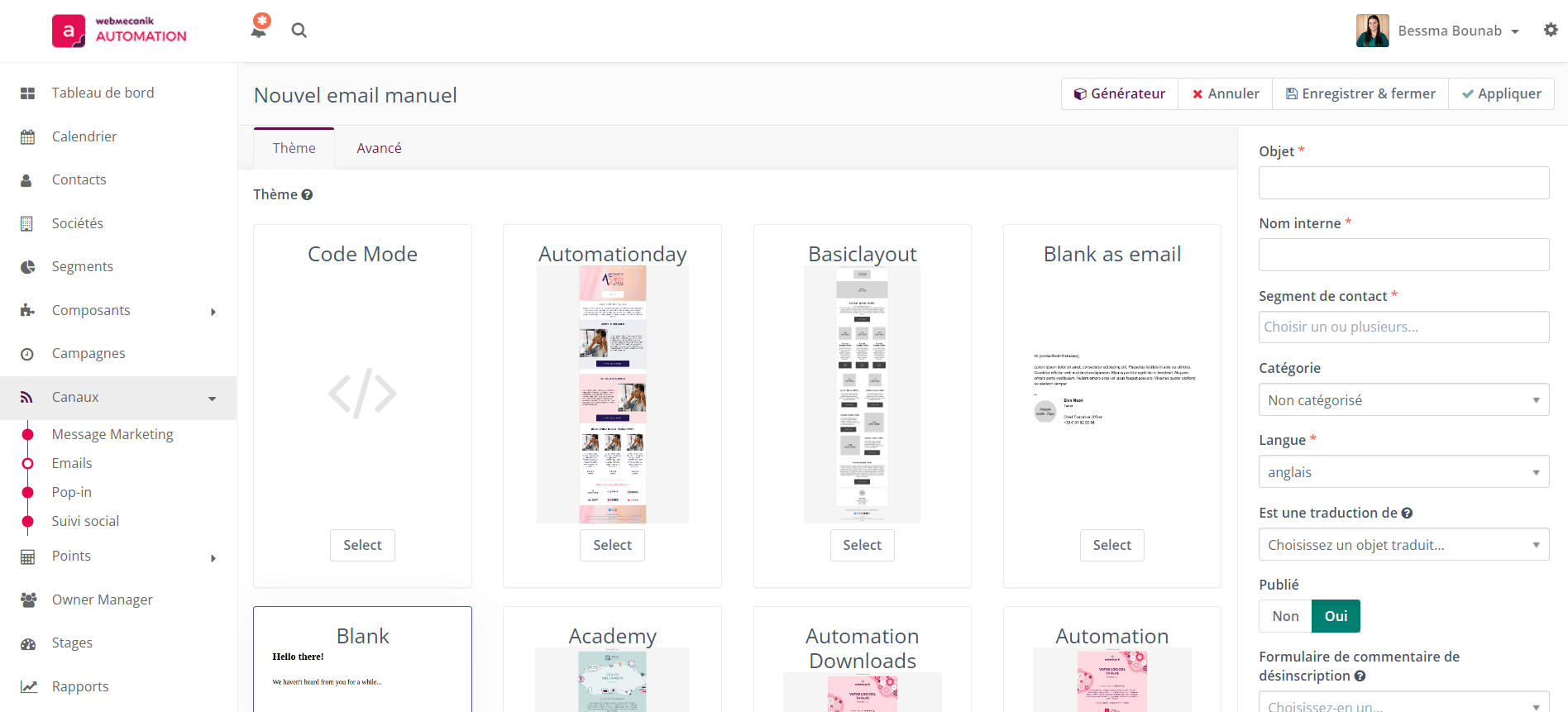
- Create a multitude of templates for your emails with the email builder
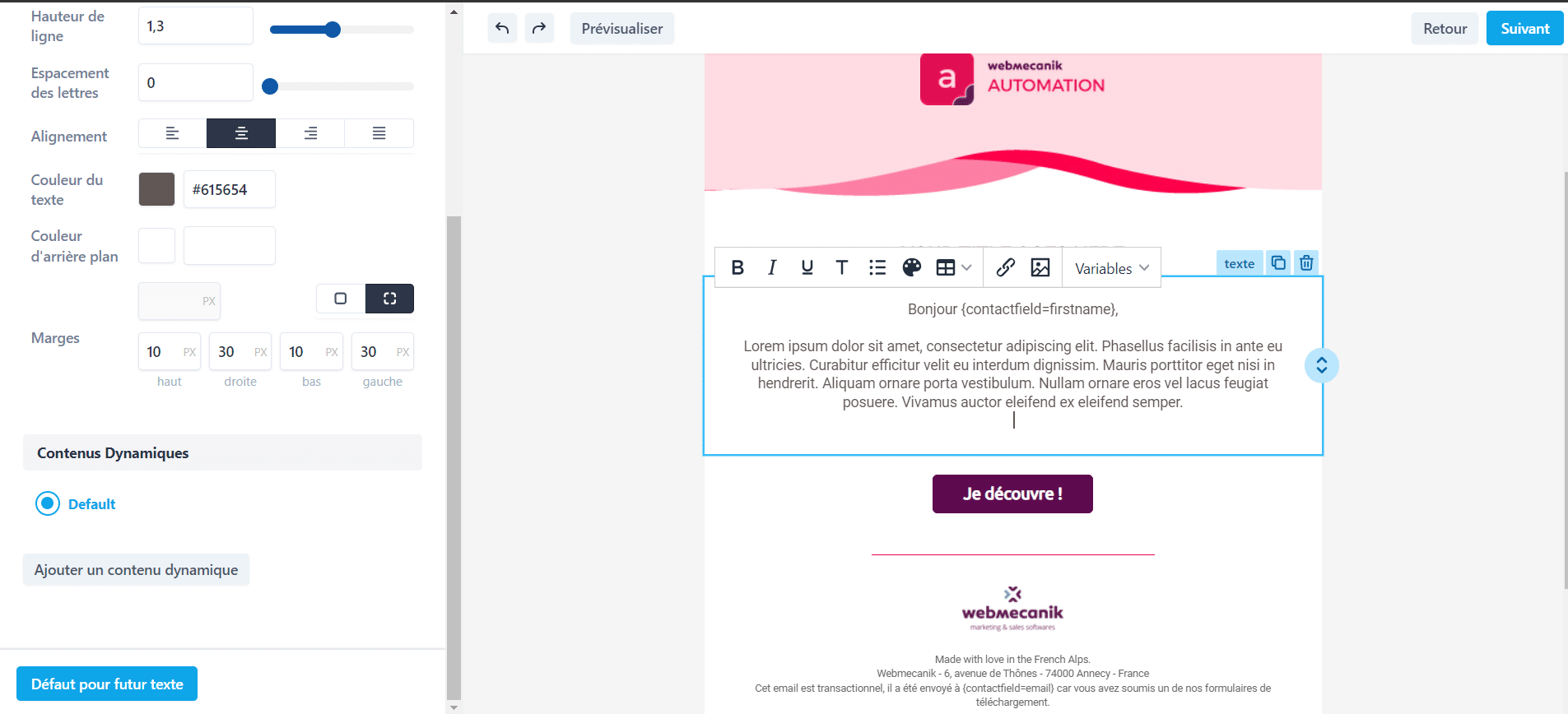
- Then choose which content you want to personalize. Let’s assume that I want to adapt my text block.
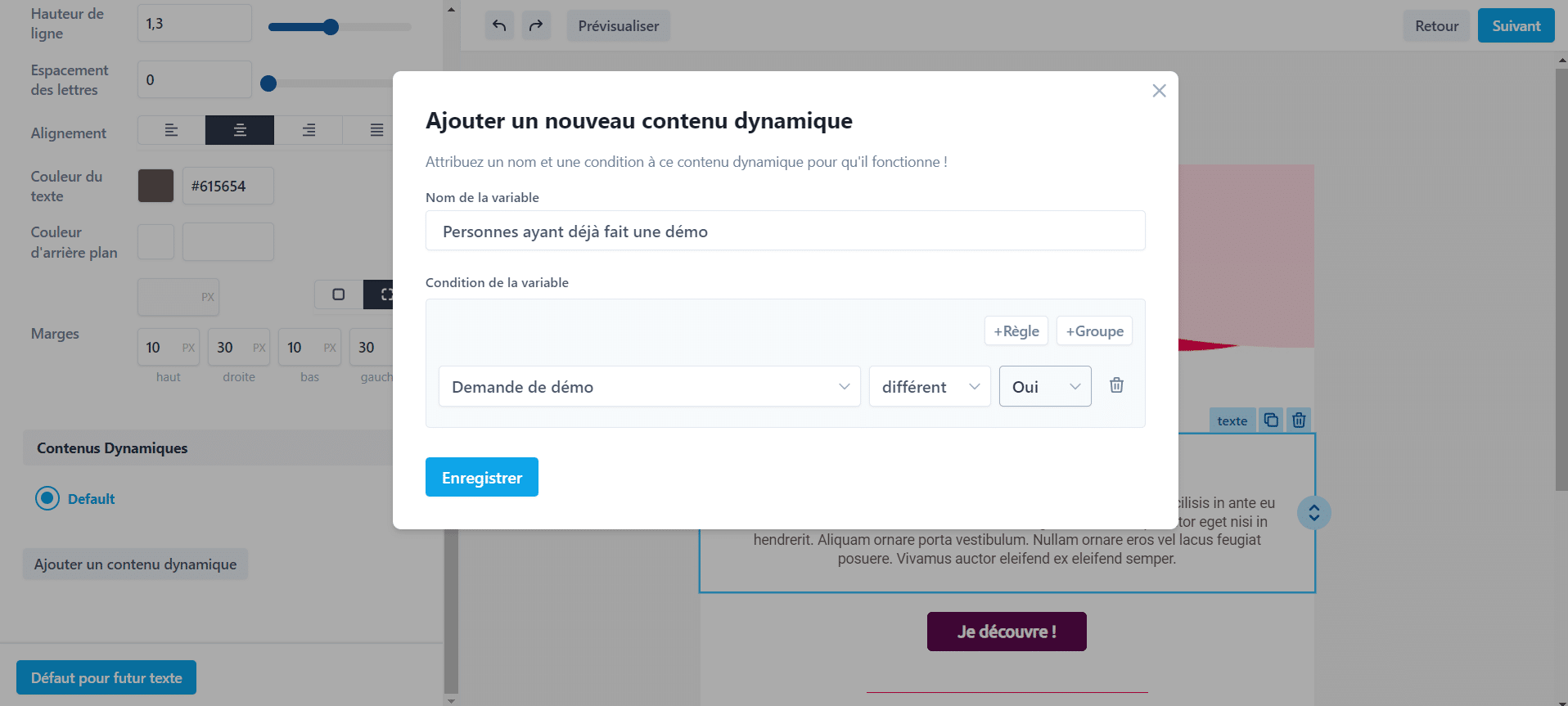
- I choose the name of the variable that I want to set up. I decide which conditions to set for my personalization. Let’s say I want my text to vary depending on whether or not people have already made a demo request.
Testing and optimizing your dynamic emails
Several methods exist to refine your personalization. It is possible to set up A/B tests, but also multivariate tests. Our Webmecanik Automation software allows you to carry out A/B tests. This allows you to test two or more types of pages or emails in order to assess what works best with your audience. You can then apply what worked best to optimize your conversion rate or even let the software choose directly for you. Multivariate testing makes it possible to test several elements in a single email or a single landing page, for example. Both strategies allow you to assess what worked best, which will make you more effective for your future strategies. You can also adapt the content according to the feedback you obtain.
Best practices for dynamic content
You have probably integrated dynamic content into your marketing strategies with a lot of enthusiasm without really taking the time to analyze your competitors, best practices or even what works best.. Here is a non-exhaustive list of Dos and Don’ts for your email practices with dynamic content:
- It is imperative to remain consistent with your brand image to avoid losing your audience, obviously, you might say.
- The dynamic content that you decide to implement must be relevant to your audience, yes, that too.
- If your audience feels that the content is not relevant, they may decide to lose interest in your brand.
- As I explained above, GDPR standards are unavoidable. If your audience feels that their data is not secure, this can lead to unsubscribing from your newsletter.
- I mentioned earlier that tests needed to be carried out; these tests must also be conducted internally to avoid errors affecting your users.
- Your CRM software must of course update the data you have to avoid having obsolete contacts, which can harm message deliverability.
- A lack of segmentation also ties in with the previous point. If your database is poorly segmented, this can lead to sending dynamic content that is not very relevant for some people.
- Conversely, too much personalization can sometimes be perceived negatively by some people, who consider it intrusive. ?
Conclusion
Dynamic content within your email campaigns helps you stand out from your competitors. As a reminder, when creating your content, do not forget your main objective, adapt your dynamic content accordingly and remain consistent with your brand image. Segmentation plays an essential role in the relevance of your personalized emails. The data you have within your database is important, use it, whether it is demographic, behavioral or geographic data. You now have all the keys to create emails with dynamic content, and do not forget that well-managed personalization is the key to success in marketing.?