
Personalization is a key element when you address your customers or prospects. Today, who still wants to receive emails/ads for products/services they are not interested in? (not me)
In 2020, personalization represents 14% of companies’ marketing budget* and has become the top challenge for more than 80% of marketers*. And for good reason! Personalization has a direct impact on sales to prospects and customer loyalty.
*source Kameleoon and storanova
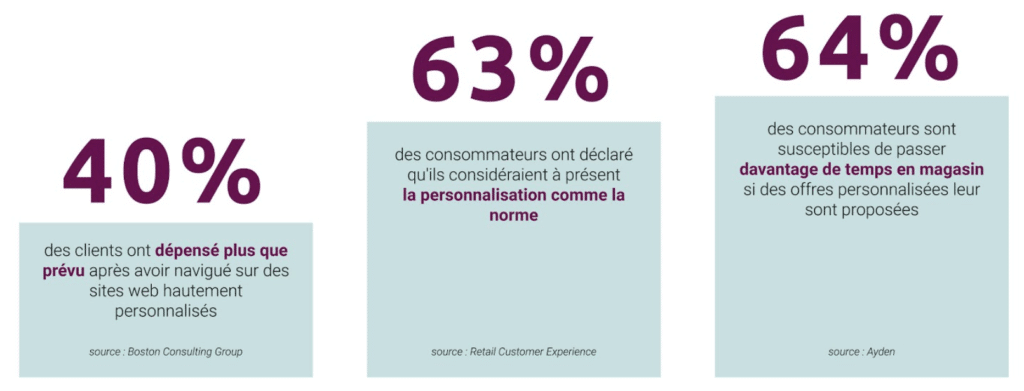
Illustrated by a few figures:
You’re convinced and you want to jump into the game? Not so fast! There are a few prerequisites not to overlook…
-
Personalize using your database

To start personalizing communications for your customers, it is essential to collect and leverage your DATA. It is often at this stage that everything becomes complicated if you do not have the right tools for proper customer relationship management (such as a CRM) or for tracking your leads (CRM and/or marketing automation)
Our first piece of advice is to segment your database: sort through the information and categorize it according to your sales strategy.
-
Define your personas

A persona is a fictional representation of your ideal customer. You can define it after carrying out market research and analyzing the real data available to you.
Defining your personas (prospects and customers) is the crucial step for determining your audience profile and how your product or service meets their expectations. The ultimate goal here is to know your targets in detail (socio-professional category, age, family situation, needs, habits, obstacles, issues, etc.) and segment them. This will greatly help you create personalized content: the better you know someone, the easier it is to know what to say to them!
For this step, we offer you a kit for creating your marketing personas. > Download the complete kit
-
Understand your customer journey

Knowing your customer journey will allow you to quickly identify needs and start a conversation with warm contacts.
This is the basis of Marketing Automation. Indeed, if your goal is to send the right message, to the right person, at the right time, you will need to know what the stages of your customer journey are (from sale to loyalty) and what stage your customers and prospects are at.
For example, a contact can be considered interested (and therefore interesting) after requesting a demo, filling out a form, or when they have provided you with key information such as their budget.
Once your sales journey has been defined, you can set up campaigns based on a state, a score, or a behavior to deliver the right content to the contact according to the segment in which you categorized them.
These preliminary steps should be useful for using the different features of your Marketing Automation tool!
Discover our 5 tips for personalizing your communications with your Marketing Automation software: > View the tips