
Manage your contacts and prospects effectively
Improve your productivity and efficiency
Track your opportunities and sales pipelines
Collaborate and share information
Analyze and make informed decisions
82% of businesses use the CRM for sales reporting. This statistic from the Stratenet site confirms this growing interest in Customer Relationship Management solutions.
In fact, in 2023, it has become essential for companies of all sizes to implement a customer relationship management system (CRM, in English). By way of reminder, a CRM is a software tool that helps you manage your contacts and prospects effectively, improve your productivity, track your sales opportunities, collaborate and share information, make informed decisions through data analysis, and improve your customers’ satisfaction. But to go further, what are the real benefits of a CRM, and is it relevant for you to adopt this software in your case? Key points.
Manage your contacts and prospects effectively
A CRM allows you to centralize all the information related to your contacts and prospects within an organized database. You can record their contact details, past interactions, preferences, and any other relevant information. This helps you better understand your customers and prospects, personalize your interactions with them, and respond more effectively to their needs.
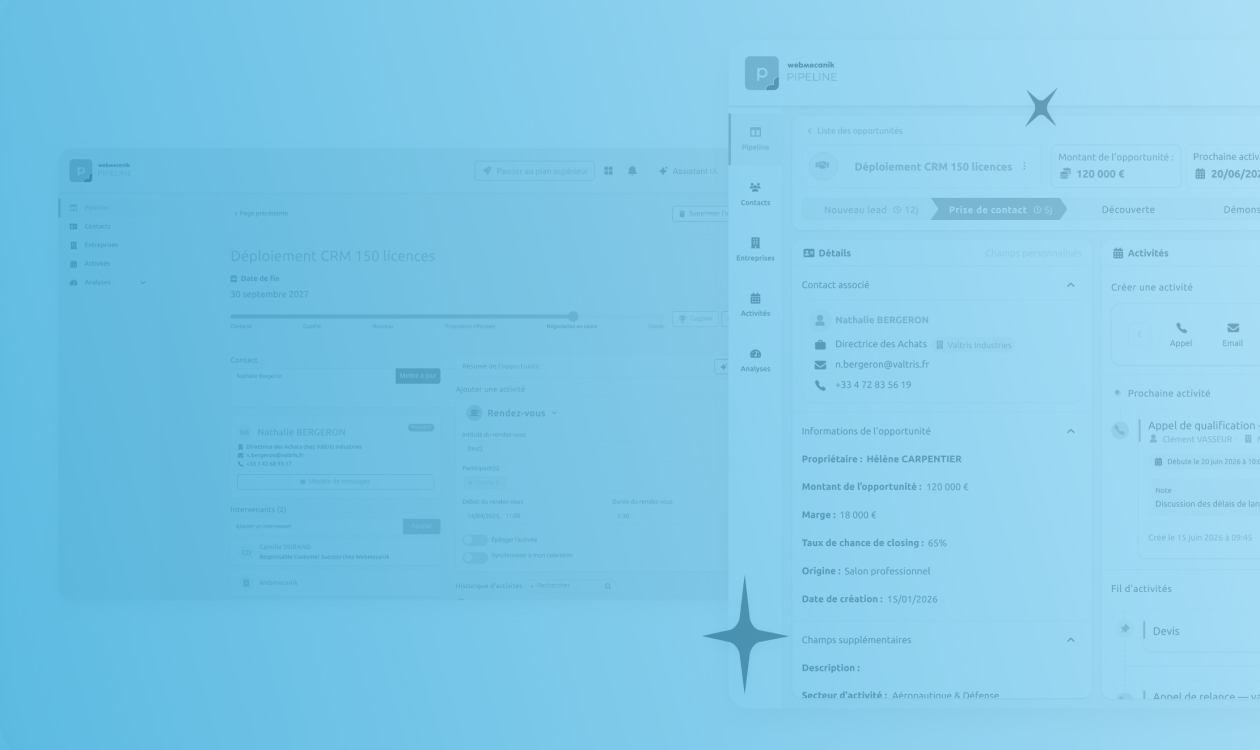
With Webmecanik Pipeline, make it easier to manage your business relationships with a tool that helps you collect data, convert your prospects, and track your opportunities. As a salesperson, you then have an almost complete view of your day-to-day tasks and progress toward achieving your goals. The CRM will soon become an indispensable ally for your sales organization !

Improve your productivity and efficiency
In addition, a CRM makes it easier to automate many time-consuming and repetitive tasks related to sales management. For example, when linked to a Marketing Automation software like Webmecanik Automation, it can make sending personalized emails (marketing automation campaigns) more efficient, create reports, track tasks and appointments, freeing up time to focus on activities with higher added value. Great news for salespeople’s wellbeing! Also, thanks to quick access to information, sales and marketing teams can collaborate more effectively and avoid duplicate work or mistakes. Another way to improve the productivity of an entire company!?
Track your opportunities and sales pipelines
Opportunity tracking, synchronization, contact and company management… with a CRM, you can track every step of the sales process, from lead generation to closing contracts. Visualize your sales pipeline, identify the most promising opportunities, assign tasks to your team, and track the progress made. A good CRM helps you stay organized, leave nothing to chance, and maximize your chances of closing sales.
And to go further, find here the replay of our webinar: identify commercial opportunities
Collaborate and share information
As mentioned above, a CRM encourages cross-team collaboration within a company. Members of your sales team, Customer Support, and also the marketing team gather around the CRM to improve the customer experience. With a CRM that performs well, you can easily share information about customers, prospects, activities, and opportunities. Everyone has access to the same up-to-date information, which makes coordination easier and helps prevent misunderstandings. The result? Better communication between colleagues and a more consistent approach to customers.
Analyze and make informed decisions
One of the major benefits of a CRM is the ability to collect, enrich, and analyze data about your sales activities. Thanks to tools that in particular allow you to clean and update your data, you can finally get detailed and reliable reports on sales performance, market trends, customer preferences, and any other information you consider important to know in order to achieve your business goals.
These data accessible to everyone help you, as a salesperson, make informed decisions while identifying areas for improvement. Indeed, you adapt your sales strategies accordingly: you now know when and how to contact your prospects and customers, and what their stage of maturity or satisfaction level is.
Improve customer satisfaction
Why does a CRM that simply brings together data make it possible to improve customer satisfaction? Because it provides better customer knowledge, enabling effective communication, tracking requests, and personalizing the service. This helps meet customers’ specific needs, resolve their issues quickly, and deliver a consistent experience—strengthening overall satisfaction. Support and marketing teams have the same information as sales teams and are able to respond as closely as possible to customers’ expectations.