
- Definition of marketing automation
- The four pillars of marketing automation
- The criteria to analyze before choosing your marketing automation software
Marketing automation translates as “automated marketing” and makes it possible to automate repetitive tasks using software. These emails, often sent as part of a campaign, can be personalized thanks to marketing automation software, which saves valuable time for all marketers. Let’s get to the heart of the matter.
Definition of marketing automation
What is marketing automation?
Marketing automation brings together all the techniques and tools used to automate repetitive tasks and guide and stimulate the prospect through a sales funnel. Equipping yourself with marketing automation software allows marketing teams to save time and become more efficient while personalizing each lead’s journey through to conversion.
What is marketing automation used for?
This set of techniques and tools allows you to automate your communication across different channels and according to your target audience’s buying journey. You move your contacts forward more quickly through their conversion process by delivering the right message, to the right person, at the right time and through the right channel.
By making resources and content available on your site, you will be able to collect data and use it (sorting, segmentation) to better understand your audience and respond to its specific needs. Concretely, marketing automation gives you the ability to send messages to your audience (SMS, social media posts, campaigns, emails, notifications) in just a few clicks if you have good software. The result? Time saved and an optimized customer journey that leads them straight to conversion. ?
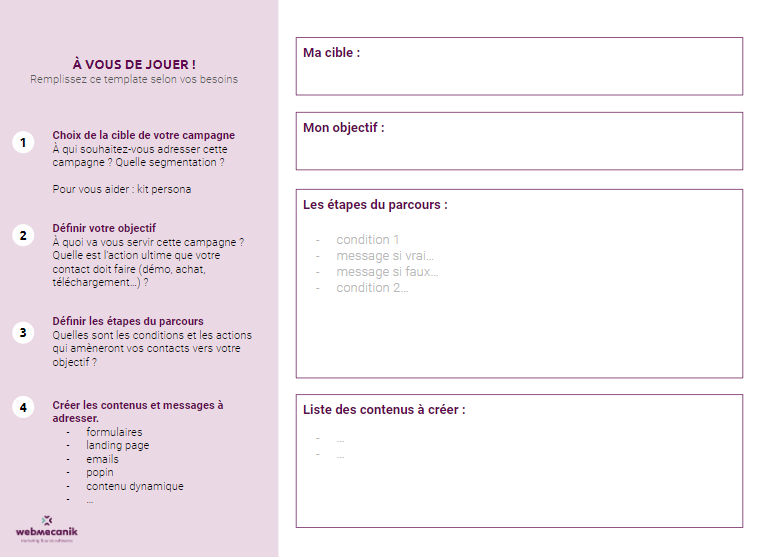
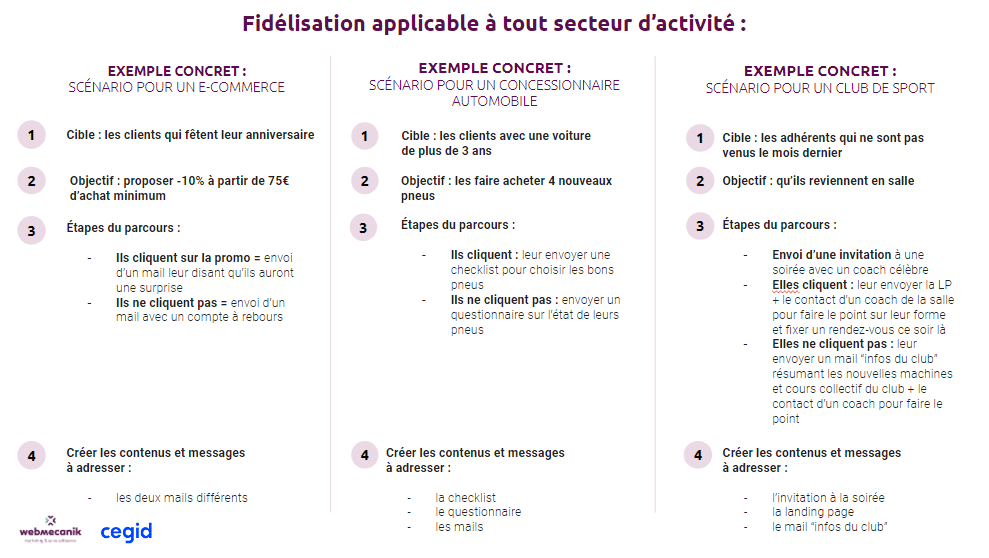
Most marketing teams use campaigns to acquire or retain customers through small touches aimed at conversion. Whether it is for your prospect’s birthday, to bring your members back on-site or to present your new collection, marketing automation makes it easy to personalize your campaigns. Use this template for each campaign and watch the magic happen.
I build my campaign
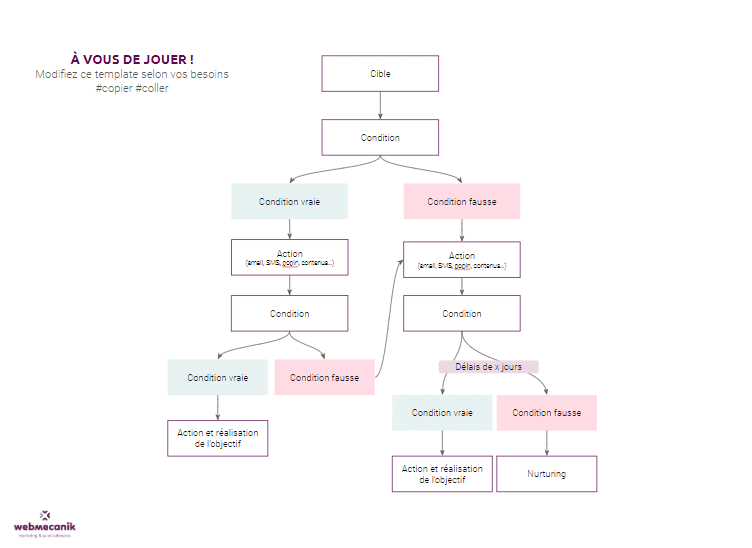
I adapt my campaigns to my goals
How does marketing automation work?
To deploy a marketing automation strategy within your company, you first need to go back over the basics that will allow you to set up solid scenarios (also called workflows), tracing your lead’s journey through to conversion.
Three questions to get started:
- Why do you want to get in touch with this customer?
- What do you expect from them?
- What is the final goal?
Once these questions have been answered, your marketing automation software allows you to map out this journey step by step, from the moment the visitor is captured.
As soon as you have a visitor’s identifier (their email address ideally), you have captured them and you can therefore build a scenario based on their journey all the way to the final purchase.
The goal of every marketing team is to convert its visitor. To do this, it must know them inside out and know where it wants to take them. The marketer must have a very clear vision of their scenario, which includes:
- A target
- An objective
- The stages of the lead journey
- The list of content to create
> I want a template to create my marketing automation scenarios
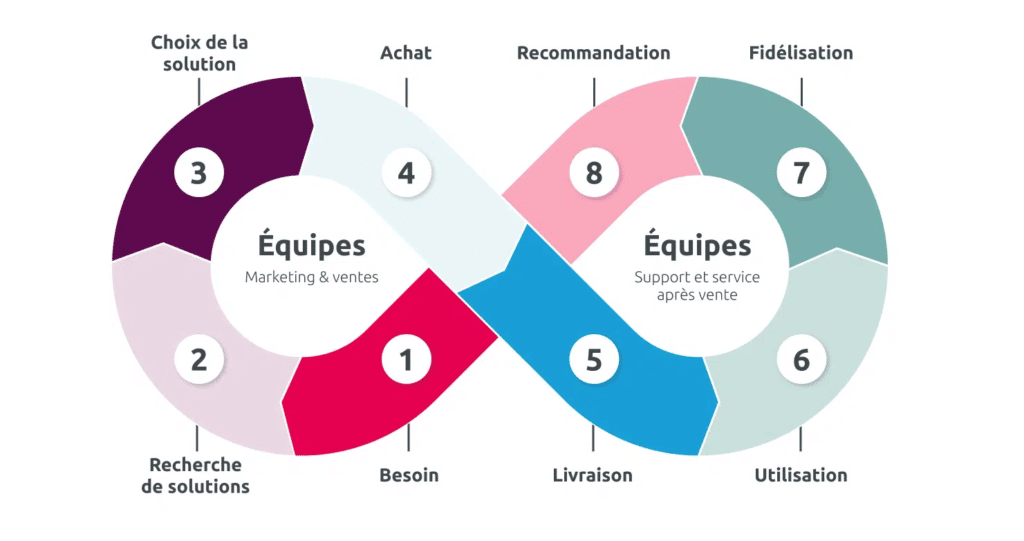
It is now time to build your workflow in detail. Remember: it will always be made up of these four major moments:
- The contact visits your site
- They download one of your pieces of content and leave their contact details in the process
- They are qualified by your marketing automation software
- They then enter a campaign that drives them toward purchase
These four major moments represent the four pillars of marketing automation, the ones that open the doors to conversion:
Capture > Qualify > Nurture > Engage
Let’s take a closer look at this in the next paragraph. ?
The four pillars of marketing automation
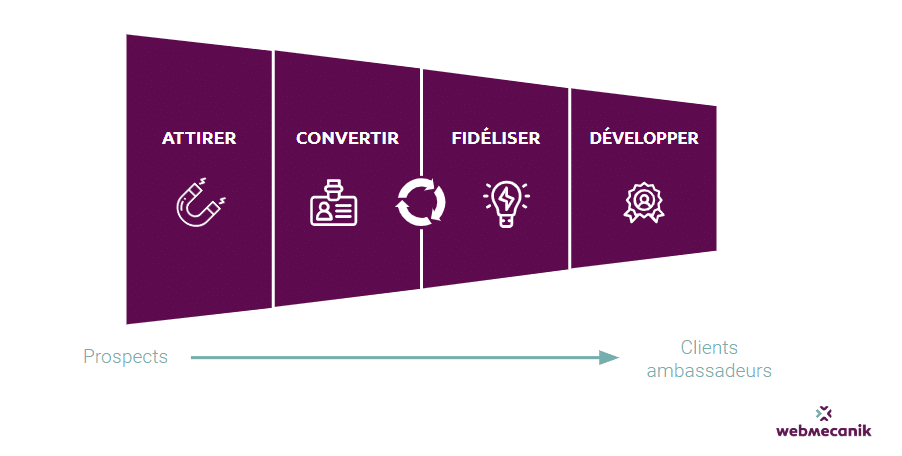
Marketing automation is an integral part of an inbound marketing strategy that consists of giving before receiving. You need to bring value to your site visitors before considering a conversion, which in the past could happen only through intrusive advertising.
According to the Insvesp study, reported by the site Market Splash, 91% of marketing automation users acknowledge that automation is important to the overall success of their online marketing activities. Want to get started with marketing automation?
First, let’s go back over the four pillars of marketing automation to create effective scenarios and convert in droves ?
Capture visitors to your website
No visitor, no campaign! Capturing visitors is the most essential step before launching your marketing automation campaigns.
To do this, you must spark interest through what you offer and position yourself as an expert. Do you sell socks? They are the best, you know it well, but your potential customers need to know it too! Whether they are the warmest and softest in France, thanks to the local artisans you selected with the greatest care, or the cheapest so everyone can wear quality socks at the right price, you need to make your voice heard. To showcase this added value, it is a good idea to promote it offline as well as online through your content, for example with a video or a social media post that draws visitors to your site.
Once on your site, a pop-in could appear to offer them 10% off their first purchase if they sign up for your newsletter. It is through landing pages (or landing pages) that you can collect your visitors’ data. These are forms generally containing last name, first name and email in exchange for a resource or an advantage (receiving your updates in this example), which allows you to generate leads for your database.
> I want to create landing pages to capture visitors
If you have created a good landing page and your visitor has agreed to leave their details, hallelujah! This means your visitor has been captured; they have now entered a scenario that you created with your marketing automation software. Well done on the first step ✅
Qualify your database
Once your leads have been captured, they need to be qualified and placed in the right database. Not all your leads are at the same stage in your sales funnel. The more details you have about them, the better you can qualify them and send them the right message at the right time. A more refined analysis of your leads’ behavior allows you to qualify them better. This precise data will be essential in the rest of the conversion process.
Two essential techniques to know for qualifying your leads:
- Segmentation: in your marketing automation software, you have the ability to create highly specific contact segments based on the needs and preferences of each prospect. Analyzing their behavior will then allow you to set up tailor-made scenarios for greater impact.
- Setting up campaign scenarios: once your segments have been created, you can develop tailor-made marketing automation campaigns aimed at your sample of contacts. For example: if your database is 100% female, you can create a segment that brings together only women under 25, who are the target audience of your latest article: “3 mistakes you can no longer make after 25.”
> Remember: depending on your marketing needs, you can either start by creating a contact segment and then set up the campaign, or the other way around. If you do not really know who your target will be (or if it is too broad) despite analyzing your prospects’ behaviors, you can first create a campaign dedicated to your entire database, then see who reacts and finally create the segment. Example: as part of an event, it is common to send an invitation email in all directions, then narrow the target with the creation of more specific segments.
Keep just one thing in mind: it is not wise to send all your messages to everyone every time. Your software is much smarter than that, so take advantage of it!
Another example: imagine that you are an e-shop selling toys for all ages but you want to create a campaign to sell soft toys for newborns. You can then create a segment containing only parents of children under one year old. This way, you exclude all the people who are not receptive to this communication and at the same time avoid unsubscribes from your newsletter.
Lead scoring: as you know, all types of visitors can subscribe to your newsletter but very few of them will be real customers. Lead scoring is a way of knowing how likely this prospect is to become a customer. Thanks to a points system and depending on how they behave toward the content you offer, they will be ranked and then qualified in a subgroup of your database. You will then be able to know whether they are rather hot or cold, or even place them in a segment to send them the right communication.
These two lead qualification techniques have proven themselves among the most seasoned marketers and they allow you to move on to the next step: nurturing ! ?️
Increase their interest with nurturing
Acquiring marketing automation software is essential for generating leads effectively, but it is first and foremost your content that will help you stand out. Indeed, this third pillar is crucial if you do not want to lose your audience. It is with the value you provide that you will retain your prospect or not.
You yourself are a prospect. Imagine receiving an email about SEO when you want information about inbound marketing? It is not relevant, so you unsubscribe from that newsletter. And the agency that targeted you has just lost a prospect and wasted its time.
It is during this third step that inbound marketing and content marketing really take center stage. Your prospect has already been captured and is part of a campaign; now you need to retain them and convert them.

The best way to save time is to reuse what has already been done! Content recycling is underestimated. Marketers forget about practical guides and webinars made some time ago and often launch into duplicate articles. Yet recycling your content in another format (an article that becomes a tutorial video, for example) is an excellent way to save time and keep your content flow going.
also read: How do you get started with marketing automation?
> I want to recycle my content
Your content is good, you gain credibility, so your prospect becomes more and more attentive and moves faster through the sales funnel thanks to one last nudge from you… You need to engage them and wait for the right moment!⏰
Engage the relationship and the act of purchase at the right time
You now know your prospects well and it is time to set up new campaigns, this time focused on customer loyalty. A good customer is a loyal customer, and getting in touch with them regularly to check in and stay connected to their needs is essential to keep them.
Close follow-up with each of your customers can multiply your results. A happy customer is a customer who talks about your products, and what could be more powerful than word of mouth to increase sales? If they become an ambassador for your brand, they can bring you a lead that requires very little effort to convert because they have already heard about you.
Your personalized lead nurturing, email automation and lead scoring strategies made possible thanks to your software have been effective; you can now build loyalty by bringing them added value. And this, even after the act of purchase, to turn them into promoters of your brand. ?
Thanks to the behavioral tracking of your customers, which is visible on your software dashboard with the number of visits to support, upsell or adsell pages along with product pages… You can identify their needs and start a conversation with them. The goal? Avoid churn (= attrition rate), that is to say customer loss ?
The criteria to analyze before choosing your marketing automation software
Is this tool right for me?
Marketing automation software seems to tick all the boxes for creating effective campaigns and converting more leads. But is it really useful for all companies? It seems so, because the figures compiled by Finances online show a growing interest in these new tools.
- 81% of marketing organizations use marketing automation (Salesforce Research, 2021).
- 19% of content marketing teams use marketing automation platforms (Semrush, 2022).
- 77% of marketing executives turned to AI technologies to automate redundant tasks (Deloitte Global Marketing Trends C-suite Survey, 2021).
A few questions to ask yourself before turning to a marketing automation solution. Do you want to:
- Have a turnkey solution for your email, SMS, commercial notification campaigns, pop-ins and chatbots
- Personalize your communications
- Segment your leads
- Align your sales and marketing teams
- Improve the effectiveness of your campaigns
- Have closer monitoring of your efforts and results
Whatever the size of your company, these priorities are fairly universal and require a certain investment to achieve results. Before contacting a software publisher, however, we recommend comparing features and prices.
Concrete example of good use of marketing automation
Marketing automation is suitable for both B2B and B2C companies. It all depends on the company’s objectives, which can be measured in the number of demos requested or the number of soft toys purchased, in the case of an online toy store.
So, let’s look concretely at how an e-commerce site used marketing automation to multiply its sales.
To set up its campaign, this site defined its objective, its targets and its channel. These three elements are essential before you start using your marketing automation software.
To increase the average basket value and therefore improve its add selling (which means additional sales), the site targeted its visitors via pop-ins on each user’s cart page. A pop-in is a window that opens while browsing a website. It has the same design as the site and makes it possible to surprise and attract the user. ?
Here is how this site set up its campaign:
- goal: increase average basket value / improve add selling
- targets: site visitors
- channel: pop-ins on the cart page
After one year, the company analyzed its first results:
- 11% increase in average basket value.
- The email conversion rate is very satisfactory, reaching 2%, making it the 2nd best-converting channel.
- Emails now represent more than 2% of revenue, compared with just 0.1% in 2019.
- Traffic on the site doubled and sessions opened from an email were multiplied by 34!
> Discover the full business case here.
For more information about marketing automation software, their implementation and their effectiveness, go here.