
The CRM tool (short for Customer Relationship Management) has become a must-have in the technical ecosystem of sales teams. According to a Stratenet study from 2022, 91% of companies with ten employees or more use a CRM to manage customer conversations.
Nowadays, innovations such as artificial intelligence and big data make it possible to go even further in digital marketing strategy. In this article, we focus on big data, a strategic approach to transforming your business.
Understanding CRM and Big Data
Synergy between CRM and Big Data for transformation
Challenges and strategic considerations
Case studies of successful business transformation
Understanding CRM and Big Data
The importance of a Customer Relationship Management tool
CRM, or Customer Relationship Management, refers to a strategic approach aimed at managing and optimizing customer relationships. This involves highlighting several essential benefits for a business. First, CRM promotes customer loyalty by enabling personalized tracking of each customer’s interactions and specific needs. Next, it facilitates the personalization of interactions by collecting and analyzing customer data, making it possible to adapt services and offers according to their preferences. In addition, CRM enables effective automation of processes related to customer management, thereby optimizing operational efficiency and productivity.?
Big Data and its role in decision-making and innovation
Big Data, characterized by its massive volume, rapid velocity, variety of sources and informational value (think of the 4 Vs!), represents a revolution in data management. It plays an important role by facilitating the collection, storage, and analysis of large amounts of data, thus opening up new optimization opportunities.
The impact of Big Data is tangible across a wide range of sectors, from healthcare to logistics and marketing, transforming processes, improving decisions, and creating real added value through the relevant use of information.
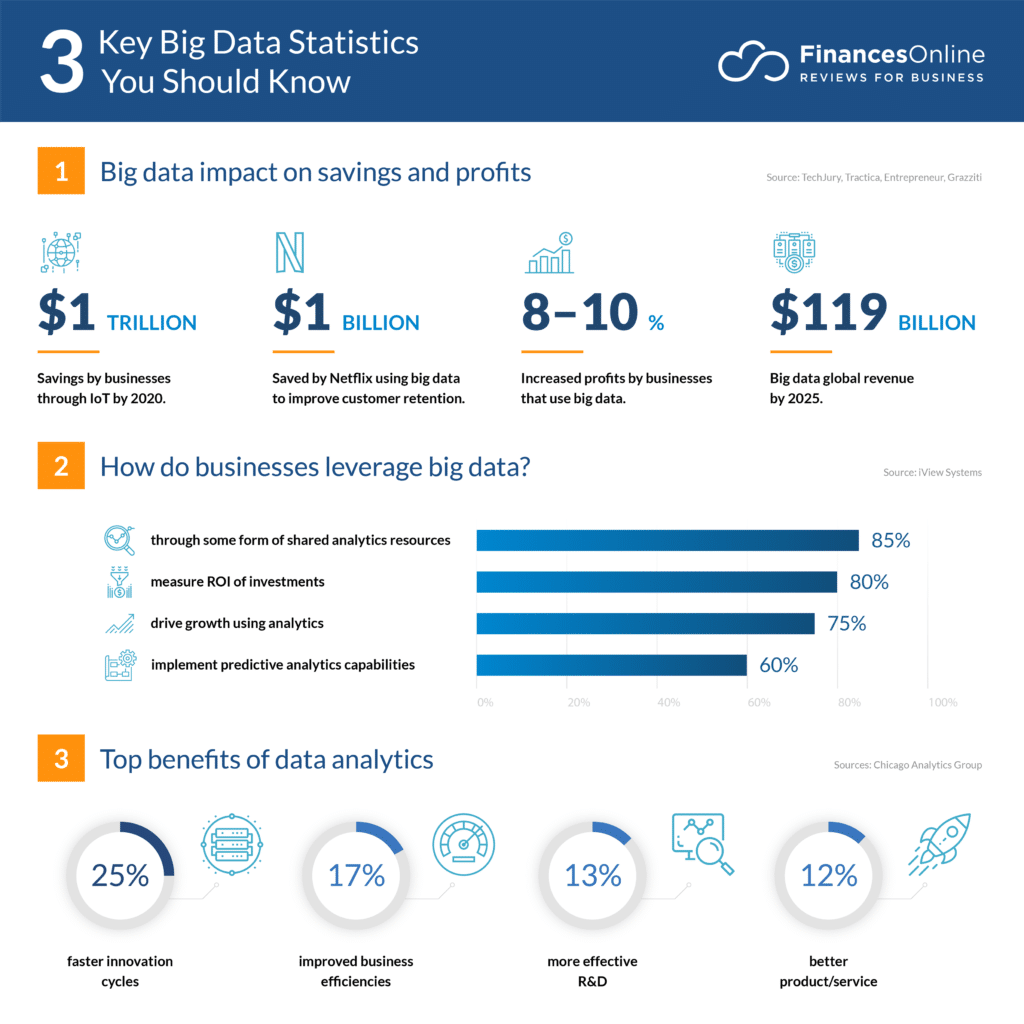
Many companies have also seen an 8 to 10% increase in profits since they started using Big Data. (Entrepreneur, 2019)
So how can you use Big Data to join the ranks of high-performing companies? We recommend investing in hiring a Data Scientist or Data Analyst, who can provide you with in-depth information about the behavior of your prospects and customers. If that is not possible, you can also train in this new discipline. A great way to take a fresh look at your data!
Synergy between CRM and Big Data for transformation
If you already have a CRM tool and truly want to transform your business to perform better, integrating CRM and Big Data may be the solution.
Customer data enrichment
Customer data enrichment is greatly facilitated by Big Data, which enables the collection and aggregation of customer data from multiple and varied sources. Thanks to this aggregation capability, it becomes possible to leverage customers’ behavioral, social, and transactional data.
The advantage? These elements enrich customer profiles by providing an in-depth understanding of their habits, preferences, and interactions, making it possible to personalize offers and services more precisely.?
A reminder of the three types of data you should know: behavioral data reveals customer actions and journeys, social data provides information from social networks, while transactional data reveals purchase histories and buying preferences, thus providing a global and detailed view of customers.
Personalization and improved customer experience
The combined use of CRM and Big Data offers considerable advantages, significantly improving personalization and customer experience. These tools make it possible to analyze CRM data in detail and extract valuable customer information. By leveraging these insights, marketing campaigns can be refined, offering highly personalized recommendations. This results in better customer retention, increased engagement, and an improved overall experience.
Forecasting and anticipating needs
Big Data, combined with predictive analytics, plays a major role in forecasting and anticipating needs. Predictive analytics makes it possible, for example, to anticipate customers’ future needs, optimize inventory management, and improve production planning. As a result, companies can respond proactively to market demand, thereby improving operational efficiency and customer satisfaction.
Challenges and strategic considerations
Data protection and privacy
Handling personal data is no small matter.
Big Data is a very powerful tool, just like a CRM solution. They must be used properly, that is, in compliance with the General Data Protection Regulation.
Indeed, CRM must be approached ethically and responsibly in the use of customer data before being connected with Big Data solutions.
To do this, your CRM must comply with the GDPR to protect your prospects and your business.
Setting up an appropriate technological infrastructure and developing skills in data analysis and project management are essential to fully benefit from these innovative tools.
Reminder of GDPR obligations
Informed consent: obtain clear and specific consent from individuals before collecting and processing their data for marketing purposes. Consent must be freely given, informed, and able to be withdrawn at any time.
Transparency: provide people with clear and detailed information on how their data will be used as part of marketing automation. Explain the purposes of the processing, the types of data collected, and the third parties with whom the data may be shared.
Individuals’ rights: respect individuals’ rights such as the right to access their data, the right to erasure, the right to data portability, and the right to object to processing for marketing purposes.
Data security: implement appropriate security measures to protect personal data against unauthorized access, loss, or leaks. Ensure that your marketing automation systems are secure and regularly updated.
Retention period: keep personal data only for as long as necessary to achieve the purposes for which it was collected. Make sure that data is not kept indefinitely.
Reminder of GDPR prohibitions
Illegal processing: do not process personal data unlawfully. This includes using data without consent or processing sensitive data without a legal basis.
Non-compliant use: do not collect data for purposes that have not been disclosed to individuals. Avoid using data for purposes for which consent has not been obtained.
Unauthorized sharing: do not share personal data with third parties without the individual’s explicit consent, unless this is necessary to achieve the declared purposes.
Unsolicited marketing: do not send unsolicited marketing communications, such as commercial emails or SMS messages, without the individual’s prior consent.
Case studies of successful business transformation
Lastly, case studies of successful business transformation, such as those of Netflix and Amazon, concretely illustrate the benefits of integrating CRM and Big Data. These companies have successfully leveraged these technologies to personalize recommendations, anticipate customer needs, and improve their logistics, thus demonstrating the positive impact on customer engagement and operational efficiency.
Even very small businesses perform better with a CRM
According to Zendesk, many very small businesses and SMEs use CRM. Indeed, 91% of companies with more than 11 employees use a CRM, while 50% use one when they have fewer than 10 employees.
Concrete example
The founder and CEO of the very small business Dix De Plus, Laurence Calvet, optimized her company’s productivity by 10% thanks to the integration of Webmecanik’s CRM. In 2011, she created Dix De Plus to support companies in organization and transformation, placing people at the heart of performance. With a varied client base, the initial challenges lay in scattered data and the lack of an overall view of contacts and customers. Adopting Webmecanik’s CRM enabled better sales management, strengthened customer knowledge, and improved the company’s image. This transition thus led to increased business performance, representing a substantial time saving each week. ?
Webmecanik’s CRM tool constitutes a significant competitive advantage, strengthening customer loyalty and consolidating Dix De Plus’s position in the market. Without this tool, efficiency would decrease and the risk of data loss would be considerable, thus highlighting the importance of CRM for this company.
Regarding Webmecanik’s support, the CEO states: “Sometimes I wonder what I feel more attached to: the CRM software or the quality of the relationship with my Customer Success Manager! (…) What is certain is that the support from the very beginning, with a setup perfectly adaptable to my needs, allowed me to get to grips with the solution right away and without losing time in my business.” To learn more, discover the full business case.
Want to transform your business in 2024?