

At the Apple Worldwide Developers Conference 2021 (June 7 to June 11), Apple has announced its new Mail Privacy Protection policy, which does not apply to users of other email applications (Gmail, etc.) even if they use iPhone.
This is a new step towards the protection of personal data, which is the logical continuation of the arrival of the GDPR in 2018. It brings new obligations for marketers, especially after the invalidation by the European Union of the Privacy Shield considering that it puts companies at risk, or the third-party cookie ban by browsers, subjects we have discussed in the past.
So what is the impact of these new rules that are expected to arrive at the end of the year with the release of iOS 15, iPadOS 15, and macOS Monterey? Is this good or bad news for users and marketers?
What are the concrete consequences of Apple’s “Mail Privacy Protection”?
The upcoming rule is simple. Users of Apple’s Mail application (on iPhone, iPad or Mac) will be able to configure their level of anonymization regarding email opening tracking. This will be defined in two ways based on 2 types of information:
- Anonymization of the IP address and the opening of the email in a systematic but private way.
- Sharing of the IP address used by the device and information on the opening of the email.
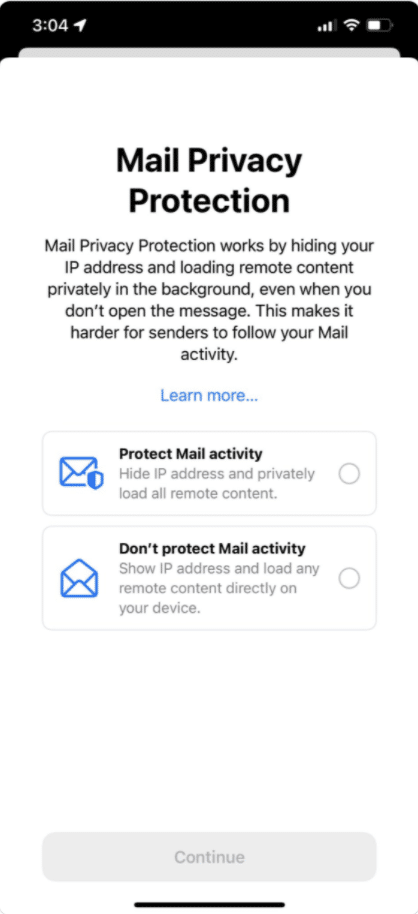
If the user chooses the first option, 100% of emails will be opened (and therefore considered as opened by your email marketing and marketing automation tools) and the IP address will not be shared.
Please note that in order to comply with the GDPR, which requires a consent for the collection of a person’s IP, Webmecanik has chosen to anonymize this data in its application to ensure that the marketer using Webmecanik Automation is not in violation of regulations, as the IP is considered as a personal data (ask yourself this question depending on the tool you are using!).
In the case of the second option, nothing will change from the current behaviour.
Is this bad news?
This new rule is a new constraint for the marketer who often uses the open rate of his marketing emails as a performance indicator and the very opening of an email by a contact as a potential trigger for automated campaigns.
Moreover, the share of users of Apple’s Mail application is not negligible. According to studies and sources, this would represent 13% according to Pathwire and 40% or even 50% according to Litmus.
This will in fact depend on the typology of your audience. The more mobile it is, the higher this share will be, the more desktop it is, the lower the share will be.
Direct and undesirable consequences:
- If you are doing email marketing, you will have an (incorrect) opening rate that will skyrocket (yay?) because 100% of users in “private mode” will be considered to have opened the email.
- If you do Marketing Automation with triggers on email opening, Apple Mail users will not go to the right branch of the campaign.
However, this is a good opportunity to ask yourself an important question: is the opening rate of an email a good indicator to measure the performance and the engagement of your contacts?
And here, at Webmecanik, we will tell you… no! Indeed, the opening rate of an email is not a strong indicator in terms of engagement of your audience. It is rather the action following the reading of an email that is important; the click on the CTA (call to action) present in the email, the visit on the associated landing page or the submission of a form. By the way, if you have set up scoring, we bet that you give very few points for opening an email, right?
Why this is actually good news
Because it is not a quality indicator (KPI)
As mentioned above, this will push you to consider more important and meaningful KPI’s of your audience’s engagement.
Because you are already working with the incorrect opening rate
Did you jump out of your chair? Don’t play innocent, you already knew that, right?
We already talked about the reliability of email statistics that are not 100% accurate due to bots and anti-spam in previous articles. To make it simple: anti-spam technologies and bots can distort the results of your emails by opening and even clicking in the emails instead of your audience.
In addition to this, you have been working for years with contacts who use Microsoft Outlook, which blocks images (we use a pixel to track opens) in the opened email for many users. This means that many openers (from Outlook) are not counted in your statistics.
If you just discovered it, it’s because you haven’t subscribed to our newsletter, or you don’t check out our marketing automation’s blog regularly enough, big mistake!
Because privacy is a good thing for the end user, so for you!
Oh yes. Before being a savvy marketer, you are a user and/or consumer of many services and content from many brands. So as Europe has done with the GDPR for a few years now, and then the web browser consortium in 2020 with third-party cookies to avoid exposing your behavioural and personal data to third-party companies to which you would not have given your consent (or not so explicitly), all new measures that aim to protect us all as individuals are good measures.
So how to get ready for this move?
Update your marketing automation campaigns to avoid using the opening of an email as a trigger for your actions and campaigns. Find a cleaner, more engaging and more effective action (like a form submitted, a visit on your website, etc.).
Modify your KPI tracking spreadsheets to add new indicators that are more relevant than a simple opening rate, that does not guarantee the impact on the ROI of your actions. A click bait email with a tacky subject line can boost your open rate by 300% without generating one single euro in revenue and can even degrade your image and the opening rate of future emails.