

Contact sources: finally understand what converts your prospects
Discover which channels attract, convert, and re-engage your prospects, and measure their contribution all the way to revenue.
Download this must-have guide to start your marketing automation journey.
Articles, expert advice, and case studies to master inbound marketing and optimize customer relations.
Discover which channels attract, convert, and re-engage your prospects, and measure their contribution all the way to revenue.

Sales follow-up: how your teams can (finally) take back control and generate more Improving your teams’ sales performance comes down to optimizing a key step that’s too often overlooked: follow-up. Today, 48% of salespeople never follow up with their prospects, and only 12% carry out more than two follow-ups. That’s a considerable missed opportunity when […]
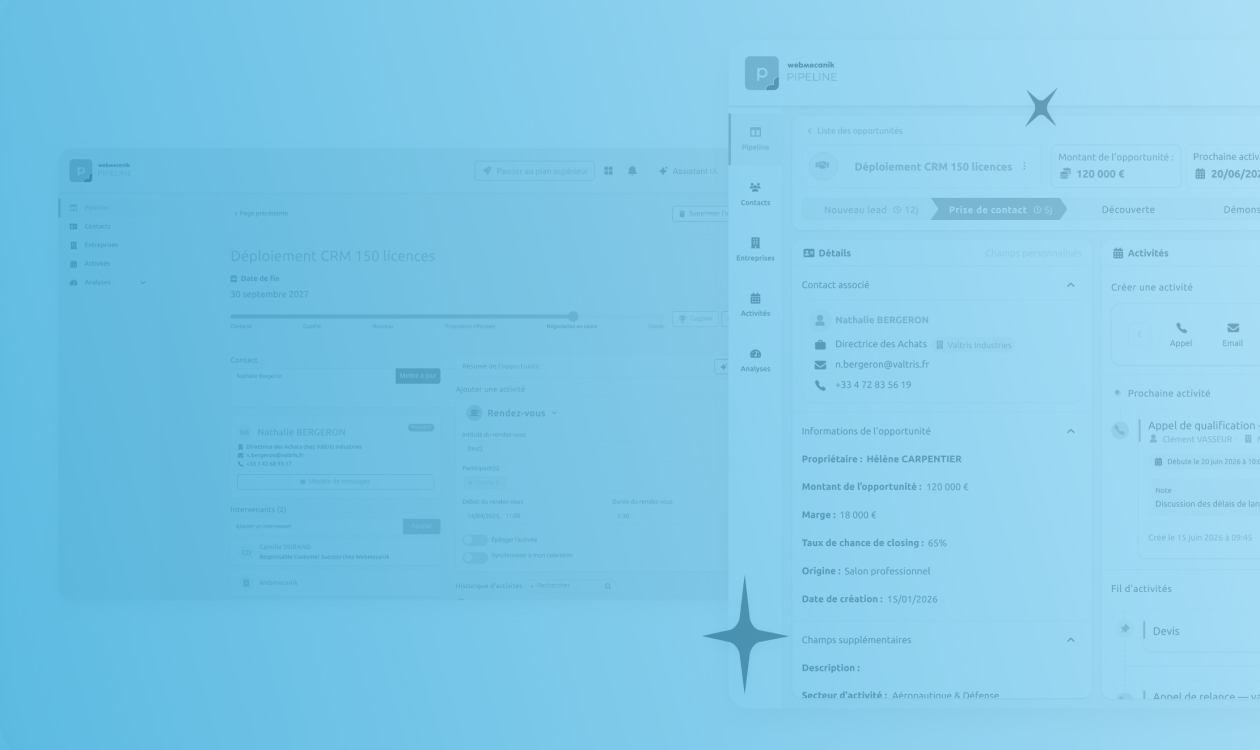
Webmecanik Pipeline improves the user experience with a redesigned interface for Contacts, Companies, and Opportunities.
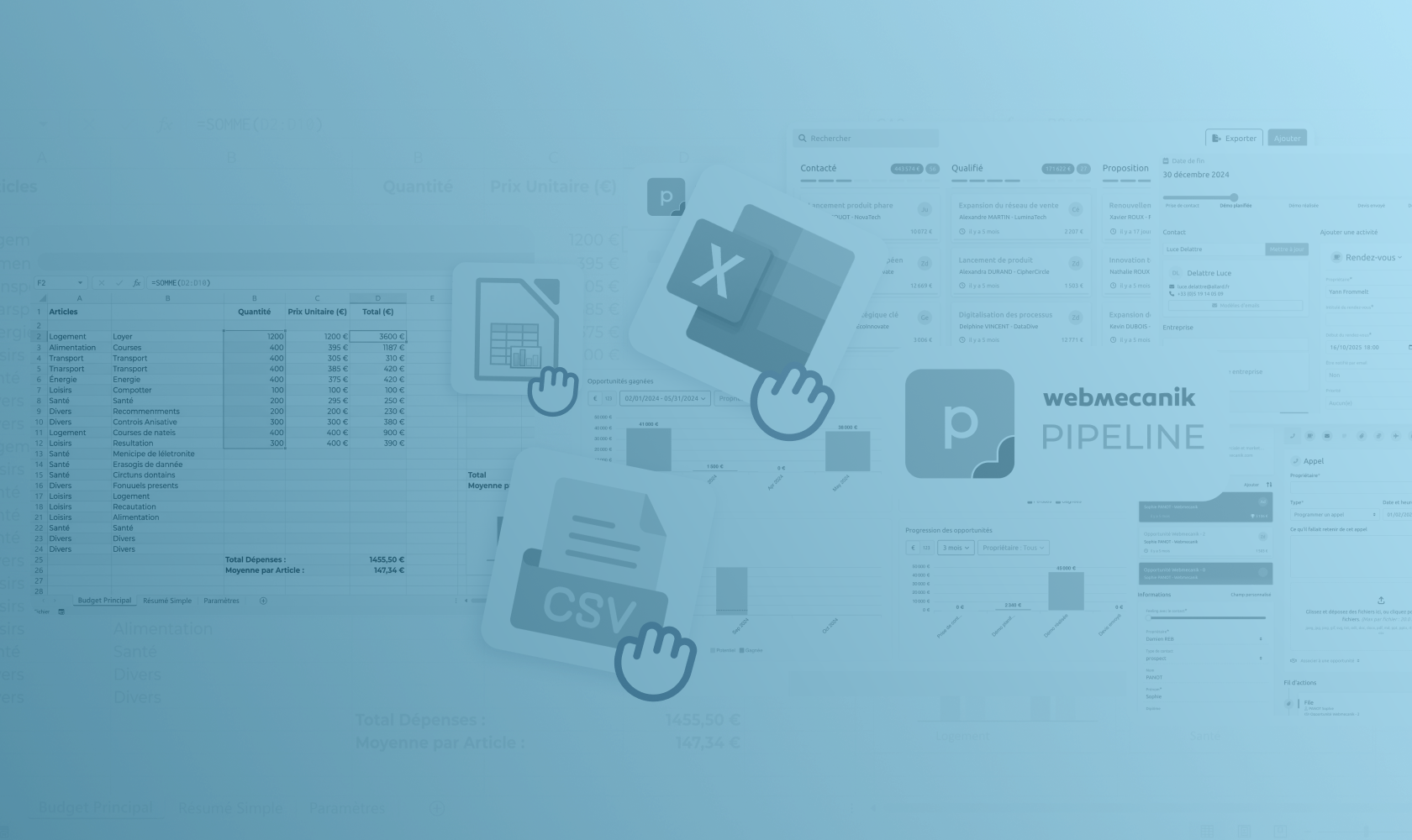
Summary: Why give up your spreadsheets in favor of a CRM like Webmecanik Pipeline? Still managing your opportunities in Excel or Google Sheets? If spreadsheets help at first, they quickly become a major obstacle to your growth: loss of information, duplicate data, lack of visibility, and limited security. Replacing your isolated files with a centralized […]

In short : in a context where prospects’ attention has become the rarest resource, discover how to orchestrate intelligent, high-performing sales journeys. Thanks to the lessons learned shared at the Intelligence Marketing Day 2026 by Sophie Panot (CEO of Webmecanik) and Hervé Schluraff (Magnetic Way), explore concrete AI-enhanced automation scenarios to boost your acquisition and […]
In short: Artificial Intelligence won’t replace salespeople, but will redefine their role. Far from magic, AI and LLM models are based on statistical prediction using your CRM data. Used wisely, it eliminates time-consuming tasks to make room for emotional intelligence and B2B advice. Discover how Webmecanik Pipeline integrates AI to synthesize your customer histories, calculate […]

CRM and marketing automation don’t have the same role, but they work far more effectively when they work together. When properly connected, they help you better qualify leads, smooth the handoff between marketing and sales, nurture relationships over time, and maintain a clearer view of each contact’s journey.

The new CNIL recommendations on tracking opens and clicks in emails introduce new recommendations for professionals who use tracking pixels in their campaigns. ➡️ Click here to read our full article on the topic. However, even if the CNIL does not require you to collect new consent from your existing contact database, you must inform […]

Email has gone through every digital revolution without ever losing its place. If it remains the most powerful channel, it’s because it’s built on three things that...

Customize your Return Path to boost deliverability, improve your sender reputation, and secure your email campaigns.
Discover our new intelligent opportunity summary feature to get, in just a few seconds, a clear recap of the actions to take.

Everything you need to know about email tracking and the CNIL’s new recommendations to stay compliant with the GDPR and continue to manage your campaigns effectively.

Use your business data to create more targeted, personalized, high-performing campaigns.

Discover the email expiration date feature to ensure your communications don’t become obsolete.

Discover our new intelligent opportunity summary feature to get, in just a few seconds, a clear recap of the actions to take.

Write, improve or translate your content in one click thanks to the AI built into your email and landing page editors.

Lead nurturing is not just a sequence of automated emails. It’s the art of keeping a relevant conversation with your prospects until they’re ready to buy. This guide gives you the keys to structure campaigns that turn interest into revenue. 1. The diagnostic phase: lay the foundations Before writing a single line, you must define […]

Emails on one side, campaigns on the other, scattered segments… What if everything were brought together in one place? Discover our new folder-based management feature.
Introduction You’re already well established in your market. Your target is clearly defined, your marketing channels are in place, and you may have even carried out an audit of your past activities. But one question remains essential: are your marketing messages truly performing? Whether it’s email, WhatsApp messages, SEA campaigns, social ads, or SMS, every […]

Let’s be honest: when we talk about email marketing, we often think about the subject line, design, the header, or even the famous CTA. But statistics? They’re sometimes pushed into the background… until the moment you ask, “But did someone really read this email?” This is where an analysis of open rates, clicks, bounce rates, […]

The opportunity nobody was asking for In 2025, the crisis of trust persists in our economies. This crisis of trust makes acquiring new customers a long, complex, and uncertain process. As in every crisis cycle of a system based on the continuous growth of sales of goods and services. In too many French companies, the […]

Introduction Calls, emails, video calls… it works. But sometimes nothing beats a handshake, a glance, a real exchange. The figures speak for themselves: in-person meetings increase the conversion rate by 25% compared with virtual interactions, according to a RAIN Group study. And according to IndustrySelect, a physical visit would be 34 times more effective than […]

In an ultra-competitive SaaS environment, growing ARR (Annual Recurring Revenue) is more than an objective: it’s a matter of survival. Yet most efforts are focused either on sales teams or on paid acquisition. What if your ARR also depended on your ability to automate and intelligently orchestrate the customer journey? Marketing automation is not limited […]

Marketing automation makes it possible to launch intelligent marketing campaigns, based on each contact’s behavior and stage in their journey. But did you know we can go even further with artificial intelligence? For some time now, at Webmecanik we’ve adopted AI within our marketing automation software. This integration has helped our customers achieve ±24% improvements […]

You probably already know this: in B2B, every interaction matters! A good marketing workflow not only saves time, but above all turns interest into engagement… then into sales. ? Of course, there are many workflows to help you turn these leads into customers: the classic sales workflow, the onboarding campaign, customer support, events, social networks, […]

Do you spend too much time organizing your sales visits or identifying opportunities around your appointments? Good news! The new feature of geolocation of contacts and companies in Webmecanik Pipeline lets you visualize the geographic distribution of your prospects on a map, optimize your trips, and improve sales efficiency. A new view to reveal your […]
After 10 years of sustained growth, the software publisher Webmecanik is taken over by its management. Sophie Panot becomes Chairwoman and keeps her role as CRO (Chief Revenue Officer), Norman Pracht remains Managing Director and David Coutelle, Technical Director. The ambition of the three managers to consolidate Webmecanik’s position as the go-to player in marketing […]

As you surely know in B2C marketing, personalization is the key to a successful customer relationship! Brands have no choice but to adapt and offer a unique, smooth but above all relevant experience to consumers who are constantly being approached. The best tool for personalizing your communications is nothing other than a marketing automation software. […]

You know the number of clicks generated by your emails, but do you know which areas really grab your readers’ attention? With the heat map (heatmap) that has just arrived in your Webmecanik Automation email statistics, instantly visualize the most compelling areas of your emails. A simple, visual and powerful way to get to grips […]
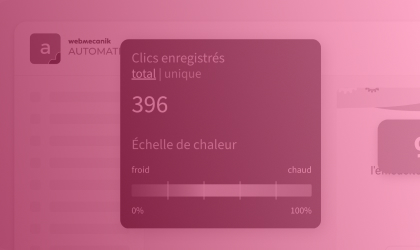
Heatmaps applied to emails reveal valuable insights into the behavior of your contacts: where their attention goes, which elements generate clicks, and which ones are ignored. But to turn this data into real optimization levers, you first need to know how to interpret it. Here’s how to make use of heat zones to concretely improve […]

Have you always wanted to send the right message, at the right time and through the right channel? With Webmecanik, it is now possible thanks to smart campaigns: AI schedules the sending of your campaign emails at the best time to maximize your leads’ engagement. How do smart campaigns work? Real results for your campaigns! […]

Need to create marketing automation scenarios, but you don’t know where to start… or how to go about it? Do you need a guide to get started? You’ve come to the right place! I’m sharing some expert advice to help you create your marketing automation scenarios. Let’s assume you have marketing automation software. Adapt to […]

Have you launched your online store? Congratulations! The next step: develop your e-commerce marketing for your site, and there’s no magic formula— you’ll need to invest some time in it. Key takeaways from the article Email marketing remains the communication channel to prioritize to reach your target. Synchronizing your e-commerce site with a marketing automation […]
An optimized landing page is a key asset to your marketing strategy. That’s why we’re excited to introduce our all-new Landing Page Builder. Enhanced to provide a better creation experience and even more powerful landing pages. ? A Redesigned Landing Page Builder to increase conversions Following the great success of our email builder since its […]

Advanced filters, already available for your contacts and companies, now extend to your CRM opportunities. With advanced filters, you can refine all your data by the fields and criteria most relevant to your business. But that’s not all! With just a few clicks, you can set up your search filters and save them for easy […]

As a salesperson, your goal is not just to sell, but to sell profitably. By mastering your margin, you can increase your profits while reducing your sales efforts. Optimized management of your sales margin is based on careful analysis and a strategy tailored to your business. What is sales margin? How to calculate your sales […]

Sales objectives play a role in business success. They serve as a benchmark to guide actions and decisions toward concrete results. Without these sales objectives, it becomes difficult to assess your performance or direct your strategic efforts. I’ll explain why defining clear sales objectives is essential to achieving your results. We will also see how […]
From now on, sales reps and sales managers can enter and track their sales margin directly from their CRM. This strategic data enriches your analysis and allows you to make better-informed decisions to optimize your sales performance. Analyze your opportunities from a new angle Make strategic decisions based on precise data A feature designed to […]

Are you looking to diversify your lead generation sources? The webinar is an excellent lead magnet (prospect magnet?) for capturing and converting leads. Generate leads with your webinar: how do you attract them? Generate leads with your webinar: organize your event Generate leads with your webinar: analysis Livestorm & Webmecanik, what does that look like? […]

Do you want to start implementing a marketing strategy but do not know where to begin or how to define the steps to follow? Bingo, you are in the right place. Whether you decide to launch your company, brand or a product, you absolutely must not neglect your marketing strategy. Thanks to the strategy you […]

In a complex sales cycle, it is essential for sales professionals to understand the internal dynamics of an organization and identify the stakeholders who influence purchasing decisions. By identifying these key stakeholders and tracking their influence, increase your chances of success throughout the sales process by tailoring your sales approach to each prospect. What is […]
Management of sales opportunities evolves ? At Webmecanik Pipeline, our mission is simple: to provide you with a CRM that adapts to the way you sell. We’re thrilled to introduce you to a powerful new feature: stakeholder management in your Sales Opportunities! Never Overlook the Real Deciders ? In any sales cycle, every interaction matters. […]

You are multiplying your marketing efforts, but are struggling to measure their profitability? You already know how important ROI is for assessing the effectiveness of your campaigns, but you do not know how to concretely analyze the results generated? By mastering the calculation of your ROI and using the right tools and indicators, you are […]

Mobile marketing in a few figures Mobile applications, a key tool to boost efficiency and engagement Implementing a mobile marketing automation strategy Example of a mobile marketing automation scenario Conclusion Mobile marketing in a few figures Mobile is much more than a tool; over the last 10 years it has become the center of interactions […]

Have you just published your first white paper? Wonderful! But this is only the beginning. Here are 10 marketing content ideas to recycle, because nothing is more rewarding than giving a second life to your old articles, forgotten videos, or using large pieces of content to make smaller ones. Recycle cleverly! ? Why recycle your […]

2024: The Year Webmecanik Automation Embraced AI This year was defined by integrating artificial intelligence into Webmecanik Automation to optimize your email campaigns. Two new features now support you in managing email sends and crafting impactful subject lines. Smart Email Scheduling Webmecanik’s AI determines the perfect time to send your emails, boosting open rates and […]

In a world where competition is fiercer than ever, the speed and efficiency of sales teams have become essential qualities. To stay in the race and outpace your competitors, nothing beats a great ally: sales process automation. Why automate your sales processes? Webmecanik Pipeline features for sales process automation The CRM and Marketing Automation combo: […]

We know, to-do lists are everywhere, and everyone says they change your life! But let’s be honest… who has never thought that it was either an urban legend or impossible to keep up with? Yet a study by InsideSales.com proves that salespeople who plan their day and week well see their productivity rise by 12 […]

Do you know how to handle objections during your sales meetings? Far from being obstacles, they are real opportunities to understand the prospect’s real needs and adjust your pitch. By addressing them with tact and expertise, you turn doubt into confidence. Knowing how to respond effectively not only increases your chances of success, but also […]

In sales, effective communication is much more than a simple exchange of information: it is the primary way to build trusting relationships with your prospects. Knowing how to listen, understand their needs, and respond convincingly is essential to increase your chances of closing sales. This article invites you to explore techniques that will help you […]

Webmecanik Automation allows companies to adapt their marketing campaign based on customer behavior. We’ll convince you with three examples of campaigns using behavioral tracking. Understanding behavioral tracking with Webmecanik Examples of behavioral tracking with Webmecanik Automation Use cases showing how Webmecanik boosts the relevance of your marketing campaigns Understanding behavioral tracking with Webmecanik Webmecanik tracking […]
Webmecanik supports you at every stage of the sales funnel—from first interaction to conversion—to transform your data into a powerful growth engine.